Transcription of Wastewater Technology Fact Sheet: Trickling Filters
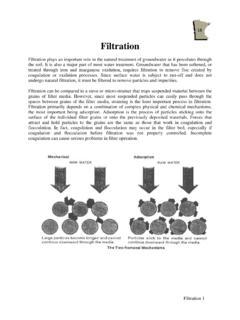
1 United StatesEnvironmental ProtectionAgencyOffice of WaterWashington, 832-F-00-014 September 2000 WastewaterTechnology Fact SheetTrickling FiltersDESCRIPTIONT rickling Filters (TFs) are used to remove organicmatter from Wastewater . The TF is an aerobictreatment system that utilizes microorganismsattached to a medium to remove organic matterfrom Wastewater . This type of system is commonto a number of technologies such as rotatingbiological contactors and packed bed reactors (bio-towers). These systems are known asattached-growth processes. In contrast, systems inwhich microorganisms are sustained in a liquid areknown as suspended-growth TFs enable organic material in the Wastewater to beadsorbed by a population of microorganisms(aerobic, anaerobic, and facultative bacteria; fungi;algae; and protozoa) attached to the medium as abiological film or slime layer (approximately mm thick).
2 As the Wastewater flows over themedium, microorganisms already in the watergradually attach themselves to the rock, slag, orplastic surface and form a film. The organicmaterial is then degraded by the aerobicmicroorganisms in the outer part of the slime the layer thickens through microbial growth,oxygen cannot penetrate the medium face, andanaerobic organisms develop. As the biologicalfilm continues to grow, the microorganisms nearthe surface lose their ability to cling to the medium,and a portion of the slime layer falls off the process is known as sloughing. The sloughedsolids are picked up by the underdrain system andtransported to a clarifier for removal from AND DISADVANTAGESSome advantages and disadvantages of TFs arelisted , reliable, biological in areas where large tracts of landare not available for land intensive qualify for equivalent secondarydischarge in treating high concentrations oforganics depending on the type of for small- to reduce soluble BOD5 in nitrification process power level of skill and technicalexpertise needed to manage and operate treatment may be needed to meetmore stringent discharge accumulation of excess biomass thatcannot retain an aerobic condition and canimpair TF performance (maximum biomassthickness is controlled by hydraulic dosagerate, type of media.)
3 Type of organic matter,temperature and nature of the biologicalgrowth).CRequires regular operator of clogging is relatively low loadings depending on and control are limited incomparison with activated-sludge and odor CRITERIAA TF consists of permeable medium made of a bedof rock, slag, or plastic over which Wastewater isdistributed to trickle through, as shown in Figure or slag beds can be up to meters (200feet) in diameter and meters (3 to 8 feet)deep with rock size varying from cm (1 to4 inches). Most rock media provide approximately149 m2/m3 (15 sq ft/cu ft) of surface area and lessthan 40 percent void space. Packed plastic Filters (bio-towers), on the other hand, are smaller indiameter (6 to 12 meters (20 to 40 feet)) and rangein depth from to meters (14 to 40 feet).These Filters look more like towers, with the mediain various configurations ( , vertical flow, crossflow, or various random packings).
4 Research hasshown that cross-flow media may offer better flowdistribution than other media, especially at loworganic loads. When comparing vertical mediawith the 60 degree cross-flow media, the verticalmedia provide a nearly equal distribution ofwastewater minimizing potential plugging at higherorganic loads better than cross flow media. Theplastic medium also required additional provisions,including ultraviolet protective additives on the toplayer of the plastic medium filter, and increasedplastic wall thickness for medium packs that areinstalled in the lower section of the filter whereloads design of a TF system for Wastewater alsoincludes a distribution system. Rotary hydraulicdistribution is usually standard for this process, butfixed nozzle distributors are also being used insquare or rectangular reactors.
5 Overall, fixednozzle distributors are being limited to smallfacilities and package plants. Recently somedistributors have been equipped with motorizedunits to control their speed. Distributors can be setup to be mechanically driven at all times or duringstalled addition, a TF has an underdrain system thatcollects the filtrate and solids, and also serves as asource of air for the microorganisms on the treated Wastewater and solids are piped to aSource: Metcalf & Eddy, Inc. and Tchobonaglous, 1 TYPICAL Trickling FILTER settling tank where the solids are , part of the liquid from the settling chamberis recirculated to improve wetting and flushing ofthe filter medium, optimizing the process andincreasing the removal is essential that sufficient air be available for thesuccessful operation of the TF.
6 It has been foundthat to supply air to the system, natural draft andwind forces are usually sufficient if large enoughventilation ports are provided at the bottom of thefilter and the medium has enough void following four basic categories of filter designare based on the organic loading of the filtersLow-rate Filters are commonly used for loadings ofless than 40 kilograms five day biochemical oxygendemand (BOD5)/100 meters cubed per day (25 lbBOD5/1000cu ft/day). These systems have fewerproblems than other Filters with regards to filterflies, odors, and medium plugging because of thelower loading rate. Low-rate Filters with a rockmedium range in depth from to meters (3-8 ft.). Most low-rate Filters are circular with rotarydistributors, but some Filters currently in use arerectangular. Both of these configurations areequipped with dosing syphons or periodic pumps toprovide a high wetting rate for short intervalsbetween rest periods.
7 A minimum wetting rate liters per square meter-second ( gal/sqft/min) is maintained to prevent the high rate plasticfilter medium from drying out. With a rockmedium, the Filters tend not to be hydraulicallylimited and have application limits ranging to liters per square meter-second ( gal/sq ft/min).The sloughed solids from a low-rate filter aregenerally well-digested and as a result these filtersyield less solids than higher rate Filters . Secondaryquality effluent is readily achievable if the low-ratetrickling filter design incorporates filter media withbioflocculation capabilities or good filtersIntermediate rate Filters can be loaded up to 64 kgBOD5/100 m3-d (40 lb BOD5/1000cu ft/day). Inorder to ensure good distribution and thoroughblending of the filter and secondary effluent, thesystem should recirculate the Trickling filtereffluent.
8 The biological solids that slough from anintermediate Trickling filter are not as well digestedas those using a low-rate filter. High-rate filtersHigh-rate Filters are generally loaded at themaximum organic loading capabilities of the filterand receive total BOD5 loading ranging from 64 to160 kg BOD5/100 m3-d (40 to 100 lb. BOD5/1000cuft/day). Achieving a secondary quality effluent isless likely for a high-rate filter without a second-stage process. As a result, high-rate Filters are oftenused with combined processes. Roughing FiltersRoughing Filters are designed to allow a significantamount of soluble BOD to bleed through thetrickling filter. Filters of this type generally have adesign load ranging from 160-480 kgBOD5/100 m3-d (100 to 300 lb. BOD5/1000cuft/day).PERFORMANCER ecent efforts have been made to combine fixed-film reactors with suspended growth processes toefficiently remove organic materials fromwastewater.
9 For example, the combination of atrickling filter with an activated-sludge process hasallowed for the elimination of shock loads to themore sensitive activated sludge while providing ahighly polished effluent that could not be achievedby a Trickling filter alone. Table 1 shows the BOD5removal rates for the four filter types the TF process is generally reliable, thereis still potential for operational problems. Some ofthe common problems are attributed to increasedgrowth of biofilm, improper design, changingwastewater characteristics, or equipment common problems with TF function arediscussed in the Operation and AND MAINTENANCED isagreeable Odors from FilterPotential Cause: Excessive organic load causinganaerobic decomposition in : Reduce loading; increase BOD removalin primary settling tanks; enhance aerobicconditions in treatment units by adding chemicaloxidants, preaerating, recycling plant effluent, orincreasing air to aerated grit chambers; scrub offgases; use plastic media instead of Cause: Inadequate : Increase hydraulic loading to wash outexcess biological growth; remove debris from filtereffluent channels, underdrains, and the top of filtermedia; unclog vent pipes.
10 Reduce hydraulic loadingif underdrains are flooded; install fans to inducedraft through filter; check for filter pluggingresulting from breakdown of the on Filter MediaPotential Cause: Excessive biological growth orforeign matter in or on the : Reduce organic loading; increasehydraulic loading to increase sloughing; usehigh-pressure stream of water to flush filter surface;maintain 1 to 2 mg/L residual chlorine on the filterfor several hours; flood filter for 24 hours; shutdown filter to dry out media; replace media ifnecessary; remove Flies (Psychoda)Potential Cause Inadequate filter media : Increase hydraulic loading; unplug sprayorifices or nozzles; use orifice opening at end ofrotating distributor arms to spray filter walls; floodfilter for several hours each week during fly season;maintain 1-2 mg/L residual chlorine on the filter forseveral Cause: Poor : Mow area surrounding filter and removeweeds and Cause: Low temperature of : Decrease recirculation; use high-pressurestream of water to remove ice from orifices,nozzles, and distributor arms; reduce number offilters in service as long as effluent limits can stillbe met; reduce retention time in pretreatment andprimary treatment units; construct windbreak Distributor Slows Down or StopsPotential Cause: Insufficient flow to : Increase hydraulic loading; closereversing Cause: Clogged arms or : Flush out arms by opening end plates; remove solids from influent Wastewater ; flush Cause: Clogged distributor arm : remove material from vent pipe byrodding or flushing.