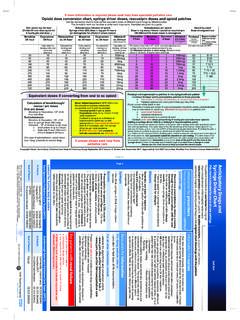
Transcription of Clinical protocol for the use of syringe drivers in ...
1 Clinical protocol for the use of syringe drivers in palliative care patients ( adults )These guidelines are written for the use of health care professionals in the Oxford Radcliffe NHS Trust and were produced by Mandie Draper and Stuart Oliver CNS s in the Trust s Hospital palliative care Teams who will review the protocol every three years. Accepted for print on Feb 2004. For review on Feb 2007. 3 Indications for 3 The main purpose of this document .. 3 The reason for developing this 3 ROLES AND 4 TRAINING 4 MAIN BODY OF TEXT.
2 5 Advantages of a syringe 5 Considerations when using a syringe driver .. 5 Drug compatibility and 5 Calculating oral morphine to subcutaneous 5 Calculating subcutaneous morphine to subcutaneous 6 Calculating from other 6 Preparing the patient and 6 Checking and starting the 7 Setting the correct 7 The patient has a distressing symptom at the timeof setting up the syringe driver?.. 7 Site selection and needle 8Re-loading the 8 Alteration of drug or dose or adding new 8 Regular 9 Changing the infusion 9 Administration of prn 10 Calculating a prn dose of 10 Calculating other prn 10 Butterfl y 10 Boost 10 Discharging a patient 11 Admitting a patient from 11Re-ordering 12 Specialist 12 AUDIT AND RISK 12 LEGAL AND PROFESSIONAL 13 WORKING 14 2 INTRODUCTIONThe syringe driver in palliative care is a small, portable.
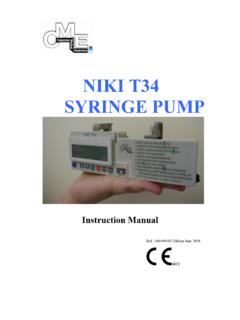
3 Battery powered infusion device that is suitable for patient use in the hospital and at home. The syringe driver is used to administer a continuous subcutaneous (sc) infusion of drugs from a syringe analgesics, antiemetics, sedatives or anticholinergics. The syringe is drawn up with a single drug or combination of drugs and administered at a constant rate over a set period of time (usually 24 hours).It is important to remember that a syringe driver is an alternative route for drug delivery and not a method of pain relief in for use include.
4 Persistent nausea and vomiting Intestinal obstruction Diffi culty in swallowing due to profound weakness / low energy levels Sleepiness / coma Poor alimentary absorption (rare) Intractable painThe main purpose of this document is to assist the registered nurse in deciding when a syringe driver is needed and to provide guidelines to be followed for setting it up and ongoing management. Principles for deciding on appropriate drug doses will also be for any decision to deviate from these guidelines should be documented in the patient s reason for developing this document is for all nurses at the ORH NHS Trust to use syringe drivers in the same safe and effective way when administering drugs to manage distressing symptoms in palliative care Graseby MS 26 (green)
5 Delivers drugs over 24 hours and is the syringe driver recommended for sub-cutaneous use in palliative care situations because of its technical simplicity. In addition, using one model avoids confusion and reduces the risk of error when calculating the rate. This is important as another device exists that appears the same at a Graseby manufacture the MS 16A (blue) which delivers drugs by the hour and is very similar in appearance. This is used in specialist areas such as paediatrics and outpatients to give a drug over a short-er period of time where use of the MS 26 model would be inappropriate.
6 Any Clinical areas owning an MS 16A must keep it locked away to avoid potential fatalities as a consequence of mistaken identity between these devices. This practice would follow the United Kingdom relevant guidance published by the Scottish Offi ce Home and Health Department (1995). 3 ROLES AND RESPONSIBILITIESThe doctor is responsible for prescribing medication to be infused via the syringe driver. The registered nurse is responsible for the setting up, monitoring and reloading the syringe every 24 hours. Registered nurses have a responsibility to ensure their own training needs are met prior to using the device.
7 A health care assistant may care for a patient with a syringe driver in situ, with responsibility to report any concerns to the qualifi ed nurse. The health care assistant has no responsibility for setting up or monitoring the syringe specialist advice can be sought from:Monday to Friday, 9am to 5 pm:Monday to Friday, 9am to 5 pm: Hospital palliative care Team at the John Radcliffe Hospital (2)21741 Hospital palliative care Team at the Churchill (2)25863 Hospital palliative care Team at the Horton Hospital (2)29238 Overnight and at weekends:Overnight and at weekends.
8 Katharine House Hospice 01295 811866 Sobell House (01865 2)25873 TRAINING NEEDSThe registered nurse will have knowledge of: When a syringe driver is needed (see indications for use ) How to check and start the Graseby MS 26 (see ) The correct equipment to use (see ) How to set the correct rate (see ) What to check regularly, during the infusion (see ) How to reload the Graseby MS 26 syringe driver (see ) The rule not to use the boost button for breakthrough administration of medication (see ) The principles applied when selecting the correct drug and dose to ensure the patients needs are met (see ,6, and 10)
9 How and when to access specialist advice (see )The registered nurse will gain this knowledge through the following ORH NHS Trust resources: The Infusion Device Training organised by the manager of the equipment library at the John Radcliffe Hospital The Use of syringe drivers in palliative care (adult) Workbook 4 MAIN BODY OF TEXTA dvantages of a syringe driver Permits good symptom control through steady levels of plasma drug concentration Better control of nausea and vomiting Control of multiple symptoms often possible with a combination of drugs that can be mixed together Avoids repeated injections The subcutaneous route is more comfortable than the intramuscular route.
10 Especially for the cachectic patient Less invasive than the intravenous route Avoids the need for IV access Does not restrict mobility and independence syringe only needs replacing once a day unless the prescription changes Technically simple to set up and use compared with other devicesConsiderations when using a syringe driver There is a need to anticipate the patient s requirements over 24 hours An exacerbation of symptoms may necessitate additional injections to supplement the infusion (the boost button is not suitable for this see boost button ) It should not be seen as the solution to all problems symptoms still need to be assessed regularly and the medication and doses adjusted accordingly Some patients may fi nd the syringe driver heavy There is a myth regarded by some that the syringe driver is a last resort, or a sign of impending death.