Transcription of Pryda Timber Connectors
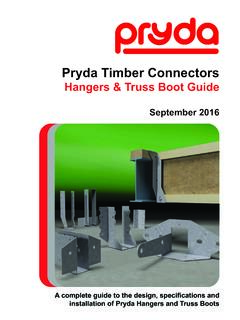
1 Pryda Timber ConnectorsBracing GuideSeptember 2016A complete guide to the design, specificationsand installation of Pryda Bracing ESSENTIAL NOTES Pryda PRODUCT GUIDES Copyright: Pryda Australia - A Division of ITW Australia ABN 63 004 235 063 - 2016 INTRODUCTION The information in this Product Guide is provided for use in Australia by architects, engineers, building designers, builders and others. It is based upon the following criteria: 1. No Substitution: The products covered by or recommended in this guide must not be substituted with other products.
2 2. Design Capacity Basis: See Codes & Standards following. 3. Supporting Constructions: Constructions using Pryda products must be built in accordance with the NCC (BCA) or an appropriate Australian Standard. Note: This includes appropriate corrosion protection- See Corrosion Protection following. 4. Correct Installation: Installation of Pryda products must be strictly in accordance with the instructions in this guide. 5. Current Guide Version Used: The current version of this guide, including any amendments or additions, must be used.
3 Users are advised to check the Pryda website, , on a regular basis for the most current design guides. CODES & STANDARDS Product design capacities in this guide have been derived from: (a) Results of laboratory tests carried out by or for Pryda Australia (b) Engineering computations in accordance with the relevant Australian Standards, ie: Timber Structures. Part 1: Design Methods. AS/NZS1170 series Structural Design Actions. AS4055-2006 Wind Loads for Housing. Design capacities tabulated in this guide apply directly for Category 1 joints.
4 For all other joints, reduce design capacities by using the factors as specified in General Notes (if applicable). Design capacities are related to the Joint Group of the Timber as defined in AS1720 and AS1684. If the Joint Group of Timber members joined together varies, the lower group must be assumed for design, for example, JD5 is lower than JD4. DEFINITIONS Special terms used in this guide are as defined in Australian Standards, including: Design Capacity: T he maximum Limit State Design load (aka action ) which the product can safely support under the specified load condition, eg, + (dead+roof live).
5 See General Notes for details (if applicable). Joint Group: Classification of a Timber according to its fastener-holding capacity. See General Notes for details (if applicable) CORROSION PROTECTION Most Pryda products are manufactured using Z275 light-gauge steel, having zinc coating of 275 gsm (total weight). This protection is adequate only for INTERNAL applications in most corrosive environments, except areas that are classified as heavy industrial or those subject to high humidity (eg, enclosed swimming pools).
6 Under these circumstances, seek advice from experts as special protection will be required. Note: INTERNAL areas are those within the building envelope that are kept permanently dry. and , Australian Standards for Residential Timber Frame Construction stipulate a minimum Z275 steel for all sheet metal products used in an internal environment. In areas outside the building envelope that are exposed to repeated wetting (EXTERNAL areas), Pryda s stainless steel products or equivalent should be considered.
7 Some alternatives include hot dip galvanised or powder coated steel, which are not supplied by Pryda . For more detailed information, read Pryda s Technical Update on Corrosion Resistance of Pryda Products or contact a Pryda office. PRODUCT CERTIFICATION Pryda Australia warrants: Products in this guide are free from defects in the material and manufacturing Design capacities are in accordance with test results or current, relevant Australian Standards and the Building Code of Australia.
8 Pryda products are structurally adequate provided they are designed, installed and used completely in accordance with this guide. This warranty applies only to: Products in this guide. Products used in the specified applications and not damaged after manufacture and supply. Joints free from wood splitting, decay or other Timber defects at the joint or within 150 mm of the joint. INSTRUCTIONS FOR INSTALLATION These notes are provided to ensure proper installation. 1. All fasteners used must be manufactured by reputable companies and be of structural quality.
9 2. Connectors must not be installed on Timber which is split before or during installation. If the Timber is likely to split as fasteners are driven, fastener holes must be pre-drilled. 3. Do not overload the joints during construction or in service. 4. Hole diameter for bolts in seasoned Timber must not be more than mm larger than the bolt diameter to achieve a snug-tight connection. Specified washers must be installed against the Timber face. 5. Use proper safety equipment and due care in installing these Connectors .
10 6. Any gaps in joints between the Timber members must not exceed 3 mm. 7. Do not over-tighten screws. Pryda Timber Connectors Bracing Guide Pryda Bracing GuideTABLE OF CONTENTS GENERAL NOTES Useful notes and definitions fore effective reading of this guide 4 Pryda ANGLE BRACE A formed steel section brace in two sizes, ie, Mini Brace and Maxi Brace for use as wall bracing and noggin 5 Pryda STRAP BRACE A flat, tensioned steel strap in six section sizes for all bracing uses 6 Pryda SPEEDBRACE A formed steel tension brace for roof and other bracing uses 8 WALL BRACING DETAILS Details of A Types and B bracing units 9 TECHNICAL INFORMATION Tension capacities for all bracing products 12 Pryda SHEAR Connectors Fixed to the top plate of non-bearing bracing walls to transfer racking loads from ceiling plane 14 RAMSET ANKASCREWS Concrete anchor screws for tie-down of bracing units 16 APPENDIX Provides information and