Transcription of 3.2 Form 5500 Q&A - HCW Employee Benefit Services
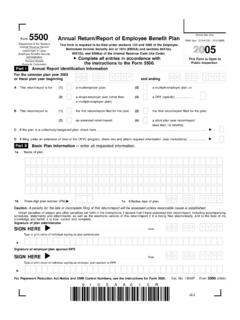
1 NOTICE: This information is not to be considered specific legal advice and should not be relied upon in lieu of advice from your attorney. Hill, Chesson & Woody does not engage in the practice of law, accounting, or medicine. Therefore, the contents of this communication should not be regarded as a substitute for legal, tax, or medical advice. Hill, Chesson & Woody| Compliance Toolkit 1/2013 1 form 5500 Q&A What is the form 5500 and where does this requirement come from? Under Title I and Title IV of ERISA and under the Internal Revenue Code, pension and welfare Benefit plans generally are required to file an annual return or report regarding their financial condition, investments, and operations.
2 The Department of Labor, Internal Revenue Service, and the Pension Benefit Guaranty Corporation jointly developed the form 5500 series so Employee Benefit plans could use this form to satisfy annual reporting requirements. What plans must file a form 5500 ? The form 5500 is required for ERISA welfare Benefit plans. Common ERISA welfare benefits include: Health insurance and self funded health benefits Dental insurance and self funded dental benefits Vision insurance and self funded vision benefits Health FSAs HRAs Wellness Programs providing significant medical benefits Many EAPs Long term disability coverage Accident, death, and dismemberment insurance Life insurance Severance benefits How are plans categorized for the purpose of form 5500 ?
3 The form 5500 filing requirements vary according to the type of plan. There are generally three types: 1. Small plans (generally plans with fewer than 100 participants* as of the beginning of the plan year) 2. Large plans (generally plans with more than 100 participants* as of the beginning of the plan year) 3. Direct filing entities (DFEs are trusts, accounts, and other investment or insurance arrangements that plans participate in and that are required to or allowed to file the form 5500 directly with EBSA) *Please note that dependents are not considered participants for determining plan size. NOTICE: This information is not to be considered specific legal advice and should not be relied upon in lieu of advice from your attorney.
4 Hill, Chesson & Woody does not engage in the practice of law, accounting, or medicine. Therefore, the contents of this communication should not be regarded as a substitute for legal, tax, or medical advice. Hill, Chesson & Woody| Compliance Toolkit 1/2013 2 What is an unfunded plan vs. a funded plan? An unfunded plan is one that pays benefits as needed solely from the general assets of the employer sponsoring the plan. A plan becomes a funded plan when it uses plan assets to pay benefits in whole or in part. A plan funded by participant contributions under a cafeteria plan may be deemed to be unfunded, for purposes of this form 5500 exemption (under DOL Technical Release 92 01).
5 What Forms and Attachments must be filed? Large Welfare Plans must file: form 5500 Schedule A Insurance Information (only if plan has insurance contracts for benefits or investments stop loss contracts may require Schedule A if the stop loss contract is issued to the plan instead of the employer, if payments under the policy are made to the plan instead of the employer, or if stop loss premiums are not paid exclusively out of employer assets) Schedule C Service Provider Information (only if service provider was paid $5,000 or more or an accountant or enrolled actuary was terminated) Others less common filings include: Schedule D DFE/Participating Plan Information Part I (only if a plan participates in a master trust investment account (MTIA), common/collective trust (CCT), pooled separate account (PSA), or 103 12 investment entities (103 12IE) Schedule G Financial Transaction Schedules (only if Schedule H, lines 4b, 4c, or 4d are required to be marked yes.))
6 Schedule H Large Plan and DFE Financial Information (only if plan is NOT unfunded, fully insured, or a combination unfunded/fully insured) Small Funded Welfare Plans must file: form 5500 Schedule A Insurance Information (only if plan has insurance contracts for benefits or investments stop loss contracts may require Schedule A if the stop loss contract is issued to the plan instead of the employer, if payments under the policy are made to the plan instead of the employer, or if stop loss premiums are not paid exclusively out of employer assets) Schedule I Small Plan financial Information What is an insured plan? For a plan to be considered insured the following must be met: Benefits must be paid exclusively through insurance policies issued by qualified insurance companies or similar organizations or through qualified health maintenance organizations; NOTICE: This information is not to be considered specific legal advice and should not be relied upon in lieu of advice from your attorney.
7 Hill, Chesson & Woody does not engage in the practice of law, accounting, or medicine. Therefore, the contents of this communication should not be regarded as a substitute for legal, tax, or medical advice. Hill, Chesson & Woody| Compliance Toolkit 1/2013 3 Premiums must be paid directly by the employer from general assets or partly from participant contributions, provided that the participant contributions are forwarded to the insurer or HMO as soon as possible but no later than three months after being withheld or contributed; and Insurance refunds to which contributing participants are entitled must be refunded within three months, and participants must be informed, when they enter the plan, about the plan s provisions for allocating refunds.
8 What plans are exempt from 5500 filing? Small unfunded, small insured, and small combination unfunded/insured welfare plans are completely exempt from the form 5500 requirement. Other plans that may be exempt include the following: Governmental plans A church plan under ERISA section 3(33). A welfare Benefit plan maintained outside the United States primarily for persons substantially all of whom are nonresident aliens. An unfunded or insured welfare plan for a select group of management or highly compensated employees which meets the requirements of 29 CFR 24. An Employee Benefit plan maintained only to comply with workers compensation, unemployment compensation, or disability insurance laws.
9 A welfare Benefit plan that participates in a group insurance arrangement that files a form 5500 on behalf of the welfare Benefit plan as specified in 29 CFR 2. See 29 CFR 43. An apprenticeship or training plan meeting all of the conditions specified in 29 CFR 22. An unfunded dues financed welfare Benefit plan exempted by 29 CFR 26. A welfare Benefit plan solely for (1) an individual or an individual and his or her spouse, who wholly owns a trade or business, whether incorporated or unincorporated, or (2) partners or the partners and the partners spouses in a partnership. See 29 CFR 3(b). Do I have one plan or multiple plans? form 5500 instructions explain that one form 5500 is required for each plan.
10 Discretion is left to the employer to designate what constitutes a plan and multiple benefits may be bundled into one plan as long as plan documents (insurance contracts, SPDs, wrap documents) reflect this intent. There are no hard and fast rules for determining how many plans an employer sponsors. As a consequence, the plan sponsor is generally free to determine the number of plans it has for ERISA compliance purposes. Determining and declaring the number of plans is therefore part of the plan design process. As part of the plan design and documentation process, the plan sponsor may choose to establish any of the following: A single bundled plan through which all fringe benefits are provided, NOTICE: This information is not to be considered specific legal advice and should not be relied upon in lieu of advice from your attorney.