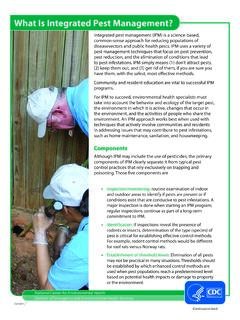
Transcription of PRINCIPLES OF INTEGRATED AND DISEASE MANAGEMENT …
1 Shaping Empowering OF INTEGRATEDPEST AND DISEASE MANAGEMENT (ASPP3204-1+1) Edited byWhat is Pest and Category of pestIntegrated DISEASE and Pest ManagementClultural, Physical and MechanicalBiological and MicrobialChemical MethodsINDEX Lectures Topic name Page 1 PEST - DEFINITION, CATEGORIES, CAUSES FOR OUTBREAK, LOSSES CAUSED BY PESTS 1-2 2 INTEGRATED PEST MANAGEMENT 3-7 3 PEST SURVEILLANCE AND FORECASTING 8-11 4 TOOLS OR COMPONENTS OF INTEGRATED PEST MANAGEMENT 12-13 5 HOST PLANT RESISTANCE 14-18 6 CULTURAL METHOD OF PEST MANAGEMENT 19-22 7 PHYSICAL CONTROL 23-24 8 MECHANICAL METHODS 25-26 9 BIOLOGICAL CONTROL 27-33 10 CHEMICAL CONTROL 34-37 11 INSECTICIDE FORMULATION 38-42 12 INORGANIC INSECTICIDES AND BOTANICALS 43-46 13 SYNTHETIC ORGANIC INSECTICIDES 47-54 14 NOVEL INSECTICIDES 55-60 15 LEGISLATIVE / LEGAL / REGULATORY METHODS OF PEST CONTROL 61-63 16 INSECT GROWTH REGULATORS (HORMONAL CONTROL)
2 64-66 17 MISCELLANEOUS USEFUL NOTES Page 1 LECTURE NO. 1 PEST - DEFINITION, CATEGORIES, CAUSES FOR OUTBREAK, LOSSES CAUSED BY PESTS PEST - Any organism that cause significant and economic damage to crops, stored produced and animals . - A pest is any organism which occurs in large numbers and conflict with man s welfare, convenience and profit - A pest is an organism which harms man or his property significantly or is likely to do so (Woods, 1976) - Pests are organisms which impose burdens on human population by causing (i) Injury to crop plants, forests and ornamentals (ii) Annoyance, injury and death to humans and domesticated animals (iii) Destruction or value depreciation of stored products. - Pests include insects, nematodes, mites, snails, slugs, etc. and vertebrates like rats, birds, etc. Depending upon the importance, pests may be agricultural, forest, household, medical and veterinary pests.
3 Parameters of insect population levels General equilibrium position (GEP) The average density of a population over a long period of time, around which the pest population tends to fluctuate due to biotic and abiotic factors and in the absence of permanent environmental changes. Economic threshold level (ETL) Population density at which control measure should be implemented to prevent an increasing pest population from reaching the ETL. It is also known as Action Thresold. ETL= EIL - Daily reproductive rate of insects Economic injury level (EIL) The lowest population density that will cause economic damage. Damage boundary (DB) The lowest level of damage which can be measured. ETL is always less than EIL. Provides sufficient time for control measures. CATEGORIES OF PESTS I. Insect pests are classified as follows based on season and locality a.
4 Regular pests: Regular pest: Occur most frequently (regularly) in a crop and have close association with that particular crop. Eg: Chilli Thrips Scirtothrips dorsalis , brinjal shoot and fruit borer, Leucinodes orbonalis, Rice stem borer. b. Occasional pests: Here a close association with a particular crop is absent and they occur infrequently. Eg: Rice case worm, Nymphula depuctalis castor slug caterpillar, Parasa lepida , mango stem borer, Batocera rufamaculata c. Seasonal pests: Occur mostly during a particular part of the year, and usually the incidence is governed by climatic conditions. Eg: Red hairy caterpillar on groundnut-June - July, Rice grasshoppers June-July d. Persistent pests: Occur on a crop almost throughout the year. Eg. Thrips on chillies. e. Sporadic pests: Pests, which occur in a few isolated localities Eg.
5 Rice ear head bug. Page 2 II. Insects pests are also classified as follows based on intensity of infestations a. Epidemic pests: Occur in a severe form in a region or locality at a particular season or time only. Eg: Rice hispa, Dicladispa armigera, rice leaf roller, Cnaphalocrocis medinalis b. Endemic pests: Pests, which occur regularly and confined to a particular area of locality. Eg. Rice Gall midge in Madurai district and rice stem borer cauvery delta. III. Pests are classified as follows based on damage potential a. Key pests: These are the most severely damaging pests. The GEP is always above the EIL. Human intervention may bring the population temporarily below the EIL, but it rises back rapidly and repeated interventions (sprays) may be required to minimize damage. These are persistent pests.
6 The environment must be changed to bring GEP below EIL. bollworm, Diamond backmoth b. Major pests: These are pests with the population crosses EIL quite frequently. Economic damage can be prevented by timely and repeated sprays Cotton jassid, Rice stem borer c. Minor pests: These are pests with population rarely crosses EIL and fluctuates around ETL. But these pests are easily amenable to available control measures and a single application of insecticides is usually enough to prevent economic damage (5-10% damage). d. Potential pests: These pests normally do not cause any economic damage. Any change in the ecosystem may make them to cause economic damage . e. Sporadic pests : GEP generally below EIL The population of these pests is usually negligible but in certain years under favorable environmental conditions, they appear in a virtually epidemic form crossing many times over DB and EIL.
7 Under these conditions, the pest has to be controlled by undertaking suitable MANAGEMENT strategies. These pests are highly sensitive to abiotic conditions and once the favorable season is over, only a residual population survives. Ex: White grub, hairy caterpillars, cut worm, grass hoppers Page 3 LECTURE NO. 2 INTEGRATED PEST MANAGEMENT History of INTEGRATED Pest MANAGEMENT - Michelbacher and Bacon (1952) coined the term INTEGRATED control - Stern et al. (1959) defined INTEGRATED control as applied pest control which combines and integrates biological and chemical control - Geier (1966) coined the term pest MANAGEMENT - Council on Environmental Quality (CEQ, 1972) gave the term INTEGRATED Pest MANAGEMENT - In 1989, IPM Task Force was established and in 1990. IPM Working Group (IPMWG) was constituted to strengthen implementation of IPM at international level.
8 - In 1997, Smith and Adkisson were awarded the World Food Prize for pioneering work on implementation of IPM. Definition IPM by Food and Agricultural Organization (FAO, 1967) INTEGRATED Pest MANAGEMENT (IPM) is a pest MANAGEMENT system that, in the context of associated environment and population dynamics of the pest species, utilizes all suitable techniques and methods in as compatible a manner as possible and maintains pest populations at levels below those causing economic injury. In IPM three aspects are emphasized, i. Multiple control tactics used in a compatible manner ii. The populations maintained below levels that cause economic damage iii. Socio economic and eco-friendly to the environment IPM definition by Luckmann and Metcalf (1994) IPM is defined as the intelligent selection and use of pest control tactics that will ensure favourable economical, ecological and sociological consequences.
9 Need for Pest MANAGEMENT (or) Why Pest MANAGEMENT 1. Development of resistance in insects against insecticides OP and synthetic pyrethroid resistance in Helicoverpa armigera. 2. Out break of secondary pests Whiteflies emerged as major pest when spraying insecticide against H. armigera. 3. Resurgence of target pests BPH of rice increased when some OP chemicals are applied. 4. When number of application increases, profit decreases. 5. Environmental contamination and reduction in its quality. 6. Killing of non-target animals and natural enemies. 7. Human and animal health hazards. Why Pest MANAGEMENT 1) Collapse of control system: After World War II the use of pesticides mushroomed, but with all the benefits of the use pesticides, it has adverse side effects not just on humans but also in animals. During the massive use of pesticides, Rachel Carson, an American biologist, warned the people about the side effects of the use of pesticides through her book entitled, Silen tSpring.
10 Through her book, she raised a lot of questions about the real benefits of the use of pesticides as well as the risks of pesticides rendered in the environment and public health. An over-reliance on chemical pesticides led to development of pesticide resistance, development of multiple resistance , emergence of secondary pest as major pests, resurgence of pests, elimination of natural enemies of pests, hazards to non-target species, hazards to agricultural workmen and deleterious effects on the environment, Page 4 2) Phases of crop protection (Collapse of control systems) Smith. (1969) has classified World wide patterns of crop protection in cotton agro ecosystem into the following phases which are also applicable to other crop ecosystems A) Subsistence phase The crop is usually grown under non irrigated conditions.