Transcription of IRLA - American Reading
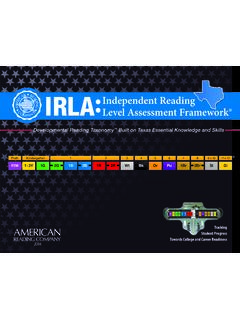
1 Tracking Student Progress Toward College and Career ReadinessDevelopmental Reading taxonomy Built on Common Core State StandardsAMERICANREADING COMPANYIRLA :Independent Reading Level Assessment FrameworkPreK123456789 &1011&12 KindergartenRTM1G2G1B2B1R2 RWtBkOrPu1 BrSiGl2Br1- 3Y 2017 GlSi1-2 BrPuOrBkWt2R1R2B1B2G1G 1-3 YActive Reading Strategies & Initial ConsonantsHigh-Frequency WordsInitial Blends & DigraphsOnset + Sight Word/Rime2-Syllable WordsMultisyllabic WordsIrregularly Spelled Words & Chapter BooksAcademic Vocabulary of 1,500+ Tier II/III Words & Series HabitAuthor s Craft, Point of View, BiasLiterary AnalysisCollege & Career ReadyGenre ExpansionLatin & Greek Roots & Genre ExpansionTier II Vocabulary in ContextRead-Aloud ImmersionIRLA Developmental Reading taxonomy Threshold Concepts That Build Reading CompetencyThe IRLA s Reading taxonomy outlines the big jumps in Reading skills, strategies, and concepts that distinguish one IRLA Reading level from the next.
2 The concept listed for each level is the new threshold concept required for independent Reading of text at that level that was not required by text at previous levels. The IRLA is not intended to limit what students read. Students should be encouraged to read anything of interest, leveled or not, because at every level, along with the new threshold concept, students are developing competence in the full range of creative and critical Reading identities, behaviors, and &1011&12 KindergartenRTM1G2G1B2B1R2 RWtBkOrPu1 BrSiGl2Br1-3Y .. IRLA is a K-12 developmental scope and sequence for Reading acquisition that prepares all students for success in college, career, and life, as articulated by the Common Core State Standards. The IRLA includes every Common Core State Standard for Reading , as well as those Language standards key to Reading success, for students in grades PreK to 12. Each Reading level represents a new threshold concept/skill that was not required to read text at the level below.
3 Teachers use the IRLA to locate each student on this standards continuum to: identify a baseline Reading level; match reader with appropriate texts, leveled to the same IRLA system; identify which skills/Standards and in what order (including foundational skills) are the most crucial for each student/reader/individual to learn next ; design individual, small-group, and whole-group instruction targeted to the development of specific skills; and monitor progress through the standards/ Reading levels in real-time, to ensure all students are on-track to make sufficient Reading growth, or intervene early. Repeat in a relentless march toward grade level and Likely Next Step/ChallengeTeach and PracticeAssess: Did this work? What else could it be?Level/Observe StudentEnd Goal: Educators who can listen to any reader read & discuss any text and deduce a specific learning goal that will accelerate Reading growth. iIndependent Reading Level Assessment:A Common Core Framework for Continuous Improvement Written by Jane Hileman and Gina Zorzi Cline Copyright 2017 by American Reading Company All rights reserved.
4 Published in the United States by American Reading Company. 1-866-810-BOOK ISBN: 1-63437-976-4 | 04212017 xivPhonics Infrastructure for LevelingThis locator provides information about a reader s control of phonics. The locator is not sufficient for determining a level. The most important indicator of a student s Reading level should always be his or her ability to understand the meaning of the text. Use this tool in initial leveling to help locate an appropriate level of text from which to begin. 1G/2G*1B2B1R2 RamamhamhammerhammeringSamuelananmancand lecandlelightpianoandandsandsandyunderst andhandicappedatatbatbattlescratchyatten tionowdownfrownhowlingMrs. DowerdytouchdownetgetmetwetterstretchMcG ettiganininskinKevininvitedskinnierititp itquittersplittingsituationupuppuppuppie supsettingTupperwareasasaskbasketbasketb allAlaskaororforforceforgottenoriginalaw sawdrawdrawingstrawberryMr. AwbrighteneeseeseedsweepingscreenMcKeesp ortillwillBillchillyHillaryWilliamallall talltallestDr.
5 Wallingtonaltogetherigbigwigignoreignora ntfiguresamecameblameblamingshamefulMrs. Amesworthyaydayclayplayerplayfullypayabl eakemakebaketakingmistakenshakeableootoo mootoothtoothachefoolishlyDirections - Have the reader:1. Read across a few rows until it becomes clear which column contains words the student is unable to handle independently. Do not provide any help of any Back up to the highest column the student has been able to read independently and have him or her read down (part of ) that column until you are comfortable that the student can/cannot handle these types of words independently. There is no need to finish the column if this is obvious part way down. The highest level at which the student can read at least 70 80% of the words is his or her phonics level. This is not necessarily his or her Reading level, because you haven t checked comprehension in actual text. DO NOT give copies of this page to students. DO NOT teach or drill these words.*Use Initial Assessment Protocol: 1-3Y (p.)
6 Viii) or 1G Entry Requirements (p. 28) if student is unable to read 70-80% of this column. xvAcademic Vocabulary Infrastructure for LevelingThis locator provides information about a reader s academic vocabulary acquisition. The locator is not sufficient for determining a reader s level. The most important indicator of a student s Reading level should always be his or her ability to understand the meaning of text. Use these lists in initial leveling to determine whether his or her working vocabulary is sufficient to comprehend text at each level and so to decide at what IRLA level to begin : Read through this column, and find a word you know. Read the word, and give me a synonym or short definition for the word. Student should be able to select 5-6 words from the column to read and provide a synonym or short definition. DO NOT allow students to use the word in a sentence in lieu of providing a *BKORPU1BR2 BRSIGL1amateurabandonedbarrierabruptlyab olishadjacentalluvialaberration2betrayab sorbedbellowedabundantaudibleaffirmative amnestyagrarian
7 3brilliantastonishbeneficialannualchaosa mbiguousarchaicapocalyptic4captureburrow circulatearomaconcedecivilianautonomyban al5disbeliefcentralconcealedbewilderedci villycommerceblatantlycapitulate6eruptce nturydecreasecontemplatecultureconcedeco ndescendingcharlatan7exclaimconfideddefi antlydecadedialectcontroversialcrescendo disconcerted8glaredcorridordepartedeleva tedeconomycurrencydepleteidiosyncrasy9ga zingdestinationdiminishemergeedibledisse ntenmityincredulous10glimmerdimestimatee quivalenthumilitydomesticatedgauntinfras tructure11muttereddwellingextendfleeinst inctivelyfederationheresylanguid12pleade denviouslyfrequentlyfrailirregularfinite heterogeneousnebulous13preyfragmentsglim psegesturekinshipinauguratedironicostent atious14probeglancedhorizonhastilylegend aryintermittentmartyrostracize15proteste dhesitateinhabithorizontalmonotonyominou smonotheismpropitious16providehumiliated marinemassivemutelyprecedentparadoxqueue 17quiverimagesmythicalnativeperpendicula rpremeditatedperipheralreiterate18recent lyinquiredpartiallyperpetualparallelrauc ousreconcilerudimentary19scowledpeeredpr eviouspropagandaperilousskepticalsubtlev enerable20shallowrarelyvastvicinityvague sparsesynthesisvicissitudesTo enter a color level, a student should correctly define 5-6 words.
8 *An entry-level Wt reader may not know these words, yet (see Wt Entry Requirements: Vocabulary Check on p. 150).DO NOT give copies of this page to students. DO NOT teach or drill these SAMPLEFor First GradeIRLA 452G2G Independent Reading Level Overview - 120 Power Words, Initial Blends & Digraphs 2G Learning FocusPower Words, Initial Blends & Digraphs Power Words: 2G readers will know and use 120 very high-frequency Power Words as a reliable and familiar support framework when Reading . They will be able to read these words in books they have never seen before and out of context (lists, flash cards, etc.) at Flash Speed. Power Words provide islands of certainty from which emergent readers can navigate the unknown. The combined Power Words in 1G and 2G make up 50% of all adult and student Blends & Digraphs: When students come to a word they don t know, they will successfully use initial blends and digraphs as Common Core State Standards CCSS Recognize and read grade-appropriate irregularly spelled Know the spelling-sound correspondences for common consonant RequirementsMust be in place before earning 2G CCSS Read with sufficient accuracy and fluency to support comprehension.
9 Ask and answer questions about key details in a Recognition CCSS Recognize and read grade-appropriate irregularly spelled CCSS Know the spelling-sound correspondences for common consonant RequirementsMust be in place before earning 1B CCSS Read with sufficient accuracy and fluency to support comprehension. Ask and answer questions about key details in a CCSS Blend and segment onsets and rimes of single-syllable spoken words. Decode regularly spelled one-syllable Recognition CCSS Recognize and read grade-appropriate irregularly spelled 462G2G Independent Reading Level Assessment - Requirements: Cumulative Record Student _____ Teacher _____ Room _____ Date Started _____2G Entry RequirementsEvidence/DateDate CompletedComprehensionCCSS and Comprehend Unfamiliar 2G TextApply Foundational Skills (Word-Solving)Use a combination of initial sounds/blends, sight words, and context clues to read 2G text with purpose and understanding.
10 A transitional 2G reader may be working out the words, rather than Reading fluently; however, she is insistent that what she reads make sense, stopping and trying again if something doesn t look right, sound right, or make Reading Standards (Comprehension) Determine what a text says explicitly and make logical inferences from Cold Read Record on page 47. Minimumscore of 2 on oneCold Read RecognitionCCSS 2G Power WordsRecognize and read grade-appropriate irregularly spelled words (were, could, would, does, some). Words selected using the following resources: Dolch, Fry et al. (2000), Johns & Lenski (1997), Pinnell & Fountas (1998), Zeno et al. (1995).See Power Words Check on page 52. Minimum score of for Initial Blends and DigraphsKnow the spelling-sound correspondences for common consonant digraphs (sh , ch , th , wh ) and Initial Blends and Digraphs Check on page 53 Minimum score of reader who is proficient at all of the above enters 2G with points.