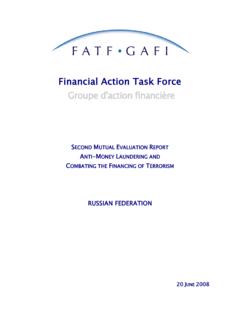
Transcription of Financial Action Task Force Groupe d'action financière
1 Financial Action Task Force Groupe d' Action financi re GUIDANCE ON THE RISK-BASED APPROACH. TO COMBATING MONEY LAUNDERING AND. TERRORIST FINANCING. high Level Principles and Procedures JUNE 2007. 2007 FATF/OECD. All rights reserved. No reproduction or translation of this publication may be made without prior written permission. Applications for such permission should be made to: FATF Secretariat, 2 rue Andr -Pascal, 75775 Paris Cedex 16, France Fax: +33 1 44 30 61 37 or FATF GUIDANCE ON THE RISK-BASED APPROACH TO. COMBATING MONEY LAUNDERING AND TERRORIST.
2 FINANCING. high Level Principles and Procedures This Guidance was developed by the FATF in close consultation with representatives of the international banking and securities sectors. This public- private sector partnership was integrally involved in the development and finalisation of the Guidance. A list of members of that group is attached at Annex 5. The Guidance Paper was adopted by the FATF at its June 2007 Plenary. TABLE OF CONTENTS. SECTION ONE: USING THE GUIDANCE/PURPOSE OF THE RISK-BASED. APPROACH .. 1. Chapter One: Background and Context.
3 1. Chapter Two: The Risk-Based Approach purpose, benefits and challenges ..2. Chapter Three: FATF and the Risk-Based Approach ..5. SECTION TWO: GUIDANCE FOR PUBLIC AUTHORITIES .. 11. Chapter One: high -level principles for creating a risk-based approach ..11. Chapter Two: Implementation of the Risk-Based SECTION THREE: GUIDANCE FOR Financial INSTITUTIONS ON. IMPLEMENTING A RISK-BASED APPROACH .. 22. Chapter One: Risk Categories .. 22. Chapter Two: Application of a Risk-Based Approach ..26. Chapter Three: Internal ANNEXES .. 30. Annex 1 Sources of Further Information.
4 30. Annex 2 Basel Committee on Banking Supervision Working Group on Cross Border Banking - Risk Matrix .. 36. Annex 3 Basel Committee on Banking Supervision Working Group on Cross Border Banking - Risk Assessment Links to the AML Management Programme .. 38. Annex 4 Glossary of Terminology: .. 39. Annex 5 Membership of the Electronic Advisory 42. SECTION ONE: USING THE GUIDANCE &. PURPOSE OF THE RISK-BASED APPROACH. Chapter One: Background and Context Following a meeting in December 2005 between the FATF and representatives of the banking and securities sectors, FATF agreed to establish an Electronic Advisory Group (EAG) on the risk-based approach as part of its outreach to the private sector.
5 The EAG, which is a sub- group of the FATF Working Group on Evaluations and Implementation (WGEI) was set up in March 2006, and was chaired by Mr. Philip Robinson ( Financial Services Authority, United Kingdom) and Mr. Rick Small (GE Money, United States). Membership of the Group has consisted of FATF members and observers, as well as representatives from the banking and securities sectors that volunteered to work on the issue of the risk-based approach to combating money laundering and terrorist financing (referred to throughout this paper as the risk-based approach (RBA)).
6 A list of members is attached at Appendix 5. The work of the EAG followed a number of steps: responses to a questionnaire on risk-based approach were obtained, then the high level elements of a risk-based approach were identified and an outline of the EAG report was agreed. There then followed extensive consultation with both public and private sector members of the EAG, and a final report of the EAG to WGEI. setting out draft guidance on the implementation of a risk based approach was provided in April 2007. After further international consultation with both public and private sectors, this Guidance Paper was adopted by the FATF at its June 2007 Plenary.
7 This is the first occasion that the FATF has developed guidance using a public-private sector partnership approach. Purpose of the Guidance: The purpose of this Guidance is to: Support the development of a common understanding of what the risk-based approach involves. Outline the high -level principles involved in applying the risk-based approach. And Indicate good public and private sector practice in the design and implementation of an effective risk-based approach. Target Audience, Status and Content of the Guidance: The Guidance is primarily addressed to public authorities and Financial institutions.
8 However, many of the high level principles contained in this document will be equally applicable to designated non- Financial businesses and professions. The overall document is structured into three interdependent sections. Section one sets out the key elements of the risk-based approach and provides the basis for which to interpret section two (Guidance for Public Authorities) and section three (Guidance for Financial Institutions). There is also Annex 1, which contains descriptions of additional sources of information. The Guidance aims to set out the key elements of an effective risk-based approach and identifies the types of issues that both public authorities and Financial institutions may wish to consider when applying a risk-based approach.
9 The Guidance recognises that each country and its national authorities, in partnership with its Financial institutions, will need to identify the most appropriate regime, tailored to address individual country risks . Therefore, the Guidance does not attempt to provide a single model for the risk-based approach, but seeks to provide guidance for a broad framework based on high level principles and procedures that countries may wish to consider when applying the 1. risk-based approach with the understanding that this guidance does not override the purview of national authorities.
10 Chapter Two: The Risk-Based Approach purpose, benefits and challenges The purpose of the Risk-Based Approach The FATF Recommendations contain language that permits countries to some degree to adopt a risk-based approach to combating money laundering and terrorist financing. That language also authorise countries to permit Financial institutions to use a risk-based approach to discharging certain of their anti-money laundering (AML) and counter-terrorist financing (CFT) obligations. By adopting a risk-based approach, competent authorities and Financial institutions are able to ensure that measures to prevent or mitigate money laundering and terrorist financing are commensurate to the risks identified.