Transcription of Code of Practice for the Care and Handling of …
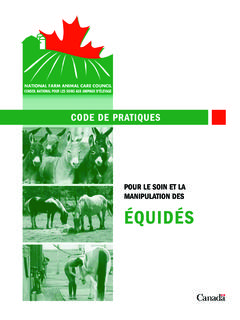
1 CODE OF Practice . FOR THE care AND Handling OF. EQUINES. ISBN 978-1-927392-40-9 (book). ISBN 978-1-927392-41-6 (electronic book text). Available from: Equine Canada 308 Legget Drive, Suite 100, Ottawa ON K2K 1Y6 CANADA. Telephone: (613) 287 1515. Fax: (613) 248-3484. Website: Email: For information on the Code of Practice development process contact: National Farm Animal care Council (NFACC). Email: Website: Also available in French Copyright is jointly held by Equine Canada and the National Farm Animal care Council (2013). This publication may be reproduced for personal or internal use provided that its source is fully acknowledged. However, multiple copy reproduction of this publication in whole or in part for any purpose (including but not limited to resale or redistribution) requires the kind permission of the National Farm Animal care Council (see for contact information).
2 Acknowledgment Funding for this project has been provided by Agriculture and Agri-Food Canada through the Agricultural Flexibility Fund, as part of Canada's Economic Action Plan. Disclaimer Information contained in this publication is subject to periodic review in light of changing practices , government requirements and regulations. No subscriber or reader should act on the basis of any such information without referring to applicable laws and regulations and/or without seeking appropriate professional advice. Although every effort has been made to ensure accuracy, the authors shall not be held responsible for loss or damage caused by errors, omissions, misprints or misinterpretation of the contents hereof. Furthermore, the authors expressly disclaim all and any liability to any person, whether the purchaser of the publication or not, in respect of anything done or omitted, by any such person in reliance on the contents of this publication.
3 Cover image copyrights: Epona Portraits Laurie Haughton, (middle and bottom photos) and Rob Hess Photography, (top photo). Table of Contents 4. 6. 8. Section 1 Duty of care Pre-Purchase 11. Pre-Purchase Veterinary 12. Section 2 Facilities and Housing Pastures and 13. Shade and Outdoor 13. Mixing and New 14. Fences and 15. Facilities for Special 16. 16. 16. Sick or Injured 17. Indoor 17. Indoor Space 17. Indoor 18. Indoor 18. Indoor 19. Indoor Air Quality and 19. Safety and 20. Section 3 Feed and Water 21. Safety of 22. Feeding 22. Nutritional Content and Feed 23. Thermal Impacts on Dietary Energy 24. Growing 24. Horses in 25. 25. Reproductive Mares and 25. Geriatric 26. Section 4 Health Management Health Management 27. Pest and Insect 28. 28. Parasite 29. CODE OF Practice FOR THE care AND Handling OF EQUINES - 2013. 1. Sick, Injured or Compromised 30.
4 31. Communicable 31. Dental 32. 33. Laminitis (Founder).. 33. Body Condition 34. Section 5 Feedlot Management Handling at Loading and 37. New 37. 38. Health Management in the 38. Pen Condition and 39. Stocking 39. Section 6 Husbandry practices Turnout, Exercise and Social 40. 40. Behaviour and 41. Handling and Restraint 42. Principles in Training and Learning 42. Methods of 44. 45. Alterations of the 46. Hoof 46. 47. Section 7 Reproductive Management Responsible 48. Evaluating Soundness for 48. care of the Pregnant Mare or 49. 49. care of the Newborn 50. 51. 51. Section 8 Transportation Pre-Transport Decision 53. Fitness for 53. Preparing Horses for 54. Arranging 55. Loading and 55. Training to 56. On-Farm Management 56. CODE OF Practice FOR THE care AND Handling OF EQUINES - 2013. 2. Section 9 Change or End of Career Change or End of Career 57.
5 Section 10 Euthanasia Timelines for 58. 59. Confirmation of 59. 61. Appendices: Appendix A - Template Budget for Horse 64. Appendix B - Sample Water 65. Appendix C - Vital Signs in Horses and 66. Appendix D - Body Condition Scoring - Horses and 67. Appendix E - Body Condition Scoring - Donkeys and 72. Appendix F - Key Points for Owners of Donkeys or 75. Appendix G - Understanding Flight Zone, Point of Balance and Field of 76. Appendix H - Transport Decision 77. Appendix I - Anatomical Landmarks for 79. Appendix J - Technical Guidelines for Euthanasia 80. Appendix K - Resources for Further 81. Appendix L - 84. Appendix M - Summary of Code 85. CODE OF Practice FOR THE care AND Handling OF EQUINES - 2013. 3. Preface The National Farm Animal care Council (NFACC) Code development process was followed in the development of this Code of Practice .
6 This Code of Practice for the care and Handling of Equines replaces its predecessor developed in 1998 and published by the Canadian Agri-Food Research Council. The NFACC Code development process aims to: link Codes with science ensure transparency in the process include broad representation from stakeholders contribute to improvements in farm animal care identify research priorities and encourage work in these priority areas write clearly to ensure ease of reading, understanding and implementation provide a document that is useful for all stakeholders. The Codes of Practice are nationally developed guidelines for the care and Handling of farm animals. They serve as our national understanding of animal care requirements and recommended practices . Codes promote sound management and welfare practices for housing, care , transportation and other animal husbandry practices .
7 Codes of Practice have been developed for virtually all farmed animal species in Canada. NFACC's website provides access to all currently available Codes ( ). The Codes of Practice are the result of a rigourous Code development process, taking into account the best science available for each species, compiled through an independent peer-reviewed process, along with stakeholder input. The Code development process also takes into account the practical requirements for each species necessary to promote consistent application across Canada and ensure uptake by stakeholders resulting in beneficial animal outcomes. Given their broad use by numerous parties in Canada today, it is important for all to understand how they are intended to be interpreted. Requirements - These refer to either a regulatory requirement, or an industry imposed expectation outlining acceptable and unacceptable practices and are fundamental obligations relating to the care of animals.
8 Requirements represent a consensus position that these measures, at minimum, are to be implemented by all persons responsible for farm animal care . When included as part of an assessment program, those who fail to implement Requirements may be compelled by industry associations to undertake corrective measures, or risk a loss of market options. Requirements also may be enforceable under federal and provincial regulation. Recommended practices - Code Recommended practices may complement a Code's Requirements, promote producer education and can encourage adoption of practices for continuous improvement in animal welfare outcomes. Recommended practices are those which are generally expected to enhance animal welfare outcomes, but failure to implement them does not imply that acceptable standards of animal care are not met. Broad representation and expertise on each Code Development Committee ensures collaborative Code development.
9 Stakeholder commitment is key to ensure quality animal care standards are established and implemented. CODE OF Practice FOR THE care AND Handling OF EQUINES - 2013. 4. Preface (continued). This Code represents a consensus amongst diverse stakeholder groups. Consensus results in a decision that everyone agrees advances animal welfare but does not imply unanimous endorsement of every aspect of the Code. Codes play a central role in Canada's farm animal welfare system as part of a process of continuous improvement. As a result, they need to be reviewed and updated regularly. Codes should be reviewed at least every five years following publication and updated at least every ten years. A key feature of NFACC's Code development process is the Scientific Committee. It is widely accepted that animal welfare codes, guidelines, standards or legislation should take advantage of the best available research.
10 A Scientific Committee review of priority animal welfare issues for the species being addressed provided valuable information to the Code Development Committee in developing this Code of Practice . The Scientific Committee report is peer reviewed and publicly available, enhancing the transparency and credibility of the Code. The Code of Practice for the care and Handling of Equines: Review of scientific research on priority issues' developed by the equine Code of Practice Scientific Committee is available on NFACC's website ( ). CODE OF Practice FOR THE care AND Handling OF EQUINES - 2013. 5. Introduction The most significant influence on the welfare of equines is the care and management provided by the person(s) responsible for their daily care . Those responsible for equines should consider the following factors: shelter feed and water to maintain health and vigour freedom of movement and exercise for most normal behaviours the company of other equines veterinary care , diagnosis and treatment, disease control and prevention emergency preparedness for fire, natural disaster, and the disruption of feed supplies hoof care end of life.