Transcription of 1. SENTENCING ORDER
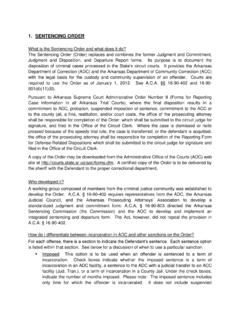
1 1. SENTENCING ORDER What is the SENTENCING ORDER and what does it do? The SENTENCING ORDER ( ORDER ) replaces and combines the former Judgment and Commitment, Judgment and Disposition, and Departure Report forms. Its purpose is to document the disposition of criminal cases processed in the State s circuit courts. It provides the Arkansas Department of Correction (ADC) and the Arkansas Department of Community Correction (ACC) with the legal basis for the custody and community supervision of an offender.
2 Courts are required to use the ORDER as of January 1, 2012. See 16-90-402 and 16-90-801(d)(11)(B). Pursuant to Arkansas Supreme Court Administrative ORDER Number 8 (Forms for Reporting Case Information in all Arkansas Trial Courts), where the final disposition results in a commitment to ADC, probation, suspended imposition of sentence, commitment to the ACC or to the county jail, a fine, restitution, and/or court costs, the office of the prosecuting attorney shall be responsible for completion of the ORDER , which shall be submitted to the circuit judge for signature, and filed in the Office of the Circuit Clerk.
3 Where the case is dismissed or nolle prossed because of the speedy trial rule, the case is transferred, or the defendant is acquitted, the office of the prosecuting attorney shall be responsible for completion of the Reporting Form for Defense-Related Dispositions which shall be submitted to the circuit judge for signature and filed in the Office of the Circuit Clerk. A copy of the ORDER may be downloaded from the Administrative Office of the Courts (AOC) web site at A certified copy of the ORDER is to be delivered by the sheriff with the Defendant to the proper correctional department.
4 Who developed it? A working group composed of members from the criminal justice community was established to develop the ORDER . 16-90-402 requires representatives from the ADC, the Arkansas Judicial Council, and the Arkansas Prosecuting Attorneys Association to develop a standardized judgment and commitment form. 16-90-803 directed the Arkansas SENTENCING Commission (the Commission) and the AOC to develop and implement an integrated SENTENCING and departure form.
5 The Act, however, did not repeal the provision in 16-90-402. How do I differentiate between incarceration in ADC and other sanctions on the ORDER ? For each offense, there is a section to indicate the Defendant s sentence. Each sentence option is listed within that section. See below for a discussion of when to use a particular sanction. Imposed: This option is to be used when an offender is sentenced to a term of incarceration. Check boxes indicate whether the imposed sentence is a term of incarceration in an ADC facility, a sentence to the ADC with a judicial transfer to an ACC facility (Jud.)
6 Tran.), or a term of incarceration in a County Jail. Under the check boxes, indicate the number of months imposed. Please note: The imposed sentence includes only time for which the offender is incarcerated. It does not include suspended imposition of sentence. 5-4-104(e)(1)(B)(ii) prohibits the suspension of the execution of a sentence. Probation: This option is to be used when an offender is placed on probation. Indicate the number of months on probation.
7 If a sentence of probation includes a term of incarceration (Probation/SIS Plus), the ORDER has a section for entering the amount of incarceration time in either days or months. SIS: This option is to be used when the offender is placed on Suspended Imposition of Sentence. If a sentence of SIS includes a term of incarceration (Probation/SIS Plus), the ORDER has a section for entering the amount of incarceration time in either days or months. Other: This option is to be used when an offender receives a sentence of Life, Life Without Parole (LWOP), or Death.
8 If the offender receives a death sentence, enter the execution date pronounced in court in the Sentence Options section. SENTENCING ORDER Elements The following are some helpful tips for completing the SENTENCING ORDER . Instructions for completing the SENTENCING ORDER may be found at: Division: Enter the number that corresponds to the judge who is presiding over the case. Offender: Enter the name, date of birth, gender and race/ethnicity of the defendant.
9 Judge: Enter the name of the judge who signs the ORDER . Legal Statements: The statements in this section reflect the legal statements that appeared on the previous judgment forms. The first box applies when a defendant is sentenced pursuant to Act 346, the First Offender Act ( 16-93-301 et. seq.) or any other statute where the court defers further proceedings without entering a judgment of guilt. The second box applies when a defendant is placed on probation, probation/SIS plus, or other alternative sanction.
10 This statement previously appeared on the Judgment and Disposition Form. The third box applies when a defendant is sentenced to a term of incarceration in the ADC or ACC facility via judicial transfer. This statement previously appeared on the Judgment and Commitment Form. State Identification Number (SID): While the SID is not legally required, it may be obtained from the criminal information sheet or the local law enforcement agency handling the case.