Transcription of 1. Types or Techniques Probability Sampling
1 Types OF Sampling . 1. Types or Techniques Probability Sampling : There are a number of Techniques of taking Probability sample. But here only six important Techniques have been discussed as follows: 1. Simple random Sampling . 2. Systematic Sampling . 3. stratified Sampling . 4. Multiple or Double Sampling . 5. Multi-stage Sampling . 6. Cluster Sampling . 2. Types of Non- Probability Sample: There are the following four Types of non- Probability sample: (1) Incidental or accidental sample. (2) Purposive sample. (3) Quota sample.
2 (4) Judgement sample. Probability Sampling . 1. Simple Random Sampling A simple random sample is one in which each element of the population has an equal and independent chance of being included in the sample a sample selected by randomization method is known as simple-random sample and this technique is simple random- Sampling . Randomization is a method and is done by using a number of Techniques as : (a) Tossing a coin. (b) Throwing a dice. (c) Lottery method. (d) Blind folded method. (e) By using random table of Tippett's Table'.
3 Advantages (a) It requires a minimum knowledge of population. (b) It is free from subjectivity and free from personal error. PHARMAQUEST. (c) It provides appropriate data for our purpose. (d) The observations of the sample can be used for inferential purpose. Disadvantages (a) The representativeness of a sample cannot be ensured by this method. (b) This method does not use the knowledge about the population. (c) The inferential accuracy of the finding depends upon the size of the sample. 2. Systematic Sampling Systematic Sampling is an improvement over the simple random Sampling .
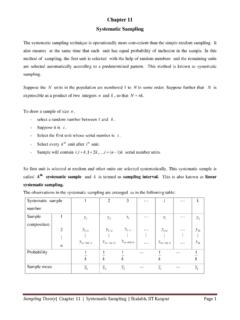
4 This method requires the complete information about the population. There should be a list of information of all the individuals of the population in any systematic way. Now we decide the size of the sample. Let sample size = n And population size = N. Now we select each N/nth individual from the list and thus we have the desired size of sample which is known as systematic sample. Thus for this technique of Sampling population should be arranged in any systematic way. Advantages (a) This is a simple method of selecting a sample.
5 (b) It reduces the field cost. (c) Inferential statistics may be used. (d) Sample may be comprehensive and representative of population. (e) Observations of the sample may be used for drawing conclusions and generalizations. Disadvantages (a) This is not free from error, since there is subjectivity due to different ways of systematic list by different individuals. Knowledge of population is essential. (b) Information of each individual is essential. (c) This method can't ensure the representativeness. (d) There is a risk in drawing conclusions from the observations of the sample.
6 PHARMAQUEST. 3. stratified Sampling It is an improvement over the earlier method. When employing this technique, the researcher divides his population in strata on the basis of some characteristics and from each of these smaller homogeneous groups (strata). draws at random a predetermined number of units. Researcher should choose that characteristic or criterion which seems to be more relevant in his research work. stratified Sampling may be of three Types : 1. Disproportionate stratified Sampling . 2. Proportionate stratified Sampling .
7 3. Optimum allocation stratified Sampling . 1. Disproportionate Sampling means that the size of the sample in each unit is not proportionate to the size of the unit but depends upon considerations involving personal judgement and convenience. This method of Sampling is more effective for comparing strata which have different error possibilities. It is less efficient for determining population characteristics. 2. Proportionate Sampling refers to the selection from each Sampling unit of a sample that is proportionate to the size of the unit.
8 Advantages of this procedure include representativeness with respect to variables used as the basis of classifying categories and increased chances of being able to make comparisons between strata. Lack of information on proportion of the population in each category and faulty classification may be listed as disadvantages of this method. 3. Optimum allocation stratified Sampling is representative as well as comprehensive than other stratified samples. It refers to selecting units from each stratum should be in proportion to the corresponding stratum the population.
9 Thus sample obtained is known as optimum allocation stratified sample. These three Types are clear from the table as given below: PHARMAQUEST. Advantages (a) It is (more precisely third way) a good representative of the population. (b) It is an improvement over the earlier. (c) It is an objective method of Sampling . (d) Observations can be used for inferential purpose. Disadvantages (a) Serious disadvantage of this method is that it is difficult for the researcher to decide the relevant criterion for stratification.
10 (b) Only one criterion can be used for stratification, but it generally seems more than one criterion relevant for stratification. (c) It is costly and time consuming method. (d) Selected sample may be representative with reference to the used criterion but not for the other. (e) There is a risk in generalization. 4. Multiple or Double or Repetitive Sampling Generally this is not a new method but only a new application of the samplings we discussed above. This is most frequently used for establishing the reliability of a sample.