Transcription of 110 RC Requirements for Electrical Installations
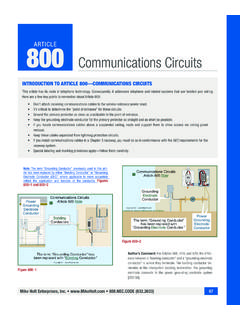
1 ARTICLEMike Holt Enterprises, Inc. ( )9 Requirements for Electrical Installations110 Note: Suitability of equipment use may be identified by a description marked on or provided with a product to identify the suitability of the product for a specific purpose, environment, or application. Special conditions of use or other limitations may be marked on the equip-ment, in the product instructions, or appropriate listing and labeling information. Suitability of equipment may be evidenced by listing or Rule 7 I. GENERAL Approval of Conductors and Equipment. The authority having jurisdiction must approve all Electrical conductors and equipment. Figure 110 1 Author s Comment: For a better understanding of prod-uct approval, review , , and the definitions for Approved, Identified, Labeled, and Listed in Article Rule 8 Examination, Identification, installation , and Use of Equipment.
2 (A) Guidelines for Approval. The authority having jurisdiction must approve equipment. In doing so, consideration must be given to the following:(1) Suitability for installation and use in accordance with the NECINTRODUCTION TO ARTICLE 110 Requirements FOR Electrical INSTALLATIONSA rticle 110 sets the stage for how you ll implement the rest of the NEC. This article contains a few of the most important and yet neglected parts of the Code. For example: How should conductors be terminated? What kinds of warnings, markings, and identification does a given installation require? What s the right working clearance for a given installation ? What do the temperature limitations at terminals mean? What are the NEC Requirements for dealing with flash protection?It s critical that you master Article 110.
3 As you read this article, you re building your foundation for correctly applying the NEC. In fact, this article itself is a foundation for much of the Code. The purpose for the National Electrical Code is to provide a safe installation , but Article 110 is perhaps focused a little more on providing an installation that is safe for the installer and maintenance electrician, so time spent in this article is time well 110 110 Mike Holt s Illustrated Guide to Essential Rules of the National Electrical Code, Based on the 2011 NECRule 9 for Electrical InstallationsEssential Rule 9 Conductor Termination and Splicing. Conduc-tor terminal and splicing devices must be identified for the conductor material and they must be properly installed and used. Figure 110 5 Connectors and terminals for conductors more finely stranded than Class B and Class C, as shown in Table 10 of Chapter 9, must be identified for the conductor class.
4 Figure 110 6(2) Mechanical strength and durability(3) Wire-bending and connection space(4) Electrical insulation(5) Heating effects under all conditions of use(6) Arcing effects(7) Classification by type, size, voltage, current capacity, and specific use(8) Other factors contributing to the practical safeguarding of persons using or in contact with the equipment(B) installation and Use. Equipment must be installed and used in accordance with any instructions included in the listing or labeling Requirements . Figure 110 2 Author s Comments: See the definitions of Labeling and listing in Article 100. Failure to follow product listing instructions, such as the torquing of terminals and the sizing of conductors, is a violation of this Code rule. Figure 110 3 When an air conditioner nameplate specifies Maximum Fuse Size, one-time or dual-element fuses must be used to protect the equipment.
5 Figure 110 4 Figure 110 2 Figure 110 3 Figure 110 4 Mike Holt Enterprises, Inc. ( )11 Author s Comments: According to UL Standard 486 A-B, a terminal/lug/connector must be listed and marked for use with conductors stranded in other than Class B. With no marking or factory literature/instructions to the contrary, terminals may only be used with Class B stranded conductors. Class D stranding has 37 strands of wire per conductor in sizes 18-2 AWG, 61 strands in sizes 1-4/0 AWG, and 91 strands in sizes 250-500 for Electrical InstallationsRule 9 and receptacles marked CO/ALR are designed to ensure a good connection through the use of the larger contact area and compat-ible materials. The terminal screws are plated with the element called Indium.
6 Indium is an extremely soft metal that forms a gas-sealed connection with the aluminum s Comments: See the definition of Identified in Article 100. Conductor terminations must comply with the manufac-turer s instructions as required by (B). For example, if the instructions for the device state Suitable for 18-12 AWG Stranded, then only stranded conductors can be used with the terminating device. If the instructions state Suitable for 18-12 AWG Solid, then only solid conductors are permitted, and if the instructions state Suitable for 18-12 AWG, then either solid or stranded conductors can be used with the ter-minating and Aluminum Mixed. Copper and aluminum conductors must not make contact with each other in a device unless the device is listed and identified for this s Comment: Few terminations are listed for the mixing of aluminum and copper conductors, but if they are, that will be marked on the product package or terminal device.
7 The reason copper and aluminum shouldn t be in contact with each other is because corrosion develops between the two different metals due to galvanic action, resulting in increased contact resistance at the splicing device. This increased resistance can cause the splice to overheat and cause a : Many terminations and equipment are marked with a tighten-ing torque, see Table in Informative Annex s Comment: Conductors must terminate in devices that have been properly tightened in accordance with the man-ufacturer s torque specifications included with equipment instructions. Failure to torque terminals can result in excessive heating of terminals or splicing devices due to a loose connec-tion. A loose connection can also lead to arcing which increases the heating effect and also may lead to a short circuit or ground fault.
8 Any of these can result in a fire or other failure, includ-ing an arc-flash event. In addition, this is a violation of (B), which requires all equipment to be installed in accordance with listing or labeling instructions. Figure 110 7 Figure 110 5 Figure 110 612 Mike Holt s Illustrated Guide to Essential Rules of the National Electrical Code, Based on the 2011 NECRule 9 for Electrical InstallationsTerminals for more than one conductor and terminals used for alumi-num conductors must be identified for this purpose, either within the equipment instructions or on the terminal itself. Figure 110 8 Author s Comments: Split-bolt connectors are commonly listed for only two con-ductors, although some are listed for three conductors. However, it s a common industry practice to terminate as many conductors as possible within a split-bolt connector, even though this violates the NEC.
9 Figure 110 9 Many devices are listed for more than one conductor per ter-minal. For example, some circuit breakers rated 30A or less can have two conductors under each lug. Grounding and bonding terminals are also often listed for more than one con-ductor under the terminal. Each neutral conductor within a panelboard must terminate to an individual terminal [ ].(B) Conductor Splices. Conductors must be spliced by a splicing device identified for the purpose or by exothermic s Comment: Conductors aren t required to be twisted together prior to the installation of a twist-on wire connec-tor, unless specifically required in the installation instructions. Figure 110 10 Question: What do you do if the torque value isn t provided with the device?Answer: Call the manufacturer, visit the manufacturer s Website, or have the supplier make a copy of the installation s Comment: Terminating conductors without a torque tool can result in an improper and unsafe installation .
10 If a torque screwdriver isn t used, there s a good chance the conductors aren t properly terminated.(A) Terminations. Conductor terminals must ensure a good connec-tion without damaging the conductors and must be made by pressure connectors (including set screw type) or splices to flexible s Comment: See the definition of Connector, Pressure in Article : What if the conductor is larger than the terminal device?Answer: This condition needs to be anticipated in advance, and the equipment should be ordered with terminals that will accom-modate the larger conductor. However, if you re in the field, you should: Contact the manufacturer and have them express deliver you the proper terminals, bolts, washers, and nuts, or Order a terminal device that crimps on the end of the larger conductor and reduces the termination 110 8 Figure 110 7 Mike Holt Enterprises, Inc.