Transcription of © OECD, November 2013
1 OECD, November 2013 Foreword his document describes the OECD Economic Outlook database - 94 edition - Volume 2013/2. Section 1 describes the content of the database and gives some information on how data have been compiled and how they can be accessed. Section 2 focuses on the main changes implemented in the last edition of the Economic Outlook database. Summary tables, codes and formulas have been grouped at the end of this document (annexes) to form a useful and practical user s guide. More detailed information - notably on Sources and Methods - can be found online in the OECD Economic Outlook website. The latter should be considered as an important complement to this document: T TABLE OF CONTENTS Foreword.
2 3 Table of contents .. 4 1. Description of the database .. 6 The Economic Outlook publication .. 6 The Economic Outlook database .. 6 Countries and country groupings .. 6 Variables .. 6 Series codes used in the Economic Outlook statistical annex .. 6 Frequency and seasonal adjustment .. 7 Scale, currency and baseyear .. 7 Data processing .. 7 Sources and methods .. 8 New revised sources and methods .. 8 General assessment of the macroeconomic situation .. 8 Frequently asked questions .. 8 Main sources .. 9 Identities .. 10 Where to find the data? What are the different electronic formats? .. 11 (full version) .. 11 Free subset of .. 11 Flash file .. 11 Excel files .. 12 Recommended uses .. 12 2.
3 Main changes to the database ( November 2012) .. 13 Date of last update .. 13 Changes in methodology .. 13 National Accounts .. 13 Quarterly National Accounts .. 13 Revised OECD supply-side estimates .. 13 Main changes by country .. 14 New reference years .. 16 ANNEXES annex 1: Codes .. 17 Table A1-1: Country codes .. 18 Table A1-2: Variable codes .. 20 Table A1-3: Codes of variables presented in the Economic Outlook statistical annex .. 26 annex 2: The 10 economic blocks which form the EO database .. 29 Table A2-1: External sectors, trade and payments .. 30 Table A2-2: Government accounts .. 32 Table A2-3: Expenditure and GDP .. 34 Table A2-4: Supply block .. 35 Table A2-5: Household sector accounts .. 36 Table A2-6: Prices and deflators.
4 37 Table A2-7: Selected variables .. 37 Table A2-8: Labour markets .. 38 Table A2-9: Monetary data .. 38 Table A2-10: Oil and commodities .. 38 annex 3: Country specifics .. 39 Table A3-1: Reference years .. 40 Table A3-2: Coverage and reporting system .. 41 Table A3-3: National currencies .. 42 Table A3-4: Euro irrevocable exchange rates .. 43 annex 4: Identities .. 45 annex 5: Miscellaneous indicators .. 65 Key international aggregates formula .. 66 1. Competitiveness indicators (XDR) .. 66 2. Export market for goods and services, volume, US$, 2005 prices (XMKT) .. 67 3. Price of non-commodity exports (imports) of goods and services (PXGSX (PMGSX)) .. 67 4. Shadow price of non-commodities goods and services imports (PMSHX) .. 68 5. Competitor s price of non-commodity goods and services exports (PXCX).
5 68 6. Competitor s prices of goods and services exports (PXC) .. 68 7. Consistency adjustment series for non-factor services exports, volume .. 68 8. World prices, Goods and services, USD .. 68 9. RAS adjustment series imports prices .. 69 10. Nominal effective exchange rate, constant trade weights .. 69 11. Goods and services trade volume, USD, 2005 prices (TGSVD) .. 69 12. Share of country s trade in the world trade (SHTGSVD) .. 69 13. Contribution to world trade volume (CTGSVD) .. 69 14. Shares in world exports (XSHA) and imports (MSHA) .. 69 Table A5-1: Cyclical adjustment of fiscal balances - Values of tax and outlays elasticities .. 71 annex 6: Country groupings and aggregates .. 71 annex 7: Archived changes in previous issues .. 72 Links and Contacts .. 77 1. DESCRIPTION OF THE ECONOMIC OUTLOOK DATABASE The Economic Outlook publication The OECD Economic Outlook (EO) publication presents the OECD s twice-yearly analysis of the major economic trends and prospects for the next two years.
6 Prepared by the OECD Economics Department, the Outlook puts forward a consistent set of projections for all OECD member countries as well as for selected non-member countries. Most data presented in the OECD Economic Outlook publication (and more specifically in the statistical annex ) are available in the EO database. The Economic Outlook database Countries and country groupings The Economic Outlook (EO) database includes a comprehensive and consistent set of macroeconomic data for the 34 OECD countries and 6 non-OECD countries (Brazil, China, India, Indonesia, Russia and South Africa). Data are also available for two major country groupings: total OECD which includes the 34 countries and the OECD euro area ( 15 countries that are both member of the OECD and the euro area: Austria, Belgium, Estonia, Finland, France, Germany, Greece, Ireland, Italy, Luxembourg, Netherlands, Portugal, Slovak Republic, Slovenia, Spain).
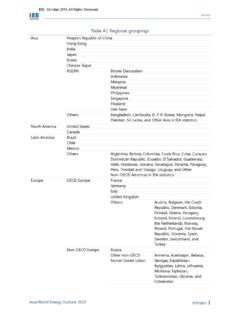
7 Some data related to non-OECD trade regions are also available in the database. annex 1 - Table A1-1: Country codes annex 6 - Country groupings and aggregates Variables For the OECD countries, the Economic Outlook database includes data on expenditure, foreign trade, output, employment and unemployment, interest and exchange rates, balance of payments, outlays and revenues of government and of households, government debt and supply and fiscal indicators. For the non-OECD countries and non-OECD trade regions, only a subset of key national accounts variables, foreign trade indicators and current account series are available. annex 1 - Table : Variable codes annex 2 The 10 economic blocks which form the EO database Series codes used in the Economic Outlook statistical annex annex 1 - Table A1-3: Codes of variables presented in the Economic Outlook statistical annex Frequency and seasonal adjustment The EO database contains yearly and quarterly data (when relevant) over the historical and projection periods, for OECD countries and OECD country groupings.
8 Quarterly levels are expressed at annual rates. Preference is given to seasonal adjustments performed by countries. However when data are not available, seasonal adjustments are performed by the OECD. OECD Quarterly projections are on a seasonally adjusted and working-day-corrected basis for selected key variables. Annual figures are obtained by averaging the quarters, thereby implying that differences between adjusted and unadjusted annual data may occur, though these in general are quite small. In some countries, official forecasts of annual figures do not include working-day correction. Even when official forecasts do adjust for working days, the size of the adjustment may in some cases differ from that used by the OECD. Scale, currency and base year Volume and current prices data are expressed in units (not in thousands, millions or billions).
9 These data are expressed at local currency or USD, except for country aggregates as explained in annex 6. Some of these aggregates are in index form with 2005=1. For most countries, data at constant prices are chained volume data. For most variables at constant prices, base years (or, more precisely, reference years) are specific to each country. Labour force data are expressed as number of persons. Prices and indices are based on 100. Like volume data, they vary as to base year depending on national conventions Prices and indices related to the external sector (BOP and Trade) are based on 2005=100 annex 3 - Table A3-1: Reference years annex 3 - Table A3-3: National currencies Data processing Variables are defined in such a way that they are as homogenous as possible over the countries.
10 Breaks in underlying series are corrected as far as possible. The following treatments applied to national data, when necessary, are: Back-splicing of data: For several countries, some historical data have been estimated by the OECD Economics Department; if countries revise their methodologies but only supply revised data for recent years, the historical data are estimated by mechanically linking the new and old series. Prior to the first year for which actual historical data are available, data have been spliced backward using the growth rates issued from the previous national accounts. Calculation of chained volume measures: a common computation of chained volume measures, which may differ from national methodologies, has been introduced over the forecast period for most of the countries and the level of a particular volume aggregate is thus no longer the simple summation of the level of its components.