Transcription of 2.2.9. CAPILLARY VISCOMETER METHOD
1 EUROPEAN PHARMACOPOEIA CAPILLARY VISCOMETER methodto a layer of 1 dm containing 1 g/ml of the specific optical rotation of a substance in solutionis always expressed with reference to a given solvent the conventional system adopted by the Pharmacopoeiathe specific optical rotation is expressed by its valuewithout units; the actual units, degree millilitres perdecimetre gram [( ) ml dm 1 g 1] conversion factor from the International System to thePharmacopoeia system is the following:In certain cases specified in the monograph the angle ofrotation may be measured at temperatures other than 20 Cand at other polarimeter must be capable of giving readings to thenearest.
2 The scale is usually checked by means ofcertified quartz plates. The linearity of the scale may bechecked by means of sucrose Determine the zero of the polarimeter and theangle of rotation of polarised light at the wavelength oftheD-lineofsodium( = nm) at 20 C, unlessotherwise prescribed. Measurements may be carried out atother temperatures only where the monograph indicates thetemperaturecorrectiontobemadetothemea suredopticalrotation. Determine the zero of the apparatus with the tubeclosed; for liquids the zero is determined with the tubeempty and for solids filled with the prescribed the specific optical rotation using the neat liquids:For substances in solution:wherecis the concentration of the solution in grams the contentcin grams per litre or the contentc in per centm/mofadissolvedsubstanceusingthefoll owingformulae: =angleofrotationindegreesreadat20 C;l=length in decimetres of the polarimeter tube; 20=density at 20 C in grams per cubic the purposes of the Pharmacopoeia, densityis replaced by relative density ( ).
3 01/2008 VISCOSITYT hedynamicviscosity orviscosity coefficient is thetangential force per unit surface, known asshearing stress and expressed in pascals, necessary to move, parallel tothe sliding plane, a layer of liquid of 1 square metre at arate (v) of 1 metre per second relative to a parallel layer at adistance (x) ratio dv/dxis a speed gradient giving therate of shear Dexpressed in reciprocal seconds (s 1), so that = unit of dynamic viscosity is the pascal second (Pa s). Themost commonly used submultiple is the millipascal second(mPa s).Thekinematic viscosity v, expressed in square metres persecond, is obtained by dividing the dynamic viscosity bythe density expressed in kilograms per cubic metre, of theliquid measured at the same temperature, /.
4 Thekinematic viscosity is usually expressed in square millimetresper CAPILLARY VISCOMETER may be used for determining theviscosity of Newtonian liquids and a rotating VISCOMETER fordetermining the viscosity of Newtonian and non-Newtonianliquids. Other viscometers may be used provided that theaccuracy and precision is not less than that obtained withthe viscometers described CAPILLARY VISCOMETERMETHODT hedeterminationofviscosityusingasuitable capillaryviscometer is carried out at a temperature of 20 C, the liquid to drop from one mark to the other is measuredwith a stop-watch to the nearest one-fifth of a second. Theresult is valid only if two consecutive readings do not differby more than 1 per cent.
5 The average of not fewer than threereadings gives the flow time of the liquid to be the dynamic viscosity ( )inmillipascalseconds using the formula:k=constant of the VISCOMETER , expressed in squaremillimetres per second squared, =density of the liquid to be examined expressedin milligrams per cubic millimetre, obtained bymultiplying its relative density () by ,t=flow time, in seconds, of the liquid to be constantkis determined using a suitable viscometercalibration calculate the kinematic viscosity (mm2 s 1), use thefollowing formula:v=kt.(1) The European Pharmacopoeia describes the system proposed by the International Organisation for Standardisation (ISO).
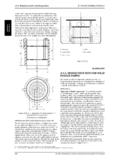
6 GeneralNotices(1) Viscosity - Rotating VISCOMETER methodEUROPEAN PHARMACOPOEIA determination may be carried out with an apparatus(Figure ) having the specifications described inTable (1):Table visco-meterKinematicviscosityrangeIntern aldiameterof tubeRVolumeofbulbCInternaldiameterof tubeNmm2 s 2mm2 s 1mmmlmm( 2%) ( 5%) to to to to to to to to to to to to10 to to30 to 000 to100 to 1. Suspended level viscometerDimensions in millimetresThe minimum flow time should be 350 s for size no. 1 Fill the VISCOMETER through tube (L)withasufficient quantity of the liquid to be examined, previouslybrought to 20 C unless otherwise prescribed, to fill bulb (A)but ensuring that the level of liquid in bulb (B)isbelowtheexit to ventilation tube (M).
7 Immerse the VISCOMETER in thebathofwaterat20 C,unlessotherwiseprescribed,maintain it in the upright position and allow to stand fornot less than 30 min to allow the temperature to reachequilibrium. Close tube (M) and raise the level of the liquidin tube (N) up to a level about 8 mm above mark (E). Keepthe liquid at this level by closing tube (N)andopeningtube (M). Open tube (N)andmeasure,withastop-watchtothe nearest one-fifth of a second, the time required for thelevel of the liquid to drop from mark (E)to(F).01/2008 VISCOSITY - ROTATINGVISCOMETER METHODT heprincipleofthemethodistomeasuretheforc eactingona rotor (torque) when it rotates at a constant angular velocity(rotational speed) in a liquid.
8 Rotating viscometers are usedfor measuring the viscosity of Newtonian (shear-independentviscosity) or non-Newtonian liquids (shear dependentviscosity or apparent viscosity). Rotating viscometerscan be divided in 2 groups, namely absolute and relativeviscometers. In absolute viscometers the flow in themeasuring geometry is well defined. The measurementsresult in absolute viscosity values, which can be comparedwith any other absolute values. In relative viscometersthe flow in the measuring geometry is not defined. Themeasurements result in relative viscosity values, whichcannot be compared with absolute values or other relativevalues if not determined by the same relative measuring systems are available for given viscosityranges as well as several rotational following types of instruments are most CYLINDER VISCOMETERS (ABSOLUTEVISCOMETERS)In the concentric cylinder VISCOMETER (coaxial doublecylinder VISCOMETER or simply coaxial cylinder VISCOMETER ),the viscosity is determined by placing the liquid in thegap between the inner cylinder and the outer measurement can be performed by rotating theinnercylinder(Searletypeviscometer)
9 Ortheoutercylinder(Couette type VISCOMETER ), as shown in Figures , respectively. For laminar flow, the viscosity (orapparent viscosity) expressed in pascal-seconds is given bythe following formula:M=torque in newton-metres acting on the cylindersurface, =angular velocity in radians per second,h=height of immersion in metres of the innercylinder in the liquid medium,Ri=radius in metres of the inner cylinder,Ro=radius in metres of the outer cylinder,k=constant of the apparatus, expressed in radiansper cubic the information section on general monographs (cover pages)