Transcription of 2-PROPANOL- MATERIAL SAFETY DATA SHEET
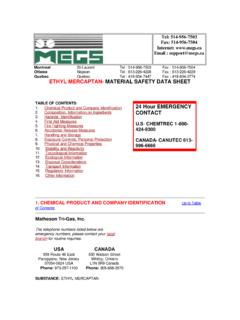
1 Tel: 514-956-7503 Fax: 514-956-7504 Internet: E-mail: Montreal St-Laurent Tel : 514-956-7503 Fax : 514-956-7504 Ottawa Nepean Tel : 613-226-4228 Fax : 613-226-4229 Quebec Quebec Tel : 418-834-7447 Fax : 418-834-3774 2- propanol - MATERIAL SAFETY data SHEET TABLE OF CONTENTS: 1. Chemical Product and Company Identification 2. Composition, Information on Ingredients 3. Hazards Identification 4. First Aid Measures 5. Fire Fighting Measures 6. Accidental Release Measures 7. Handling and Storage 8. Exposure Controls, Personal Protection 9. Physical and Chemical Properties 10.
2 Stability and Reactivity 11. Toxicological Information 12. Ecological Information 13. Disposal Considerations 14. Transport Information 15. Regulatory Information 16. Other Information 24 Hour EMERGENCY CONTACT CHEMTREC 1-800-424-9300 CANADA- CANUTEC 613-996-6666 1. CHEMICAL PRODUCT AND COMPANY IDENTIFICATION-----------Up to Table of Contents Matheson Tri-Gas, Inc. The telephone numbers listed below are emergency numbers, please contact your local branch for routine inquiries. USA 959 Route 46 East Parsippany, New Jersey 07054-0624 USA Phone: 973-257-1100 CANADA 530 Watson Street Whitby, Ontario L1N 5R9 Canada Phone: 905-668-3570 SUBSTANCE: 2- propanol SYMBOL: C3H8O TRADE NAMES/SYNONYMS: ISOPROPANOL; ETHYL CARBINOL; DIMETHYLCARBINOL; 2- propanol ; ISOHOL; SEC-PROPYL ALCOHOL; PROPYL ALCOHOL; STCC 4909205; UN 1219; C3H8O; MAT12090; RTECS NT8050000 CHEMICAL FAMILY: alcohols , aliphatic CREATION DATE: Jan 24 1989 REVISION DATE: Mar 16 1999 2.
3 COMPOSITION, INFORMATION ON INGREDIENTS-----------Up to Table of Contents COMPONENT: isopropyl ALCOHOL CAS NUMBER: 67-63-0 EC NUMBER (EINECS): 200-661-7 EC INDEX NUMBER: 603-003-00-0 PERCENTAGE: 3. HAZARDS IDENTIFICATION-----------Up to Table of Contents NFPA RATINGS (SCALE 0-4): HEALTH=2 FIRE=3 REACTIVITY=0 WHMIS CLASSIFICATION: B EC CLASSIFICATION (ASSIGNED): F Highly Flammable R 11 EC Classification may be inconsistent with independently-researched data . EMERGENCY OVERVIEW: Color: colorless Physical Form: liquid Odor: alcohol odor Major Health Hazards: respiratory tract irritation, eye irritation, central nervous system depression Physical Hazards: Flammable liquid and vapor.
4 Vapor may cause flash fire. POTENTIAL HEALTH EFFECTS: INHALATION: Short Term Exposure: same as effects reported in other routes of exposure, irritation, symptoms of drunkenness Long Term Exposure: no information on significant adverse effects SKIN CONTACT: Short Term Exposure: same as effects reported in short term ingestion, mild irritation, symptoms of drunkenness Long Term Exposure: no information on significant adverse effects EYE CONTACT: Short Term Exposure: irritation, eye damage Long Term Exposure: same as effects reported in short term exposure INGESTION.
5 Short Term Exposure: nausea, stomach pain, irregular heartbeat, headache, symptoms of drunkenness, lung congestion, kidney damage, coma Long Term Exposure: no information on significant adverse effects CARCINOGEN STATUS: OSHA: N NTP: N IARC: N 4. FIRST AID MEASURES-----------Up to Table of Contents INHALATION: Remove from exposure immediately. Use a bag valve mask or similar device to perform artificial respiration (rescue breathing) if needed. Get medical attention. SKIN CONTACT: Remove contaminated clothing, jewelry, and shoes immediately. Wash with soap or mild detergent and large amounts of water until no evidence of chemical remains (at least 15-20 minutes).
6 Get medical attention, if needed. EYE CONTACT: Wash eyes immediately with large amounts of water or normal saline, occasionally lifting upper and lower lids, until no evidence of chemical remains. Get medical attention immediately. INGESTION: Contact local poison control center or physician immediately. Never make an unconscious person vomit or drink fluids. When vomiting occurs, keep head lower than hips to help prevent aspiration. If person is unconscious, turn head to side. Get medical attention immediately. NOTE TO PHYSICIAN: For ingestion, consider gastric lavage and activated charcoal slurry.
7 Consider oxygen. 5. FIRE FIGHTING MEASURES-----------Up to Table of Contents FIRE AND EXPLOSION HAZARDS: Severe fire hazard. The vapor is heavier than air. Vapors or gases may ignite at distant ignition sources and flash back. Vapor/air mixtures are explosive. EXTINGUISHING MEDIA: alcohol resistant foam, carbon dioxide, regular dry chemical, water, alcohol resistant foam Large fires: Use alcohol-resistant foam or flood with fine water spray. FIRE FIGHTING: Move container from fire area if it can be done without risk. Cool containers with water spray until well after the fire is out.
8 Stay away from the ends of tanks. For fires in cargo or storage area: Cool containers with water from unmanned hose holder or monitor nozzles until well after fire is out. If this is impossible then take the following precautions: Keep unnecessary people away, isolate hazard area and deny entry. Let the fire burn. Withdraw immediately in case of rising sound from venting SAFETY device or any discoloration of tanks due to fire. For tank, rail car or tank truck: Evacuation radius: 800 meters (1/2 mile). Do not attempt to extinguish fire unless flow of MATERIAL can be stopped first.
9 Flood with fine water spray. Do not scatter spilled MATERIAL with high-pressure water streams. Cool containers with water spray until well after the fire is out. Apply water from a protected location or from a safe distance. Avoid inhalation of MATERIAL or combustion by-products. Stay upwind and keep out of low areas. Water may be ineffective. FLASH POINT: 54 F (12 C) (CC) LOWER FLAMMABLE LIMIT: UPPER FLAMMABLE LIMIT: @ C AUTOIGNITION: 750 F (399 C) FLAMMABILITY CLASS (OSHA): IB 6. ACCIDENTAL RELEASE MEASURES-----------Up to Table of Contents OCCUPATIONAL RELEASE: Avoid heat, flames, sparks and other sources of ignition.
10 Remove sources of ignition. Stop leak if possible without personal risk. Reduce vapors with water spray. Small spills: Absorb with sand or other non-combustible MATERIAL . Collect spilled MATERIAL in appropriate container for disposal. Large spills: Dike for later disposal. Keep unnecessary people away, isolate hazard area and deny entry. Stay upwind and keep out of low areas. 7. HANDLING AND STORAGE-----------Up to Table of Contents Store and handle in accordance with all current regulations and standards. Subject to storage regulations: OSHA 29 CFR Grounding and bonding required.