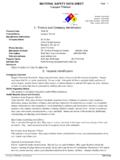
Transcription of MATERIAL SAFETY DATA SHEET 1 LACQUER THINNER
1 1 Page: LACQUER THINNERMATERIAL SAFETY data SHEET230 SpecialHealthFlammabilityInstability05/2 4/200503/15/200606/16/2005 Date Created:Revision:Supercedes Revision:10/14/2009 Printed:FLAMMABILITYHEALTHPPEGPHYSICAL Product and Company IdentificationProduct Name: LACQUER THINNERR eference # Information Company Name:W. M. Barr2105 Channel AvenueMemphis, TN 38113 Phone Number:(901)775-0100 Emergency Contact:3E 24 Hour Emergency Contact (800)451-8346 Barr Customer Service (800)398-3892 Web site Composition/Information on Ingredients200 ppm200 ppmNo Components (Chemical Name)Methanol {Methyl alcohol; Carbinol; Woodalcohol}67-56-1 CAS # %ConcentrationOSHA TWAACGIH TWAO ther Limits ppm200 ppmNo {Benzene, Methyl-; Toluol}108-88-3 % ppm1000 ppmNo % glycol methyl ether acetate (PMAgylcol ether acetate)108-65-6 % ppm200 ppmNo ethyl ketone {MEK; 2-Butanone}78-93-3 % ppm400 ppmNo alcohol {sec-Propyl alcohol; IPA;2-Propanol}67-63-0 % ppmNo Components (Chemical Name)Methanol {Methyl alcohol; Carbinol.}
2 Woodalcohol}67-56-1 CAS #No STELOSHA CEILACGIH STELACGIH CEIL ppmNo {Benzene, Methyl-; Toluol}108-88-3 500 ppm/(10min) ppmNo No data . glycol methyl ether acetate (PMAgylcol ether acetate)108-65-6 No data . ppmNo ethyl ketone {MEK; 2-Butanone}78-93-3 No data . ppmNo alcohol {sec-Propyl alcohol; IPA;2-Propanol}67-63-0 No data . Hazards IdentificationDanger! Extremely flammable. Keep away from heat, sparks, flame and all other sources of ignition. Vaporsmay cause flash fire or ignite explosively. Do not smoke. Extinguish all flames and pilot lights, and turn offstoves, heaters, electric motors and all other sources of ignition during use and until all vapors are gone. Bewareof static electricity that may be generated by synthetic clothing and other OverviewThis MATERIAL is classified as hazardous under OSHA Regulatory Status:Inhalation Acute Exposure Effects:Vapor harmful.
3 May cause dizziness; headache; watering of eyes; irritation of respiratory tract; weakness;drowsiness; nausea; numbness in fingers, arms and legs; depression of central nervous system; loss of appetite;fatigue; hallucinations; light headedness; visual disturbances; giddiness and intoxication; sleepiness; cough andPotential Health Effects (Acute and Chronic)Licensed to Barr and CompanyANSI Format03/15/2006 Revision:10/14/2009 Printed: 2 Page: LACQUER THINNERMATERIAL SAFETY data SHEET06/16/2005 Supercedes Revision:dyspnea; cold, clammy extremities; diarrhea; vomiting; dilation of pupils; spotted vision. Severe overexposuremay cause convulsions; unconsciousness; coma; and death. Intentional misuse of this product by deliberatelyconcentrating and inhaling can be harmful or Contact Acute Exposure Effects:May be absorbed through the skin. May cause irritation; numbness in the fingers and arms; drying of skin; anddermatitis.
4 May cause increased severity of symptoms listed under Contact Acute Exposure Effects:This MATERIAL is an eye irritant. May cause irritation; burns; conjunctivitis of eyes; and corneal ulcerations of theeye. Vapors may irritate Acute Exposure Effects:Poison. Cannot be made non-poisonous. May be fatal or cause blindness. May cause dizziness; headache;nausea; vomiting; burning sensation in mouth, throat, and stomach; loss of coordination; depression of the centralnervous system; narcosis; stupor; gastrointestinal irritation; liver, kidney, and heart damage; diarrhea; loss ofappetite; coma and death. May produce symptoms listed under Exposure Effects:Reports have associated repeated and prolonged overexposure to solvents with neurological and otherphysiological damage. Prolonged or repeated contact may cause dermatitis. Prolonged skin contact may result inabsorption of a harmful amount of this MATERIAL .
5 May cause conjunctivitis; gastric disturbances; insomnia;dizziness; headache; weakness; fatigue; nausea; heart palpitations; skin irritation; numbness in hands and feet;permanent central nervous system changes; some loss of memory; pancreatic damage; giddness; visualimpairment or blindness; kidney or liver damage; and death. May cause symptoms listed under inhalation. Primary Routes of Exposure:Inhalation, ingestion and and Symptoms Of ExposureDiseases of the skin, eyes, liver, kidneys, central nervous system and respiratory Conditions Generally Aggravated By Exposure4. First Aid MeasuresInhalation:If user experiences breathing difficulty, move to air free of vapors, Administer oxygen or artificial medicalassistance can be Contact:Wash with soap and large quantities of water and seek medical attention if irritation from contact Contact:Flush with large quantities of water for at least 15 minutes and seek immediate medical :Call your local poison control center, hospital emergency room or physician immediately for instructions toinduce and First Aid ProceduresPoison.
6 This product contains methanol. Methanol is metabolized to formaldehyde and formic acid. Thesemetabolites may cause metabolic acidosis, visual disturbances and blindness. Since metabolism is required forthese toxic symptoms, their onset may be delayed from 6 to 30 hours following ingestion. Ethanol competes forthe same metabolic pathway and has been used as an antidote. Methanol is effectively removed by to PhysicianLicensed to Barr and CompanyANSI Format03/15/2006 Revision:10/14/2009 Printed: 3 Page: LACQUER THINNERMATERIAL SAFETY data SHEET06/16/2005 Supercedes Revision:Call your local poison control center for further Fire Fighting MeasuresFlammability Classification:Class IBFlash F Method Used: TAG Open CupExplosive Limits:LEL: UEL: No respiratory protection should be provided for fire fighters fighting fires in buildings or confinedareas.
7 Storage containers exposed to fire should be kept cool with water spray to prevent pressure build-up. Stayaway from heads of containers that have been exposed to intense heat or Fighting InstructionsNo data Properties and HazardsUse carbon dioxide, dry powder, or MediaNo data Extinguishing Media6. Accidental Release MeasuresClean up:Keep unnecessary people away; isolate hazard area and deny entry. Stay upwind, out of low areas, and ventilateclosed spaces before entering. Shut off ignition sources; keep flares, smoking or flames out of hazard spills:Take up with sand, earth or other noncombustible absorbent MATERIAL and place in a plastic container spills:Dike far ahead of spill for later Disposal:Dispose in accordance with applicable local, state and federal To Be Taken In Case MATERIAL Is Released Or Spilled7. Handling and StorageRead carefully all cautions and directions on product label before use.
8 Since empty container retains residue,follow all label warnings even after container is empty. Dispose of empty container according to all not reuse this To Be Taken in HandlingKeep container tightly closed when not in use. Store in a cool, dry place. Do not store near flames or at To Be Taken in Storing8. Exposure Controls/Personal ProtectionFor OSHA controlled work place and other regular users. Use only with adequate ventilation under engineeredair control systems designed to prevent exceeding appropriate TLV. For occasional use, where engineered aircontrol is not feasible, use properly maintained and properly fitted NIOSH approved respirator for organic solventvapors. A dust mask does not provide protection against Equipment (Specify Type)Licensed to Barr and CompanyANSI Format03/15/2006 Revision:10/14/2009 Printed: 4 Page: LACQUER THINNERMATERIAL SAFETY data SHEET06/16/2005 Supercedes Revision: SAFETY glasses, goggles or face shields are recommended to safeguard against potential eye contact, irritation, orinjury.
9 Contact lenses should not be worn while working with ProtectionWear impermeable gloves. Gloves contaminated with product should be discarded. Promptly remove clothingthat becomes soiled with GlovesVarious application methods can dictate use of additional protective SAFETY equipment, such as impermeableaprons, etc., to minimize exposure. A source of clean water should be available in the work area for flushing eyesand skin. Do not eat, drink, or smoke in the work area. Wash hands thoroughly after use. Before reuse,thoroughly clean any clothing or protective equipment that has been contaminated by prior use. Discard anyclothing or other protective equipment that cannot be decontaminated, such as gloves or Protective ClothingUse only with adequate ventilation to prevent build-up of vapors. Open all windows and doors. Use only with across ventilation of moving fresh air across the work area.
10 If strong odor is noticed or you experience slightdizziness, headache, nausea, or eye-watering - Stop - ventilation is inadequate. Leave area Controls (Ventilation etc.)9. Physical and Chemical PropertiesPhysical States:[ ] Gas [ X ] Liquid [ ] SolidMelting Point:No Point:> FAutoignition Pt:No F Method Used: TAG Open CupExplosive Limits:LEL: UEL: No Gravity (Water = 1):No LB/GAVapor Pressure (vs. Air or mm Hg):No Density (vs. Air = 1):No Rate (vs ButylAcetate=1):No in Water:No % by / G/LHeat Value:No Size:No Rate:No :No data and Odor10. Stability and ReactivityStability:Unstable [ ] Stable [ X ]No data To Avoid - InstabilityIncompatible with strong oxidizing agents, reducing agents, acids, bases, amines, aldehydes, ammonia, halogens,nitric acid, and hydrogen - Materials To AvoidDecomposition may produce carbon monoxide; carbon dioxide; formaldehyde; and unidentified organiccompounds in black Decomposition Or ByproductsLicensed to Barr and CompanyANSI Format03/15/2006 Revision:10/14/2009 Printed: 5 Page: LACQUER THINNERMATERIAL SAFETY data SHEET06/16/2005 Supercedes Revision:Hazardous Polymerization:Will occur [ ] Will not occur [ X ]No data To Avoid - Hazardous Polymerization11.