Example: tourism industry
2007 NIPS Tutorial on: Deep Belief Nets
<>1 vihj i j i j t = 0 t = 1 "=(<>0!<>1) wij#vihj vihj Start with a training vector on the visible units. Update all the hidden units in parallel Update the all the visible units in parallel to get a “reconstruction”. Update the hidden units again. This is not following the gradient of the log likelihood. But it works well.
Tags:
Information
Domain:
Source:
Link to this page:
Documents from same domain

Fundamentals of Requirements Engineering …
www.cs.toronto.eduFundamentals of Requirements Engineering ... The two engineering disciplines most relevant to this book are software engineering and systems engineering.

Lecture 2 Software Re-engineering - University of …
www.cs.toronto.eduSpring 2005 ECE450H1S Software Engineering II Today … 1. Review SE process 2. Discuss Reengineering Concepts 3. Go over some case studies, a road map to our

Introduction to Operations Research
www.cs.toronto.eduIntroduction to Operations Research Deterministic Models JURAJ STACHO Department of Industrial Engineering and Operations Research

What Is Sound? - University of Toronto
www.cs.toronto.eduWhat Is Sound? Sound is a pressure wave which is created by a vibrating object. This vibrations set particles in the sur-rounding medium (typical air) in

University of Toronto Lecture 7: Why a feasibility …
www.cs.toronto.edu2 University of Toronto Department of Computer Science ©2004-5SteveEasterbrook.Thispresentationisavailablefreefor non-commercialusewithatribution underacreativecommonslicense. 5

Proposed Design of an Inventory ... - University of …
www.cs.toronto.eduProposed Design of an Inventory Database System at Process Research ORTECH System Design Prepared by Andrew Ramadeen Manojav Sridhar Kunendran Deivendran
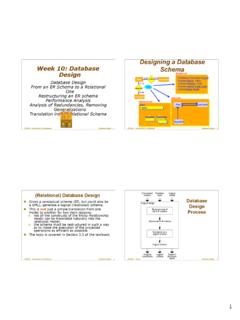
Designing a Database Week 10: Database Schema …
www.cs.toronto.eduOperational DB (OLTP - On-Line Transaction Processing) CSC343 – Introduction to Databases Database Design — 8 ... [CASE = Computer-Aided Software Engineering] CSC343 – Introduction to Databases Database Design — 46 Logical Design witha CASE Tool. Title: 10_DBDesignStG.ppt Author:
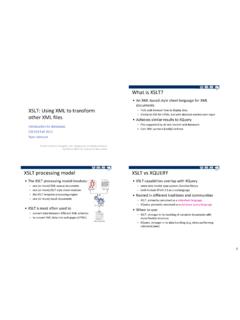
XSLT: Using XML - University of Toronto
www.cs.toronto.edu1 XSLT: Using XML to transform other XML files Introduction to databases CSC343 Fall 2011 Ryan Johnson Thanks to Manos Papagelis, John Mylopoulos, Arnold Rosenbloom

XSL - University of Toronto
www.cs.toronto.edu– XSLT is a language for transforming XML documents into other XML documents – XSLT is designed to be used independently of XSL. • However, XSLT is not intended as a completely general-purpose XML transformation language. • Rather it is designed primarily for the kinds of transformations

CSC340S - Information Systems Analysis and Design
www.cs.toronto.educsc340 Information Systems Analysis and Design page 3/18 b. Using Prototyping tools c. Purchasing a software application package
Related documents

Translating Embeddings for Modeling Multi ... - NIPS
papers.nips.ccfunction (1) favors lower values of the energy fortraining tripletsthan for corrupted triplets, and is thus a natural implementation of the intended criterion. Note that for a given entity, its embedding vector is the same when the entity appears as the head or as the tail of a triplet.

Supervised Contrastive Learning - NIPS
papers.nips.cc34th Conference on Neural Information Processing Systems (NeurIPS 2020), Vancouver, Canada. Figure 2: Supervised vs. self-supervised contrastive losses: The self-supervised contrastive loss (left, Eq.1) contrasts a single positive for each anchor (i.e., an augmented version of the same image) against a set of

Sentence-BERT: Sentence Embeddings using Siamese BERT …
arxiv.orgn(n 1)=2 = 49995000inference computations. On a modern V100 GPU, this requires about 65 hours. Similar, finding which of the over 40 mil-lion existent questions of Quora is the most similar for a new question could be modeled as a pair-wise comparison with BERT, however, answering a sin-gle query would require over 50 hours.

Random Features for Large-Scale Kernel Machines
people.eecs.berkeley.edu1 Q d 1 π(1+ω2 d) Cauchy Q d 2 1+∆2 d e−k∆k 1 Figure 1: Random Fourier Features. Each component of the feature map z( x) projects onto a random direction ω drawn from the Fourier transform p(ω) of k(∆), and wraps this line onto the unit circle in R2.

A Simple Unified Framework for Detecting Out-of ...
proceedings.neurips.cc1.0 FPR on out-of-distribution (TinyImageNet) 0 0.5 1.0 0.85 0.90 0.95 1.00 0 0.2 0.4 (c) ROC curve Figure 1: Experimental results under the ResNet with 34 layers. (a) Visualization of final features from ResNet trained on CIFAR-10 by t-SNE, where the colors of points indicate the classes of the corresponding objects.

Kernel Descriptors for Visual Recognition
rse-lab.cs.washington.eduThe hard binning underlying Eq. 1 is only for ease of presentation. To get a kernel view of soft binning [13], we only need to replace the delta function in Eq. 1 by the following, soft –(¢) function: –i(z) = max(cos(µ(z)¡ai)9;0) (4) where a(i) is the center of the i¡th bin. In addition, one can easily include soft spatial binning by