Example: barber
2007 NIPS Tutorial on: Deep Belief Nets
stochastic variables. •We get to observe some of the variables and we would like to solve two problems: •The inference problem: Infer the states of the unobserved variables. •The learning problem: Adjust the interactions between variables to make the network more likely to generate the observed data. stochastic hidden cause visible effect
Tags:
Information
Domain:
Source:
Link to this page:
Documents from same domain

Fundamentals of Requirements Engineering …
www.cs.toronto.eduFundamentals of Requirements Engineering ... The two engineering disciplines most relevant to this book are software engineering and systems engineering.

Lecture 2 Software Re-engineering - University of …
www.cs.toronto.eduSpring 2005 ECE450H1S Software Engineering II Today … 1. Review SE process 2. Discuss Reengineering Concepts 3. Go over some case studies, a road map to our

Introduction to Operations Research
www.cs.toronto.eduIntroduction to Operations Research Deterministic Models JURAJ STACHO Department of Industrial Engineering and Operations Research

What Is Sound? - University of Toronto
www.cs.toronto.eduWhat Is Sound? Sound is a pressure wave which is created by a vibrating object. This vibrations set particles in the sur-rounding medium (typical air) in

University of Toronto Lecture 7: Why a feasibility …
www.cs.toronto.edu2 University of Toronto Department of Computer Science ©2004-5SteveEasterbrook.Thispresentationisavailablefreefor non-commercialusewithatribution underacreativecommonslicense. 5

Proposed Design of an Inventory ... - University of …
www.cs.toronto.eduProposed Design of an Inventory Database System at Process Research ORTECH System Design Prepared by Andrew Ramadeen Manojav Sridhar Kunendran Deivendran
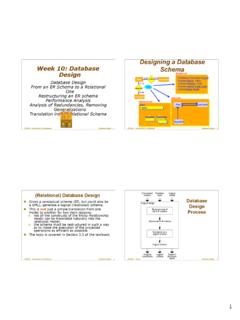
Designing a Database Week 10: Database Schema …
www.cs.toronto.eduOperational DB (OLTP - On-Line Transaction Processing) CSC343 – Introduction to Databases Database Design — 8 ... [CASE = Computer-Aided Software Engineering] CSC343 – Introduction to Databases Database Design — 46 Logical Design witha CASE Tool. Title: 10_DBDesignStG.ppt Author:
XSLT: Using XML - University of Toronto
www.cs.toronto.edu1 XSLT: Using XML to transform other XML files Introduction to databases CSC343 Fall 2011 Ryan Johnson Thanks to Manos Papagelis, John Mylopoulos, Arnold Rosenbloom
XSL - University of Toronto
www.cs.toronto.edu– XSLT is a language for transforming XML documents into other XML documents – XSLT is designed to be used independently of XSL. • However, XSLT is not intended as a completely general-purpose XML transformation language. • Rather it is designed primarily for the kinds of transformations

CSC340S - Information Systems Analysis and Design
www.cs.toronto.educsc340 Information Systems Analysis and Design page 3/18 b. Using Prototyping tools c. Purchasing a software application package
Related documents

A Lecture on Model Predictive Control
cepac.cheme.cmu.eduoptimization problem ... stochastic model) • on-line estimation of parameters / states • “robust” solution of optimization. FCCU Debutanizer ~20% under capacity. Debutanizer Diagram Reflux Fan Slurry Pump Around PCT RVP Pressure Flooding Tray 20 Temp. Feed Pre-Heater 160 F 400 F 190 lb From Stripper

Taking the Human Out of the Loop: A Review of Bayesian ...
www.cs.ox.ac.ukimprovements. Bayesian optimization is a powerful tool for the joint optimization of design choices that is gaining great popularity in recent years. It promises greater automation so as to increase both product quality and human productivity. This review paper introduces Bayesian optimization, highlights some
algorithms - arxiv.org
arxiv.org2.2 Stochastic gradient descent Stochastic gradient descent (SGD) in contrast performs a parameter update for each training example x(i) and label y(i): = r J( ;x(i);y(i)) (2) Batch gradient descent performs redundant computations for large datasets, as it recomputes gradients for similar examples before each parameter update.

Objectives and Constraints for Wind Turbine Optimization
www.nrel.govObjectives and Constraints for WindTurbine Optimization S.Andrew Ning National Renewable Energy Laboratory January, 2013 NREL is a national laboratory of the U.S. Department of Energy, Office of Energy Efficiency and Renewable Energy, operated by …

Understanding deep learning requires rethinking …
arxiv.orgoutput of running stochastic gradient descent. Appealing to linear models, we analyze how SGD acts as an implicit regularizer. For linear models, SGD always converges to a solution with small norm. Hence, the algorithm itself is implicitly regularizing the solution. Indeed, we show on small
Model Predictive Control - Stanford University
stanford.edu• MPC problem is highly structured (see Convex Optimization, §10.3.4) – Hessian is block diagonal – equality constraint matrix is block banded • use block elimination to compute Newton step – Schur complement is block tridiagonal with n×n blocks • can solve in order T(n+m)3 flops using an interior point method