Example: stock market
ÉLECTROPHORÈSE
Gel de polyacrylamide. Figure 2-afin d’augmenter la résolution et donc restreindre les protéines dans des bandes plus minces, le gel peut être modifié ...
Tags:
Information
Domain:
Source:
Link to this page:
Documents from same domain

Regression and Calibration - Authentification
www.webdepot.umontreal.caLC•GC Europe Online Supplement statistics and data analysis 15 The p value is the probability that a value could arise by chance if the true value was zero. By convention a p value of less than 0.05 indicates a significant non-zero statistic.

Chapitre 13 Le monopole - Université de Montréal
www.webdepot.umontreal.caLe monopole 1. Qu’est-ce que le monopole? 2. La production et le prix du monopoleur non discriminant 3. La concurrence parfaite et le monopole non discriminant : une comparaison 4. Le monopole et la discrimination par les prix 5. La réglementation du monopole
Chapitre 12 La concurrence parfaite
www.webdepot.umontreal.caChapitre 12 La concurrence parfaite 1. La concurrence parfaite 2. Quelle quantité produire? 3. Production, prix, et profit à court terme 4. Production, prix, et profit à long terme 5. Les effets externes et le progrès technologique 6. La concurrence et l’efficacité
Related documents

DNA Polyacrylamide Gel Electrophoresis
microbiology.ucdavis.eduDNA Polyacrylamide Gel Electrophoresis How to pour and run a neutral polyacrylamide gel. Buffers and Solutions Acrylamide:bisacrylamide (29:1) (30% w/v) Ammonium persulfate (10% w/v) Ammonium persulfate is used as a catalyst for the copolymerization of acrylamide and bisacrylamide gels. The polymerization reaction is driven by free

Classification of Microorganisms
instruction2.mtsac.edupolyacrylamide gel electrophoresis • Premise: Genes determine protein sequence •Procedure: – Lyse cells, extract protein and dissolve in detergent – Place sample into a polyacrylamide gel – Electrophoresis separates out protein by charge and size …
Protein Blotting Guide - Bio-Rad
www.bio-rad.compolyacrylamide gel electrophoresis, or PAGE), electrophoretic transfer preserves the high-resolution separation of proteins by PAGE n Microfiltration — for proteins in solution, microfiltration is fast and useful for determining working conditions for a new blotting assay or any other situation where the resolving power of gel
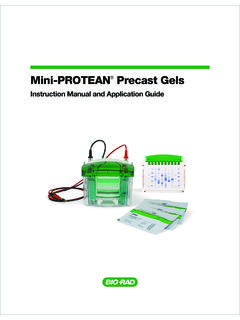
Instruction Manual and Application Guide
www.bio-rad.comGel material Polyacrylamide Gel dimensions 7.2 x 8.6 cm Gel thickness 1.0 mm Resolving gel height 6.2 cm (5.6 cm for 50 μl well) Cassette dimensions 8.5 x 10 cm Cassette material Styrene copolymer Comb material Polycarbonate Running buffer 750 ml for 1–2 gels, 1,000 ml for 3–4 gels (Mini-PROTEAN Tetra cell)

Protein Detection & Identification Methods
njms.rutgers.edupolyacrylamide gel electrophoresis (SDS-PAGE) A method for protein separation and visualization based on size ... assay and general detection in gel electrophoresis 5. Immunoblotting: a sensitive and specific method for detecting interested proteins separated by gel electrophoresis 6.
Methods for Protein Analysis SDS-PAGE
www.mcgill.caMethods for Protein Analysis 1. Protein Separation Methods The following is a quick review of some common methods used for protein separation: SDS-PAGE (SDS-polyacrylamide gel electrophoresis) separates proteins mainly on the basis of molecular weight as opposed to charge (which is ‘swamped out’
Polymer-to-Solvent Reference Table for GPC/SEC
www.agilent.comPolyacrylamide (PAM) Water + 0.05 M Na 2 SO 4 at pH 3 PL aquagel-OH 25 5991-5789EN Polyacrylamide (PAM) Water + 0.2 M NaNO 3 + 0.01 M NaH 2 PO 4 at pH 7 PL aquagel-OH 40 5991-5773EN Polyacrylic acid (PAA) Water + 0.2 M NaNO 3 + 0.01 M NaH 2 PO 4, adjusted to pH 7 PL aquagel-OH 25 5991-5783EN Poly-alpha-olefi n (PAO) TCB + 0.015 % BHT PLgel …

Chapter 14
capricorn.bc.eduthe stacking gel, resolving gel and electrophoresis buffer produce a system that is capable of finely resolving proteins according to their MWs. Gel electrophoresis of macromolecules In gel electrophoresis, an electric field is used to move charged molecules through a matrix of a polymerized substance such as agarose or polyacrylamide.