Transcription of 2015 Guidelines AC LS Instructor -Led Training FAQ
1 2015 Guidelines ACLS Instructor -Led Training FAQ As of August 31, 2016 General ACLS Course Questions Q: What is the AHA s ACLS Course? A: The AHA s ACLS Course has been updated to reflect new science in the 2015 AHA Guidelines Update for CPR and ECC. This course builds on the foundation of lifesaving BLS skills, emphasizing the importance of continuous, high-quality CPR. This advanced course highlights the importance of high-performance team dynamics and communication, systems of care, recognition and intervention of cardiopulmonary arrest, immediate post-cardiac arrest, acute dysrhythmia, stroke, and acute coronary syndromes.
2 The goal of the ACLS Provider Course is to improve outcomes for adult patients of cardiac arrest and other cardiopulmonary emergencies through early recognition and interventions by high-performance teams. Q: What specifically is taught in the new ACLS Course? A: After successfully completing the ACLS Course, students should be able to Apply the BLS, Primary, and Secondary Assessments sequence for a systematic evaluation of adult patients Perform prompt, high-quality BLS, including prioritizing early chest compressions and integrating early automated external defibrillator (AED)
3 Use Recognize and perform early management of respiratory arrest Discuss early recognition and management of ACS and stroke, including appropriate disposition Recognize and perform early management of bradyarrhythmias and tachyarrhythmias that may result in cardiac arrest or complicate resuscitation outcome Recognize and perform early management of cardiac arrest until termination of resuscitation or transfer of care, including immediate post cardiac arrest care Model effective communication as a member or leader of a high-performance team Evaluate resuscitative efforts during a cardiac arrest through continuous assessment of CPR quality, monitoring the patient s physiologic response.
4 And delivering real-time feedback to the team Recognize the impact of team dynamics on overall team performance Discuss how the use of a rapid response team or medical emergency team may improve patient outcomes Define systems of care Q: What are the key differences between the 2010 Guidelines version of the ACLS Course and the 2015 Guidelines version of the ACLS Course? A: The new ACLS Course includes the following changes: New Educational Design: The ACLS Course uses a variety of teaching methods and adult learning principles in an environment that, in some cases, will mimic (simulate) or actually be a real healthcare setting (such as the back of an ambulance or an emergency department bed).
5 From an educational perspective, the closer the simulated emergency is to a real-life case, the better the transfer of skills. Simulation, previously referred to as mock codes, has been the fundamental educational model for ACLS for more than 20 years. Although the technology is more sophisticated and the science of simulation education continues to expand, the fundamentals remain the same. Simulation offers students the opportunity to learn and practice their cognitive and psychomotor skills before applying them to real patients.
6 There is ample evidence from many disciplines to support the effectiveness of such simulation-based education in improving participant knowledge, skills, team performance, 2015 Guidelines ACLS Instructor -Led Training FAQ leadership, and communication. For this reason, the ACLS Course continues to incorporate this model in its design. Course Flexibility: The AHA allows ACLS Instructors to tailor the ACLS course to meet audience-specific needs. One example of course flexibility is local protocol discussions built into some of the lessons.
7 Also, some local protocols related to CPR can be implemented into the learning stations. Use of different protocols, such as 3 cycles of 200 continuous compressions with passive oxygen insufflation and airway adjuncts, compression-only CPR in the first few minutes after arrest, and continuous chest compressions with asynchronous ventilation once every 6 seconds with the use of a bag-mask device are a few examples of optimizing chest compression fraction (CCF) and high-quality CPR. In addition, an increased number of case scenarios for a more diverse audience and the ability to build your own scenarios further expands the flexibility to tailor the ACLS course.
8 Mandatory Precourse Self-Assessment: Before attending the ACLS Course, students must complete the mandatory precourse self-assessment located on the ACLS Student Website. They must achieve a score of 70% or higher, and they have unlimited chances to pass the precourse self-assessment. Students must print their completion certificate and bring it to their ACLS class. Case Scenarios: For the learning stations in the new ACLS Course, the AHA has added many new and diverse case-based scenarios within three settings (prehospital, emergency department, and inhospital).
9 New scenarios are rated by difficulty from 1 to 3, with 3 indicating the most difficult scenario. Instructors should use the scenario rating to match with the students background, experience, and scope of practice. Also experienced Instructors may use the template and directions provided to create their own scenarios relevant to their students. New Lesson Plans: The AHA s 2016 Instructor materials include Lesson Plans (as opposed to Lesson Maps), which have been completely redesigned to better meet the needs of AHA Instructors.
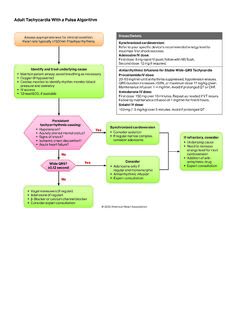
10 New Videos: New videos have been added to the ACLS Course DVD, including megacode videos for prehospital and inhospital settings, 4 new algorithm videos, and a new Coping with Death video. New Learning Stations: New learning stations have been added, including, Immediate Post-Cardiac Arrest Care, optional Intraosseous Access, and optional Coping with Death. ACLS Provider Manual: The ACLS Provider Manual has been updated to include the revised systematic approach in part 4, which is consistent with PALS; a change in the flow of the cases in part 5 (removed CPR and AED case, which is now in the supplemental materials, added new post-cardiac arrest care case, and combined stable and unstable tachycardia case, cardiac arrest case VF/pVT, asystole, and PEA); and new illustrations and ECGs.