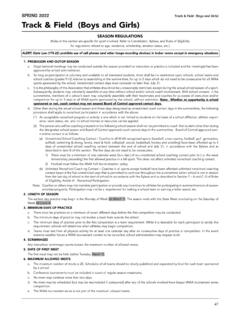
Transcription of 2022 TRACK AND FIELD PRE-MEET NOTES
1 TRACK AND FIELDPRE-MEET NOTESHIGHLIGHTS OF RULES CHANGES01 Headwear and Garments: Clarifies that religious headwear is permitted and no prior authorization is needed and garments with logos completely around the waistband on uniform bottoms are Zones: Clarifies when each exchange zone is to be used when races are run in lanes or with incoming legs of 200 meters or less. 03 Warm-up Areas: Clarifies that running in a direction other than how the event is conducted is prohibited in warm-ups for horizontal jumps, pole vault and Area: Clarifies that an athlete is not penalized for a hat or sunglasses falling in the pit after they have made their mark.
2 202222022 PRE-MEET NOTESIN THIS ISSUE:1 RULES CHANGES HIGHLIGHTS2 2021 POINTS OF EMPHASIS3 HOW TO OFFICIATE UNSPORTING CONDUCT4 LAP COUNTING IN HIGH SCHOOL AND MIDDLE SCHOOL RACES5 IMPORTANCE OF HAVING UMPIRES AT TRACK MEETS/ESSENTIALS OF UMPIRING6 STARTER/ASSISTANT STARTER BEST PRACTICES POSITIONING, COMMANDS, CURVED STARTS7 ELECTRONIC STARTING DEVICES8 FIELD EVENT WARMUP RUNBACKS9 DISCUS AND JAVELIN VENUE SAFETY CONSIDERATIONS10 CULTURAL AND RELIGIOUS HEADWEAR02 POINTS OF EMPHASISE xchange ZoneRecent changes within multiple TRACK and FIELD rules codes regarding the definition of relay exchange zones prompted the rules committee to adjust NFHS exchange zone rule change does not require that tracks be repainted or resurfaced in order to be in compliance with NFHS rules.
3 There is no immediate cost to schools as the current TRACK markings can be utilized with minor acceleration zone is now incorporated into the exchange zone, thus creating a 30-meter exchange zone. Existing acceleration zone markings (triangles, squares) or colored tape placed at that location, may be used to denote the beginning of the exchange zones on a sprint relays such as the 4x100 meter and 4x200 meter, and other relays with legs of 200 meters or less, the outgoing runner, while waiting for the baton, must be positioned entirely inside the 30-meter exchange zone. The exchange zones for relay races with legs more than 200 meters are not impacted by this rule of Electronic DevicesThe use of electronic devices is permitted in unrestricted areas and coaches boxes in a meet Photo provided by XL Sports Photography, New PRE-MEET NOTES provided it does not interfere with the progress of the meet.
4 Coaches and athletes can review video in these areas and discuss techniques and a competitor views video or uses wireless devices in a restricted area during competition (on the clock for a trial in FIELD events or in a race for running events) they have gained an unfair advantage over their opponents. This is an infraction to the rules and will lead to disqualification from the games committee for each meet will determine all restricted and unrestricted areas. Restricted areas are limited to competitors, officials, and event personnel associations may also have policies in place to further address the use of electronic devices.
5 Adapted AthletesNFHS playing rules allow each state association, in keeping with applicable laws, to authorize exceptions to NFHS TRACK & FIELD and Cross Country rules to provide reasonable accommodations to individual participants with disabilities and/or special needs, as well as those individuals with unique and extenuating circumstances. The accommodations shouldnot fundamentally alter the sport, heighten risk to the athlete or others or place opponents at a playing rules can be adapted to include students with disabilities and many times do not require undue administrative burden.
6 In addition, the same TRACK & FIELD venues can be used with little to no modifications needed in this allowance to include student-athletes with disabilities and/or special needs is permitted within NHFS rules, with each state association authorized to provide exceptions for these reasonable accommodations to occur. There are also several resources available, on the NFHS website, to state associations and schools looking to provide opportunities to all TO OFFICIATE UNSPORTING CONDUCTT here are two types of Unsporting Conduct as described in NFHS Rules 4-6-1 and 4-6-2. Unacceptable conduct by a competitor includes, but is not limited to: willful failure to follow the direction of a meet official, using profanity that is not directed at someone or any action which would bring discredit to the individual or his/her school.
7 The penalty for unacceptable conduct is disqualification from that event. Preventive officiating can be used to make athletes aware that their action can result in disqualification from the event. If, in the judgment of the official, an athlete acts in a courteous manner, regretting action after the heat of the moment, a disqualification may be unnecessary. It is recommended that the coach be informed of the incident and outcome of the second, and more serious type, is unsporting conduct, which applies to all coaches, contestants and other team/school personnel. Unsporting conduct is behavior that is unethical or dishonorable and includes but is not limited to: disrespectfully addressing an official, any flagrant behavior, intentional contact, taunting, criticizing or using profanity directed toward someone.
8 The penalty for athletes is disqualification from that event and further competition in the meet. The penalty does not remove places or points earned in events completed prior to the unsporting conduct. The penalty for coaches or other personnel will be disqualification from further participation in the meet. Many state high school associations require that the incident be reported to their office and impose a suspen-sion of at least one contest or event, so make sure you check your state should establish positive rapport with coaches and athletes. This would include treating them respectfully and fairly.
9 When informing the competitor and the coach of a disqualification, be firm but be prepared to listen to them rather than react. Understand that a coach may be disappointed by your call and advocate for less severe or no penalty for their athletes. Be prepared to describe the specific action and whether you observed it directly or if it was reported by another official. Always have the rule reference to show the coach, and don t forget to use the case book for specific PRE-MEET NOTESNFHS Rule 3-4-7 gives the responsibility of counting laps for competitors to the meet referee or an individual the meet referee designates.
10 While the responsibility for completing the course remains with the competitor, the meet personnel tasked with counting and indicating laps need to be experi-enced and knowledgeable. To avoid costly mistakes, this task should preferably be designated by the referee to a group of individuals so that each lap counter only counts laps for three to four Counters Meet management should attempt to have a sufficient number of trained lap counters for each race of two laps or more. Pre-race time should allow lap counters to visually identify the competitors for which they will be responsible.