Transcription of 28. Reluctant THIRTY DO’S
1 Story. During a suspenseful part, slow down, and lower your The most common mistake in reading aloud whether the reader is a seven-year-old or a forty-year-old is reading too fast. Read slowly enough for the child to build mental pictures of what he just heard you read. Slow down enough for the children to see the pictures in the book without feeling hurried. Reading quickly allows no time for the reader to use vocal Preview the book by reading it to your-self ahead of time. Such advance reading allows you to spot material you may wish to shorten, eliminate, or elaborate on.
2 25. Bring the author to life, as well as his book. Google the author to find a personal Web page, and always read the informa-tion on your book s dust jacket. Either be-fore or during the reading, tell your audi-ence something about the author. This lets them know that books are written by peo-ple, not by Add a third dimension to the book when-ever possible. For example, have a bowl of blue-berries ready to be eaten during or after the reading of Robert McCloskey s Blueber-ries for Encourage relatives living far away to record stories on audiocassettes that can be mailed to the child.
3 Inviting other faculty members, parents, and local celebrities (like the police chief) to read to the Reluctant readers or unusu-ally active children frequently find it difficult to just sit and listen. Paper, cray-ons, and pencils al-low them to keep their hands busy while listening. (You doodle while talking on the telephone, don t you?)29. Fathers should make an extra effort to read to their children. Because the vast ma-jority of primary-school teachers are women, young boys often associate reading with women and schoolwork.
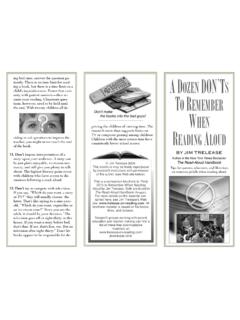
4 And just as unfortunately, too many fathers would rather be seen playing catch in the driveway with their sons than taking them to the li-brary. It is not by chance that male school scores have taken a dramatic downturn in the last three decades. A father s early in-volvement with books and reading can do much to elevate books to at least the same status as sports in a boy s When children wish to read to you, it is better for the book to be too easy than too hard, just as a beginner s bicycle is better too small than too DO STO REMEMBERWHENREADING ALOUDBY JIM TRELEASEA uthor of the New York Times BestsellerThe Read-Aloud Handbook Jim Trelease brochure may be freely reproduced by non-profit institutions with permission of the author ( ).
5 This is a companion brochure to A Dozen DON Ts To Remember When ReadingAloud by Jim Trelease. For more details on the material contained here, see Jim Trelease s Web site: All brochure material is based on his books, films, and are not created by machines but by The first time you read a book, discuss the cover illustration. What do you think this book is going to be about? 12. As you read, keep listeners involved by occasionally asking, What do you think is going to happen next? 13. Picture books can be read easily to a fam-ily of children widely separated in age.
6 Novels, however, pose a challenge. If there are more than two years (and thus social and emotional differences) between the children, each child would benefit greatly if you read to him or her individually. This requires more effort on the part of the par-ents, but it will reap rewards in direct pro-portion to the effort expended. 14. Avoid long descriptive passages until the child s imagination and attention span are capable of handling them. There is nothing wrong with shortening or eliminating them. Prereading helps to locate such passages, and they can then be marked with pencil in the margin.
7 Dickens did it often in his pub-lic If the chapters are long or if you don t have enough time each day to finish an en-tire chapter, find a suspenseful spot at which to stop. Leave the audience hanging; they ll be counting the minutes until the next Allow your listeners a few minutes to settle down and adjust their feet and minds to the story. If it s a novel, begin by asking what happened when you left off yesterday. Mood is an important factor in listening. An authoritarian Now stop that and settle down! Sit up straight.
8 Pay at-tention doesn t create a receptive If you re reading a picture book, make sure the children can see the pictures eas-ily. In school, with the children in a semi-circle around you, seat yourself just slightly above them so children in the back can see above the heads of the In reading a novel, position yourself where both you and the children are com-fortable. Do not read or stand in front of brightly lit windows. Backlighting strains the eyes of your Remember that everyone enjoys a good picture book, even a teenager.
9 If you doubt it, try Johnny on the Spot by Edward Sorel with Allow time for class and home discus-sion after reading a story. Thoughts, hopes, fears, and discoveries are aroused by a book. Allow them to surface and help the child to deal with them through verbal, written, or artistic expression if the child is so inclined. Do not turn discussions into quizzes or insist upon prying story inter-pretations from the Remember that reading aloud comes naturally to very few people. To do it suc-cessfully and with ease you must Use plenty of expression when reading.
10 If possible, change your tone of voice to fit the dialogue. Adjust your pace to fit the 1. Begin reading to children as soon as pos-sible. The younger you start them, the eas-ier and better it With infants through toddlers, it s impor-tant to include books that contain repeti-tions; as they mature, add predictable and rhyming During repeat readings of a predictable book, occasionally stop at a key phrase and allow the child to provide the Read as often as you and the child (or students) have time Set aside at least one traditional time each day for a Remember: The art of listening is an ac-quired one.