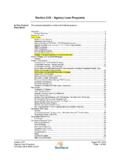
Transcription of 3 – ELIGIBLE BORROWERS
1 (Rev. 06/21/18) ELIGIBLE BORROWERS 3 eligible borrowers NON DISCRIMINATION All applicants must be considered irrespective of age, race, color, religion, national origin, sex, marital status or physical handicap. IRS TAX CODE COMPLIANCE To be ELIGIBLE for a Mortgage Loan, the applicant must satisfy the requirements of the IRS Code described in this section. The Commission requires documentation that the loan applicant meets these requirements and is ELIGIBLE to receive a Mortgage Loan. RESIDENCY TYPE REQUIREMENTS In order to be named on the Note and/or Deed of Trust, a person must meet the guidelines established by the loan type originated under the Program. Documentation Required. The Commission requires the same documentation used to meet the guidelines established by the loan type originated under the Program.
2 ELIGIBLE BORROWERS are either Citizens or Citizens as follows: Citizen: o The borrower must have a valid social security number and be a citizen of the United States or of a Possession or Territory. Citizen: o Permanent Resident: A permanent resident is a citizen who is legally ELIGIBLE to maintain permanent residency in the Document with acceptable evidence of permanent residency issued by the Immigration and Naturalization Service (INS). OR o Non-Permanent Resident: A non-permanent resident is a citizen who lawfully enters the United States for specific time-periods under the terms of a visa. A non-permanent resident status may or may not permit employment. Document with acceptable visas: H-1, H-2A, H-2B, H-3, L-1, E-1, and G series. DACA BORROWERS are not ELIGIBLE under the program. (Rev. 02/13/09) ELIGIBLE BORROWERS OCCUPANCY REQUIREMENT All BORROWERS must occupy the Single-Family Residence as their personal principal residence within 60 days from the date the Mortgage Loan is closed.
3 At no time can the Single-Family Residence be used as an investment property, vacation or recreational home. Documentation Required. At loan application, the borrower (s) signs and the Mortgage Lender has notarized the Addendum to Residential Loan Application whereby the borrower (s) attests that the Single-Family Residence intended to be purchased will be used as a personal principal residence. FIRST-TIME HOMEBUYER REQUIREMENT The borrower (s) must be a First-Time Homebuyer unless the Single-Family Residence is located within a Targeted Area or the borrower is a Veteran. A First-Time Homebuyer is defined as someone who has not owned and occupied a primary residence at any time in the three years preceding the closing of the Mortgage Loan. Please see Appendix IV for further information on the Veterans Exception. A borrower may qualify if they owned other property such as vacation property, a recreational vehicle, a mobile home (not affixed to real property and for which they paid no property tax or claimed a mortgage interest deduction), or if they inherited property in which they did not reside.
4 Documentation Required. The primary form of documentation is the federal income tax returns for the last three years submitted by the borrower at loan application. The Mortgage Lender must examine the returns to determine that no mortgage interest or real estate tax deductions were taken. DEFINITION OF HOUSEHOLD SIZE Household size includes all persons who will permanently reside in the Single-Family Residence. Household size does not include: dependents that are claimed on tax returns, but will not permanently reside in the home. Household size does include: non-borrowing co-habitants that will reside in the Single-Family Residence (income must also be included in Annualized Gross Household Income for persons 18 years of age or older); persons who are full-time household occupants regardless of age; (Rev.)
5 02/13/09) ELIGIBLE BORROWERS children expected to be born to a pregnant woman; children in joint custody arrangements who are present in the household 50% or more of the time; children who are away at school and who live at home during recesses. CALCULATION OF INCOME FOR TAX COMPLIANCE PURPOSES The income calculation described below for the purpose of determining Program loan eligibility for federal tax purposes is an entirely different process than the one used for credit underwriting. The income used for Program purposes is the anticipated (future) income for the 12 months following Mortgage Loan closing. The income used to qualify the borrower (s) for credit underwriting may not exceed the income used to qualify for Program compliance.
6 (Exception: foster care payments may be used for credit underwriting even though they are excluded for Program loan eligibility. See also Examples of Income to Include or Not to Include in this Section.). The household income of a borrower is referred to as the borrower 's "annualized gross (before any taxes or deductions) household income." Annualized Gross Household Income is defined as the borrower 's gross monthly household income multiplied by 12. Gross monthly household income is the sum of: monthly gross pay; any additional income from overtime, part-time employment, bonuses, dividend, interest, royalties, pensions, IRAs. 401(k) plans, Veterans Administration (VA) compensation, net rental income, etc.; and other income (such as alimony, child support, public assistance, sick pay, social security benefits, unemployment compensation, income received from trusts, and income received from business activities or investments.)
7 Income from all sources must be verified and included when calculating an applicant's gross monthly household income. The income of all residents 18 years or older (related and unrelated) must be included in the calculation of Annualized Gross Household Income and may not exceed the Program limits established by the Commission at the time of loan closing. These limits are located under the heading "Maximum Total Annual Income" in this section of the Program Manual. To determine Annual Gross Household Income for full-time employment, multiply hourly wages by 2080 weekly wages by 52 bi-weekly wages by 26 semi-monthly wages by 24 monthly wages by 12 (Rev. 02/13/09) ELIGIBLE BORROWERS To determine Annual Gross Household Income for less than full-time employment, multiply: hourly wages by the number of hours the person is expected to work per week x 52.
8 If a range of hours is given, you must use the highest number of hours. If this puts the household over income, you may need to contact the employer and clarify. If the hours are irregular, average the number of regular hours at current regular pay rate and average the overtime hours times current overtime rate. CURRENT PERIOD Lenders must determine the household earnings for the "current period." The "current period" begins with the pay period prior to the date of loan application and ends at loan approval. VERIFICATION OF INCOME In order to accurately determine "current period" income, all income earners in the household over the age of 18 years of age must provide paycheck stubs or other earnings statement for each source of income for each household resident over the age of 18 years preferably within the 30 day period prior loan closing.
9 The purpose of these earnings statements is to accurately delineate the current household earnings for a minimum of one pay period. A full written Verification of Employment from the borrower 's current employer(s) is also required to verify pay raises, bonuses, overtime, and hours worked per week. Paycheck stubs do not always provide this breakdown of information. Mortgage Lenders must include a copy of the calculation if income is from a source other than a monthly salary. (Rev. 03/10/16) ELIGIBLE BORROWERS MAXIMUM TOTAL ANNUAL INCOME To be ELIGIBLE for a Program loan, an applicant's Annualized Gross Household Income must not exceed the following Program income limits at the time of loan closing: For other reservations: Non-targeted Targeted County 1- 2 persons 3 or more 1- 2 persons 3 or more persons persons Jefferson/Skagit/Whatcom $70,000 $80,000 $70,000 $80,000 Island/Kitsap/Thurston Clark/Pierce $80,000 $90,000 $80,000 $90,000 San Juan $75,000 $90,000 n/a n/a King/Snohomish $90,000 $97,000 $90,000 $97,000 All Other Counties $65,000 $75,000 $80,000 $85,000 EXAMPLES OF INCOME TO INCLUDE OR NOT TO INCLUDE The following guidelines are provided as a general computational aid and may not apply to all situations.
10 Please call the Commission for assistance whenever in doubt as to the correct way to calculate income. 1. Overtime: Income earned from overtime will be included if the borrower has a history of such income or if the income was earned during the "current period." The Mortgage Lender must not include more overtime income in qualifying the borrower for the Mortgage Loan than is used in determining income for Program compliance. To calculate overtime for compliance purposes, first consider the amount earned during the "current period" and annualize it. If the borrower claims that the overtime earned in the "current period" is excessive or unusual, the Mortgage Lender may average the number of hours of overtime worked during the previous two years. Multiply the average monthly hours by the current rate of overtime pay and use that figure for overtime earnings.