Transcription of 3 PERCEPTION - SAGE Publications
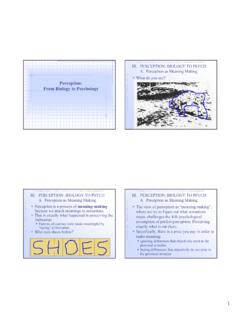
1 38 PERCEPTIONR ecognizing Patterns and ObjectsCHAPTER OUTLINEG estalt Approaches to PERCEPTION Bottom-Up ProcessesTemplate Matching Featural Analysis Prototype MatchingTop-Down ProcessesPerceptual Learning The Word Superiority Effect A Connectionist Model of Word PERCEPTION Direct PERCEPTION Disruptions of PERCEPTION : Visual Agnosias3 Look across the room right now and notice the objects you see. If you are looking out a window, maybe you see some trees or bushes, perhaps a bicycle or car, a person walking or a group of children you ve just done, cognitively speaking, is an amazing achievement: You ve taken sensory input and interpreted it meaningfully, in a process known as PERCEPTION .
2 In other words, you have perceived patterns, objects, people, and possibly events in your world. You may not consider this achievement at all remarkable after all, you do it every day. However, computer scientists trying to create artificially intelligent systems have discovered just how complicated the process of PERCEPTION is. Neuroscientists have estimated that the areas of our brain responsible for visual processing occupy up to half of the total cortex space (Tarr, 2000).The central problem of PERCEPTION is explaining how we attach meaning to the sen-sory information we receive.
3 In the example just given, you received and somehow interpreted a great deal of sensory information: You saw certain objects as trees, people, and so forth. You recognized certain objects that is, saw them as things you had seen before. The question for cognitive psychologists is how we manage to accomplish these feats so rapidly and (usually) without vast topic of PERCEPTION can be subdivided into visual PERCEPTION , auditory PERCEPTION , olfactory PERCEPTION , haptic (touch) PERCEPTION , and gustatory (taste) percep -tion.
4 For the purposes of this chapter, we will concentrate on visual and auditory PERCEPTION in part to keep our discussion manageable and in part because those two are the kinds of PERCEPTION psychologists study most. From time to time, however, we will also look at examples of other kinds of PERCEPTION to illustrate different that when you look at an object, you acquire specific bits of information about it, including its loca-tion, shape, texture, size, and (for familiar objects) name.
5 Some psychologists namely, those working in the tradition of James Gibson (1979) would argue that you also immediately acquire information about the object s function. Cognitive psychologists seek to describe how people acquire such information and what they then do to process related questions suggest themselves. How much of the information we acquire through PERCEPTION draws on past learning? How much of our PERCEPTION do we infer, and how much do we receive directly?
6 What specific cognitive processes enable us to perceive objects (and events, and states, and so on)? Where can the line be drawn between PERCEPTION and sensation, which is the initial reception of information in a specific sensory modality vision, hearing, olfaction? Where can the line be drawn between PERCEPTION and other kinds of cognition, such as reasoning or categorization? Clearly, even defining PERCEPTION so as to answer these questions is a the present, we will adopt what might be called the classic approach to defining PERCEPTION .
7 Figure illustrates this approach for visual PERCEPTION . Out in the real world are objects and events things to be per-ceived such as this book or, as in my earlier example, trees and shrubs. Each such object is a distal stimulus. For a living organism to process information about these stimuli, it must first receive the information through one or more sensory systems in this example, the visual system. The reception of information and its registration by a sense organ make up the proximal stimulus.
8 In our earlier example, light waves reflect from the trees and cars to your eyes, in particular to a surface at the back of each eye known as the retina. There, an image of the trees and cars, called the retinal image, is formed. This image is two-dimensional, and its size depends on your distance from the window and the objects beyond (the closer you are, the larger the image). In addition, the image is upside down and is reversed with respect to left and meaningful interpretation of the proximal stimulus is the percept your interpretation that the stimuli are trees, cars, people, and so forth.
9 From the upside-down, backward, two-dimensional image, you quickly (almost instantaneously) see a set of objects you recognize. You also recognize that, say, the giant oak tree is closer to you than are the lilac shrubs, which appear to recede in depth away from you. This Figure : Distal stimuli, proximal stimuli, and (recognition of object as a book)Proximal stimulus (retinal image of book)Distal stimulus (book)Chapter 3: PERCEPTION : Recognizing Patterns and Objects39 COGNITIVE PSYCHOLOGY IN AND OUT OF THE LABORATORY40 GESTALT APPROACHES TO PERCEPTION .
10 When stimuli occur close to one another in space and in time, they may group perceptually into coherent, salient patterns or wholes. Such Gestalts, as they are called, abound in our perceptual world, as when leaves and branches cluster into trees, and when trees merge into forests; when eyes, ears, noses and mouths configure into faces; when musical notes coalesce into chords and melodies; and when countless dots or pixels blend into a resulting wholes may have properties their component parts lack, such as the identity or expression on a face that is unrecognizable from any one part, or the key in which a melody is played that cannot be deduced from any single note.