Transcription of 4. LEARNING STRATEGIES, SUPPORTS, AND INTERVENTIONS
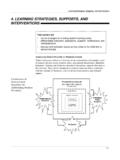
1 LEARNING Strategies, Supports, and INTERVENTIONS 4. LEARNING STRATEGIES, SUPPORTS, AND. INTERVENTIONS . This section will review strategies for meeting student LEARNING needs . differentiated instruction, adaptations, supports, modifications, and individualization discuss communication issues as they relate to the child who is alcohol-affected Addressing Student Diversity in Manitoba Schools Today's classroom reflects the diversity of our communities and includes a mix of student interests, needs, LEARNING styles, and cultural backgrounds. Manitoba Education, Training and Youth has described instructional supports that address this diversity. They can be visualized as a nested continuum that is consistent with the concepts of inclusion, effective professional practice, and collegial support.
2 Continuum of Instructional Provincial Curriculum Supports for (including Differentiated Instruction). Addressing Student Diversity Adaptations Support Personnel Collegial/. Professional Redesigned Team Practice Course Content Support Individualized Programming Inclusion Towards Inclusion: Tapping Hidden Strengths teacher Planning in the Classroom At the beginning of the school year , the teacher should clearly establish the needs of the students in the classroom. In almost every classroom there will be students who require special consideration. Remember, the teacher is not expected to provide totally different programs to students; rather, the differences can be managed using a variety of approaches. The teacher should determine the best methods to address students' needs. In a typical classroom, there may be several students who require differentiated instruction (Note that all students benefit from differentiated instruction, but for some students it is essential.)
3 Some students who require adaptations to instruction and assessment some students who require additional supports a few students who require modifications outlined in their Individual Education Plan occasionally students who require individualized programming outlined in their Individual Education Plan The teacher should examine ways to meet the LEARNING needs within the unit or lesson being taught. A teacher who examines the needs of a classroom in this way is able to see commonalties as well as differences in students. A classroom that includes students who are alcohol-affected might also have other students whose LEARNING needs can be met in the same way. The Unit Planning form is an excellent way of planning for a variety of needs. *. *. LEARNING Strategies, Supports, and INTERVENTIONS The following is an example of how a geography unit could be developed to meet the needs of all students in a classroom.
4 Senior 2 Geography: Unit 1 - Overview of North America LEARNING Outcomes: Where is North America located? Which countries are included in North America? Which national boundaries will be significant? Why? Class instruction: Complete the map of North America by writing the provinces/states, capital cities, and major rivers/bodies of water. Include a legend that indicates the general topography and the major industry associated with each province. Differentiated instruction for all students: Use overheads and videos Enable students to conduct research using computers, CD-ROMs, and the Internet Make a class project of building three-dimensional map, and provide separate areas where students can work at various times Provide a variety of materials to students ( , modeling clay, small objects).
5 Differentiated evaluation/assessment: Develop a rubric to weight various types of finished products ( written format, picture format, oral presentation). Assess student knowledge of specific content and various levels of expected performance. Possible adaptations: Provide a word bank of provinces, rivers/waterways Provide pictures of major industries and topography for students to place on maps. Put the pictures of trees, prairies, and mountains on the map. From the list of jobs (fishing, farming, mining, etc.) select one or two that are found in each province and write the job(s) on the map. Enlarge maps for easier labeling Possible supports: Librarian Resource Paraprofessional Possible modifications: (the extent of the modification will be dependent on the students functioning level.)
6 Modify only to the extent that is necessary.). Provide a map of the provinces and instruct students to colour each province a different colour ( , British Columbia - blue; Manitoba - pink). Provide a labeled map and ask students to locate specific places on the map ( , underline the Red River; find Hudson Bay and colour it blue). Use pictures ( , of fish, tractors) to represent major industries in a province, and ask students to match the pictures with the appropriate province(s). Provide a map of Manitoba only. Ask students to locate Winnipeg and two major rivers. (This is appropriate for small group work - one student could work on the Manitoba map while the others work on a map of the country. The Manitoba map could then be included on the final, larger map of the group.).
7 Possible activities for students on an individualized program: Provide students with maps of the school, classroom, or community to help them learn functional mapping skills as they relate to their environment. Working on bus schedules is an example of a functional mapping skill. In the sections below, additional information, strategies, and suggestions are provided regarding differentiated instruction adaptations adding support team members designating courses as modified . individualized programming Towards Inclusion: Tapping Hidden Strengths Provincial Curriculum with Differentiation There are four programs in Manitoba: English, French Immersion, Fran ais, and Technology Education. The first three are available from Kindergarten to Senior 4, while Technology Education is only available at the Senior Years.
8 Each program is organized in domains (subject areas) which, in turn, have provincial curricula that are organized around LEARNING outcomes and describe content and methods for instruction. Differentiated instruction refers to a wide range of instructional and classroom strategies that teachers can use to help each student achieve the prescribed LEARNING outcomes. It is the component of classroom instruction that specifically acknowledges and responds to learner diversity. Using differentiated instruction establishes a supportive LEARNING environment for all students. Differentiated instruction helps teachers provide provincial curricula by For a full description of accommodating students with a wide differentiated range of abilities, interests, and LEARNING instruction, see Success for All Learners: A Handbook on styles.
9 Teachers can differentiate Differentiating Instruction curriculum in three broad areas: content, (Manitoba Education and process, and product. Training, 1996). Differentiated instruction helps students meet provincial curricular outcomes because varied instructional approaches are used, thus matching their varied LEARNING styles. There are many differentiated instruction techniques that have been found to work effectively with students who are alcohol-affected. Because these students may experience difficulty with receptive and expressive language, with remembering, and with understanding abstract ideas, techniques need to be chosen with care. Students who are alcohol-affected prefer activities that involve concrete LEARNING visual/tactile/kinesthetic LEARNING styles The strategies below can help students who are alcohol-affected (and may also be effective with many students who are not).
10 In using these strategies, teachers need to remember that strategies may need to be explained to students several times. There are six examples of differentiated instruction approaches provided on the following pages. LEARNING Strategies, Supports, and INTERVENTIONS LEARNING Strategies LEARNING strategies are instructional strategies that have been developed to assist students with LEARNING difficulties. LEARNING strategies include: teaching study Examples of skills, editing assignments, reading strategies, and thinking strategies. Two Differentiated examples of LEARNING strategies that can be used with students who are alcohol- Instruction affected are the COPS strategy and the JETS strategy. LEARNING COPS is an editing strategy that helps students edit their work by focusing on strategies four key elements of the editing process: C Capitalization Graphic organizers O Overall Editing and Appearance Additional information P Punctuation Lesson frames on LEARNING strategies S Spelling is available from the Organizational University of Kansas- strategies JETS is a strategy for task Institute for Research in completion or assistance in preparing LEARNING Disabilities.