Transcription of 4004R Suppression Release Panels
1 Features Fire alarm control panel designed specifically for Suppression Release operation with: Four initiating device circuits (IDCs) Two notification appliance circuits (NACs) Two releasing appliance circuits (RACs) Two special purpose monitor inputs (SPMs) that accept manual Release request and manual abort request for Agent Release systems, and waterflow and supervisory for Preaction or Deluge systems Three auxiliary relays with selectable functions Easily selected activity timing options Suppression Release operation includes: Automatic extinguishing Release Deluge and preaction sprinkler system Release Dual or single hazard area protection Combined agent Release and preaction operation** IDCs are selectable for cross-zoning or for activation from a single detection input Short circuit RAC supervision Compatible with Listed/Approved valves and actuators Audible Escalation of Events: Single Audible Appliance Tone: Stage 1 activates Temporal or 20 bpm March Time pattern; Stage 2 activates 120 bpm March Time pattern to indicate Release timer active.
2 Release activates On Steady to indicate Release timer expired and actuator is activated Dual Audible Appliance Control** (Single Hazard): RAC 2 provides a third NAC for dedicated Stage 1 Bell control; NACs 1 & 2 indicate Release as On Steady Operator interface provides: Status LEDs per circuit for Alarm, Trouble, and Supervisory (where appropriate) Acknowledge, Alarm Silence, and system Reset Operating mode selection and timer selections when in programming mode Related system components: Coil supervision module 2081-9046, one per RAC Maintenance Switch, one per RAC Abort Switch Listed to UL Standard 864 and ULC Standard S527 Introduction Dedicated for Suppression Release .
3 4004R Suppression Release Panels provide conventional fire alarm control circuits and are equipped with the features required for a wide variety of single or dual hazard Suppression Release applications. Capabilities include automatic extinguishing agent Release and deluge and preaction sprinkler control. ** Requires Software Revision or higher. RAC 2 RAC 1 NAC 2 SPM 1 IDC 1 SPM 2 IDCs 2, 3, and 44004R Suppression Release PanelAC PowerZone 1 Zone 2 Zone 3 Zone 4 AlarmTroubleAlarmTroubleAlarmTroubleAlar mTroubleAlarm SilencedSupervisorySystem TroubleRelay DisconnectEarth FaultAgent ReleasedAbort ActiveManual ReleaseManual ReleaseZone 5 TroubleZone 6 TroubleNAC 1 TroubleNAC 2 TroubleRAC 1 TroubleRAC 2 TroubleCAUTIONDISCONNECTBATTERY ANDA.
4 C. POWERBEFORESERVICINGM aintenance SwitchAgentsourceAgent discharge pathActuatorCoilsupervisorymoduleCOIL SUPERVISION MODULE (2 AMP) 2081-9046 INSTALLATION INSTRUCTIONS 574-437 REVMAINT AIN 1 /4 " SEPAR ATIONBETW EEN POW ER L IMITED( RED /BL K) AND NONPOWERL IMIT ED (YEL /BL K) W IRINGRED N AC+ N AC-BL KDATE CODE:519-958 YELBL KSSIM PLEX T I ME RECORDER CO. GARDNER MA. USAA ctuatorcircuitPUSH AND HOLDFIRE SUPPRESSIONSYSTEM SUPPRESSIONDISCONNECT / DISABLE01 NAC 1 4004R Suppression Release Panel One-Line system Reference Drawing Introduction (Continued) Flexible I/O Capabilities. Four IDCs allow for either four separately monitored zones or two, cross-zoned connections.
5 Two SPMs allow dedicated manual inputs for Release or abort; for waterflow and supervisory, or Release /abort and pressure, depending on system type. Two releasing appliance circuits (RACs) supervise to the actuator coils and activate the actuators when required. The two NACs and the three panel auxiliary relays provide status condition information. Easy Program Selections. The operator panel has a program mode that allows selection of panel operation type and detailed operating selections using an easily selected sequential programming operation. History Log. The last 50 events are stored in non-volatile memory. This information is accessed by connecting a technician s computer to the service port which is also used to set the date and time.
6 Panel Feature Description Operator Panel. The operator panel has alarm and trouble status indicating LEDs for each input and output, visible through the locking cabinet door (refer to diagram on page 4). Unlocking the door provides access to the Acknowledge, Alarm Silence, and system Reset pushbutton switches. * This product has been approved by the California State Fire Marshal (CSFM) pursuant to Section of the California Health and Safety Code. See CSFM Listing 7165-0026:314 for allowable values and/or conditions concerning material presented in this document. Additional listings may be applicable; contact your local Simplex product supplier for the latest status.
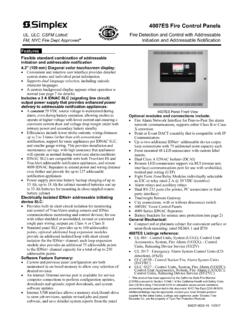
7 Listings and approvals under Simplex Time Recorder Co. are the property of Tyco Fire Protection Products Westminster. Release Control Fire Alarm Systems UL, ULC, CSFM Listed; FM Approved; 4004R Suppression Releasing Panel for Automatic MEA (NYC) Acceptance* Extinguishing, Deluge and Preaction Sprinkler Control S4004-0002-9 7/2018 Panel Feature Description (Continued) (Refer to specifications on page 6 for more information.) Four Class B IDCs provide coverage for either two cross-zoned areas or four separately zoned areas. IDCs are capable of supporting up to 30 Simplex current-limited smoke detectors or electronic heat detectors (see list on page 2) as well as manual stations and other compatible contact closure initiating devices.
8 IDCs are capable of Class A operation with an optional adapter module and can be programmed as Style C (short or open initiates a trouble) for use with current limited devices only. Single hazard agent Release applications monitor pressure switches with IDC 3 and tamper switches with IDC 4. Two Class B Special Purpose Monitoring Circuits (SPMs) are dedicated for manual Release or abort, waterflow and supervisory, or Release /abort and pressure, depending on system type. Inputs are normally open switches. An abort switch stops Release while activated and upon deactivation, the Release operation occurs after a selectable time delay. Manual Release inputs override abort switches and activate the Release after selectable delays of from 0 to 30 seconds in 5 second increments.
9 For Dual Hazard applications, current limited abort operation is required. SPMs are programmable as Style C and capable of Class A operation with the optional adapter module. Two Class B NACs are provided for reverse polarity, notification appliance operation, each rated 2 A. Class A operation is available with the optional adapter module. NAC operation is selectable per application. Synchronized strobe operation requires a separate 4905 Series Strobe Synchronization Module (see product selection below), and a continuous, steady-on (non-coded) input from the NAC. Two Class B Releasing Appliance Circuits (RACs). Rated 2 A each, these circuits are dedicated to operating Release control actuators.
10 RAC cutout timing is selectable as no cutout, 45 seconds, or 1, 3, , 4, 5, 6, 7, 21, 25, 34, 44, or 64 minutes. For bell/horn/strobe single hazard applications, RAC 2 functions as a third NAC (NAC 3). Auxiliary Power Output. Two sets of output terminals are provided, one for continuous operation and the other for resettable operation, rated for 750 mA combined. Resettable terminals are provided for 4-wire smoke detector power. Standard Panel Auxiliary Relay Outputs. Three relay outputs are available, selectable as normally open or normally closed, rated 2 A @ 30 VDC, inductive: Aux Relay 1 (Trouble) is energized when Normal and is de-energized with a common Trouble condition.