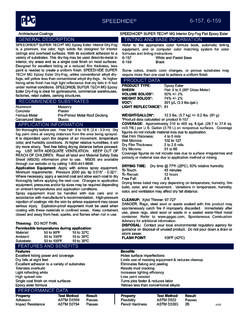
Transcription of 6-723XI SPEEDHIDE 6-725XI - PPG
1 PPG Architectural CoatingsSUPER TECHTMWB Interior Flat Latex Dry-FogRECOMMENDED SUBSTRATESPRODUCT DATAPACKAGINGGENERAL DESCRIPTIONS peedhide Super TechWB Interior Flat Latex Dry-Fog is a premium,fast-drying, low VOC flat designed for interior ceilings and its excellent adhesion to a variety of substrates, this low odourdry fog is formulated to have excellent flash rust high hiding white finish has a high light reflectance that dry falls in3 m (10 feet) under normal Super TechWB Interior Flat Latex Dry-Fog is self-primingon a variety of substrates and is ideal for gymnasiums, commercialwarehouses, factories, retail outlets, and parking STANDARDSB efore use, be sure to read and follow the instructions and warnings on the label and Safety Data Sheet.
2 See other cautions on the last 6-723XI6-725XI Complies with the Canadian Volatile Organic CompoundConcentration Limits for Architectural Coatings Regulations. Can help earn Canada LEED - CI (2006) and NC & CS (2009). 6-725XI , MPI # 118 Dry Fall, Latex, Flat. Meets MPI Green Performance Standard (GPS-1 & GPS-2). LAluminumConcrete, MasonryConcrete/Masonry BlockFerrous MetalGalvanized SteelGypsum WallboardPlasterWoodSee details in the recommended primers AND BASE INFORMATIONPRODUCT TYPE: Acrylic & PVA LatexSHEEN: Flat: 0 to 5 % (60 and 85 Gloss Meter)VOLUME SOLIDS*:28% 2%WEIGHT SOLIDS*:46% 2%VOC*:< 50 g/LDENSITY*: kg/L*Product data calculated on product RATE PER COAT:Approximately m (200 ft ) litres on smooth and nonporous Film Thickness:203 milsDry Film Thickness: 57 milsCoverage figures do not include loss due to surface irregularities andporosity or material losses due to application method or : Dry time @ 25 C (77 F).
3 50% relative Touch:15 minutesTo Recoat:2 hours minimumFree Fall:: 3 m (10 feet)Full curing: 30 daysDrying times listed may vary depending on temperature, humidity, filmbuild, colour, and air movement. Permissible temperatures during the application:Material: 10 to 32 C 50 to 90 FAmbient: 10 to 38 C 50 to 100 FSubstrate: 10 to 38 C 50 to 100 FCLEANUP: Remove as much product quantity as possible and cleantools with lukewarm soapy water immediately after up all overspray within 4 hours after job : Consult your municipality in order to dispose of paintresidues according to environmental regulations. Do not pour down adrain or storm POINT: Over 93 C (200 F)Refer to the appropriate colour formula book, automatic tintingequipment, and/or computer colour-matching system for colourformulas and tinting & pastel NOT colours, drastic colour changes, or porous substrates mayrequire more than one coat to achieve a uniform / BENEFITSF eatures BenefitsHigh hiding power and coverageHides surface falls at 3 m (10 feet)
4 Limits use of masking material & reduces crawling on the overbuildingResists mud Light reflecting whiteIncreases lighting flash rust resistanceMinimizes surface on a variety of substratesTurns jobs faster and reduces help earn LEED2009 creditsContributes to sustainable DATAP ropertyTest MethodResultsPropertyTest MethodResultsAdhesionASTM D3359 PassesImpact ResistanceASTM D2794 PassesFlexibilityASTM D522 PassesPencil HardnessASTM D33634 BPPG PAINTSS peedhide6-723XI SeriesGENERAL SURFACE PREPARATIONPPG Architectural CoatingsSUPER TECHTMI nterior Flat Latex Dry-FogLIMITATIONS OF USEFOR INTERIOR USE ONLY. PROTECT FROM FREEZING. KEEP OUT OF REACH OF when air, surface and product temperatures are between 10 C to 32 C (50 F to 90 F).
5 Not recommended for immersion for airless spray application only. Some types of machinery and equipment may still require covers as a protection against possibledamage to working parts (such as bearings, etc.) Clean any dry overspray before rolling scaffold or allowing foot traffic into area. Clean upall overspray within 4 hours after job completion. USE WITH ADEQUATE VENTILATION. Proper ventilation is required to prevent excessive humidity build-up, which would inhibit all spray equipment in a remote area for the proper tips, pressure settings and free-fall drying before to be coated must be dry, clean, sound, and free from all contamination including loose and peeling paint, dirt, grease, oil, wax,concrete curing agents and bond breakers, chalk, efflorescence, mildew, rust, product fines, and dust.
6 Remove loose paint, chalk, andefflorescence by wire brushing, scraping, sanding, and/or pressure all nail holes and caulk all cracks or open all glossy, rough, or patched back all rough edges to sound surface by all bare and porous substrates with an appropriate primer as recommended in primers unsure of suitability of the substrate for painting, first spot check the product to test for adhesion :Dry sanding will give rise to dust and/or hazardous fumes. Wear suitable respiratory protective !If you scrape, sand, or remove old paint, you may release lead dust. LEAD IS TOXIC. EXPOSURE TO LEADDUST OR FUMES CAN CAUSE SERIOUS ILLNESS, SUCH AS BRAIN DAMAGE, ESPECIALLY IN CHILDREN. PREGNANTWOMEN SHOULD ALSO AVOID EXPOSURE. Wear a properly fitted NIOSH-approved respirator and prevent skin contact tocontrol lead exposure.
7 Contact a regional Health Canada office for more these instructions to control exposure to other hazardous substances that may be released during surface : This substrate may present potential adhesion problems. Any coating applied directly to aluminum should be spotapplied, allowed to cure overnight, and then evaluated for adhesion. If adhesion is good, the application may & MASONRY: New concrete should cure for at least 30 days and preferably 90 days prior to priming andtopcoating. The pH of the substrate must be less than 10 before BLOCK: Mortar should cure for at least 30 days and preferably 90 days prior to priming. Fill blockwith an appropriate block filler. Surfaces previously coated with water thinned cement-based paint must be prepared withextra care.
8 If the material appears to be adhering tightly, a masonry sealer may be applied to seal the surface. Checkadhesion by applying a piece of masking tape. If the sealer peels off and has loose particles, remove all chalking orcrumbling material, reseal and recheck METAL: The surface must be cleaned thoroughly to remove any dust, rust, oil, and surface contaminants, and STEEL: Caution must be used when selecting coatings for use on all galvanized metal surfaces. Thesesubstrates may have a factory-applied stabilizer, which is used to prevent white rusting during storage and shipping. Suchstabilizers must be removed by either brush blasting, sanding, or chemical treatment prior to WALLBOARD: Nails or screws should be countersunk, and they along with any indentations should be muddedflush with the surface, sanded smooth and cleaned to remove any dust prior to painting the : Plaster or other alkaline surfaces should be allowed to cure for at least 30 days prior to METAL ROOF DECKING: This substrate may present potential adhesion problems.
9 Topcoats should be spotapplied, allowed to cure overnight, and then evaluated for adhesion. If adhesion is good, the application may : Unpainted wood or wood in poor condition should be sanded smooth, wiped clean, and then primed. Any knots orresinous areas must be sealed before painting. Countersink all nails, putty flush with surface, then use, be sure to read and follow the instructions and warnings on the label. Contact your local representative for any additional surface preparation : 6-723XI 11/2018 Page 2 of 3 PPG PAINTSS peedhide6-723 XISeriesPPG Architectural CoatingsSUPER TECHTMI nterior Flat Latex Dry-FogRECOMMENDED PRIMERSAPPLICATION INFORMATIONPRECAUTIONSA luminum: 17-921 XIC, Self-primingConcrete, Masonry(Block filler):6-7C, 36250 Concrete, Masonry (Primer-sealer):17-921 XIC, Self-primingFerrous Metal90-712 CGalvanized Steel17-921 XIC, 90-712C, Self-primingGypsum Wallboard6-2C, 6-4C, 9-900C, Self-primingPlaster17-921 XIC, Self-primingWood6-2C, 9-900C, 17-921 XIC, 60000 AKEEP OUT OF REACH OF CHILDREN.
10 USE WITH ADEQUATE VENTILATION. Read all label and Safety Data Sheet (SDS) informationprior to use. SDS are available from your retailer, through our website or by calling thoroughly before use and occasionally during use. When using more than one container of the same colour, intermix to ensure colouruniformity. Where necessary, apply a second coat and allow each coat to dry thoroughly before applying the next Equipment: Apply with airless spray equipment. Airless Spray: Pressure 2000 psi, tip in. - in application equipment, pressure and/or tip sizes may be required depending on ambient temperatures and equipment must be handled with due care and in accordance with the manufacturer s recommendation. High-pressure injection ofcoatings into the skin by airless equipment may cause serious : No thinning is usually required.