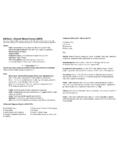
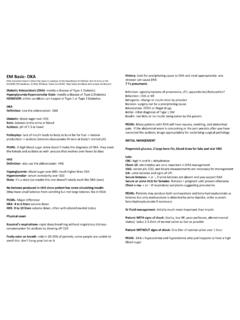
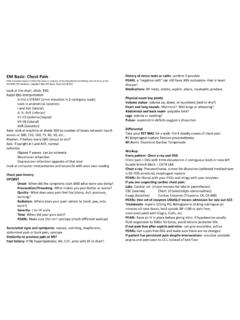
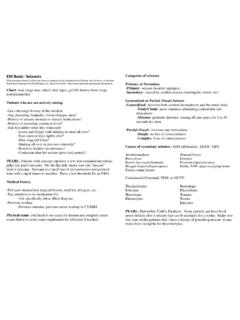
Transcription of 60 Sepsis 3.0- Updated March 2017 - EM Basic
1 EM Basic - Sepsis March 2017 - Sepsis - known or suspected source of infection with at least 2 out of 3 qSOFA 2017 EM Basic LLC, Steve Carroll DO. May freely distribute with proper attribution criteria -Hypotension (Systolic BP <90) Recognizing Sepsis -Altered Mental Status -Tachypnea (Respiratory rate of 22 or higher) Vitals- Fever, tachycardia, hypotension, hypoxia, tachypnea -Triage respiratory rates frequently inaccurate PEARL: Remember this with the mnemonic HAT . Technically also an -Look at respiratory effort- fast or increased work of breathing? allowance for an increase in the full SOFA score of 2 points or more- but not really useful in the ED. Also- don't stop a Sepsis resuscitation just because Systolic BP is 95- this is trying to find the sickest Sepsis patients History and Symptoms -Severe Sepsis - now defined as the need to use vasopressors to maintain a Head to Toe recent symptoms/ROS- fever, headache, stiff neck, cough, Mean Arterial Pressure (MAP) of less than 65 AND a lactate of greater than 2 shortness of breath, abdominal pain, urinary symptoms, diarrhea, new after adequate fluid resuscitation AND rashes or bumps, back pain - Adequate is not defined- left up to your judgment Recent procedures?
2 - new port in an oncology patient? New -Also- the AND statement should probably be OR to make sure that nephrostomy tube? Recent surgeries? patients who are on pressors but clear their lactate are still treated aggressively- some patients will clear their lactate but still die! Complete Past Medical and Surgical History Before resuscitating- consider if the patient would be better served by forgoing resuscitation and starting comfort care instead Ask about medications, allergies, recent admissions to the hospital, -Check for advance directives, consider functional status, talk with the recent use of antibiotics patient's family -A healthy 20 year old with bacterial meningitis is much different than a Exam- Full Head to Toe 90 year old patient with dementia in a nursing home with a feeding tube- do the right thing for the patient and their family -Don't forget neuro exam and walking the patient if there is headache.
3 Stiff neck or neuro deficits Labs -Examine every inch of the patient's skin (including axilla, groin, peri-rectal -Standard large bore IV access area) for abscesses or cellulitis -CBC, CMP, UA, Urine Culture, Blood Cultures x2, VBG/ABG with lactate -Check lung sounds (pneumonia?) -Check for abdominal tenderness (chole, appy, etc.) Imaging -Overall perfusion- cap refill? Skin pale and/or cool? -Chest x-ray (screen for pneumonia) -Overall picture of the patient- if any patient looks sick they could be septic! -Non-contrast head CT/LP (if suspecting meningitis) New definitions of Sepsis (February 2016) PEARL: Head CT is to look for mass, hemorrhage, and signs of increased -No more severe Sepsis - only Sepsis and septic shock intracranial pressure that could (in theory) cause herniation if an LP is done.
4 Definitely do an CT before LP in patients who are altered, have an abnormal neuro exam, elderly, or immuncompromised. Imaging (continued) -Fluid choice- normal saline ok for the first two liters but risk of hyperchloremic metabolic acidosis with large volumes due to high sodium load- consider -Abdomen/Pelvis CT- if patient complains of abdominal pain and/or has starting or switching to lactated ringer's (LR) or plasmalyte which are closer to abdominal tenderness- use contrast if the patient's kidney function can handle actual physiologic levels of electrolytes it, otherwise get a non-contrast CT Antibiotics -Ultrasound- bedside US can help find cholecystitis quickly, but have a low threshold to get a CT to get the whole picture in the abdomen if needed -Unknown/unsure source Old versus new Sepsis guidelines -Zosyn (piperacillin/tazobactam) and Vancomycin -Zosyn grams IV ( grams ok if more readily available in the ED)
5 -Old guidelines for Early Goal Directed Therapy mandated central and arterial -Give first- can be infused quickly over about 10 minutes lines for all of these patients along with transfusing to hemoglobins of more -Zosyn is a penicillin- keep that in mind with allergies than 10 (after initial volume resuscitation) as well as using dobuatmine -Vancomycin- 15- 20 mg/kg IV of ACTUAL body weight, some advocate -These interventions have been shown by the ARISE, PROCESS, and PROMISE 25-30 mg/kg with a max of 2 grams IV trials to be unnecessary unless the clinician thinks they are needed -Give second- takes at least 2 hours to give -No need for central access unless you need pressors (and these can be started PEARL.)
6 1 gram of vancomycin is not enough unless patient weight 50kg peripherally first), no need for higher hemoglobin thresholds for transfusion (use 7 grams/dl) -Cefepime (cephalosporin) and Vancomycin -Some evidence that Zosyn/Vanc leads to more acute kidney injury Sepsis Treatment -Cefepime- 2 grams IV Fluids PEARL: Cefepime can be used in patients with PCN allergy since it's a 4th generation cephalosporin -Scott Weingart on the EmCrit podcast- You don't have to do a lot of crap, you just have to give a crap - give aggressive care! Known or Suspected Source- LUCAS mnemonic- (Hat tip: Rob Orman from the ErCast podcast)- if you know the source, we can be smarter about abx choices -Immediate IV fluids- at least 30 mls/kg- 2 liters in a typical 70 kilogram male -Lung -2 liters should be a starting point for most patients -Urine -But are we giving too much fluids?
7 Some experts say yes but no good -CNS evidence -Abdomien -Skin -Re-evaluate patients frequently- the question is- would the patient benefit from more fluid? Did their heart rate come down, their blood pressure -Lung source- Pnemonia increase, or do they look more awake or better perfused? -Non-ICU patients- Levaquin (levofloxacin) 750mg IV -Fluid responsiveness- check the website for many resources -ICU and Healthcare Associated Pneumonia (HCAP) -Zosyn/Vanc or Cefepime/Vanc -HCAP criteria- admitted to the hospital for more than 2 days in the last 90 days, resident of a nursing home or long term care facility, patients on dialysis or chemotherapy PEARL: New surviving Sepsis guidelines from 2017 DO NOT recommend routine First line pressor- dopamine is no longer recommended double coverage of pseudomonas with levaquin (in addition to zosyn/vanc or cefepime/vanc) in those patients with HCAP.
8 Levophed (norepinephrine- commonly norepi) -Alpha and beta agonism -Urine -2 mcg/min, maximum of 20-30 mcg/min -Ceftriaxone 1 gram IV- ok to give in patients with PCN allergy -Some will go as high as 1 mcg/kg/min (70 mcg/min) -Generally point of diminishing returns above 20-30 mcg/min PEARL: Depending on local sensitivities, Zosyn frequently has lower effectiveness (80%) against urinary E. Coli versus ceftriaxone (98%). So Zosyn Second line Pressors and call it a day may not work for urinary issues. If urine is a likely source but not yet confirmed, can given cefepime/vanc pending UA results. Vasopressin- especially if patient remains tachy on norepi units per minute PEARL: Check for previous urine culutres for the patient to check the patient's previous antibiotic sensitivities and let that guide your antibiotic choice Epinephrine- especially if the patient has a normal heart rate on norepi -1 10 mcg/min -Central Nervous System- Meningitis - Ceftiraxone 2 grams IV Re-evaluate -Vancomycin 15-20 mg/kg, max 2 grams -After fluids, abx, and pressors on board re-evaluate the patient -Acyclovir 10 mg/kg if suspecting HSV meningitis- history of HSV infection, -Re-check exam- worth of breathing?
9 Signs of fluid overload, perfusion young patient with a new psychotic break status better or worse? Mental Status? -Re-check lactate- is the lactate down by at least 10% in the first hour? -Abdomen- Cholecystitis, appendicitis, ascending cholangitis, complicated -More fluids or pressors to help improve metabolic status? diverticulitis, intra-abdominal abscess -Work of breathing- can be up to 30% of patient's metabolic load in -Zosyn good for chole/appy Sepsis -Cirpo (ciprofloxacin) 400mg and Flagyl (metronidazole) 500 mg IV usually used -Should you consider intubating semi-electively? for diverticulitis and other bowel issues or in cases of PCN allergy -If you do, low dose sedatives, high dose paralytics -Skin- abscesses, cellulitis causing Sepsis Good ongoing critical care (big and small stuff!)
10 -Zosyn/Vanc- especially Vanc if suspecting MRSA (frequently hospitalized, dialysis, chemo patients or history of multiple abscesses in the past) -Head of bed to 30 degrees- improves ventilation, prevents vent associated PNA Vasopressors in Sepsis -Tidal volume 6-8 ml/kg of IDEAL body weigh on vented patients -Generally best to start after sufficient fluid loading -Use a tape measurer to measure sternum to fingertips, multiply by 2- -Start them if MAP <65 after fluid loading. gives you wingspan which is very close to patient's height- needed to -Good evidence to say you can start pressors peripherally while waiting to calculate IDEAL body weight complete central access -Use a good peripheral- 18 gague in AC or forearm ok- tenous 24 gague -Place arterial line (especially if on pressors) in the hand is not ok -Make sure to check IV sites at least once an hour for extravasation and -Avoid high FiO2 settings (hyperoxia)- wean down FiO2 on vent to keep sats stop the infusion if its detected above 92% Good ongoing critical care (continued)