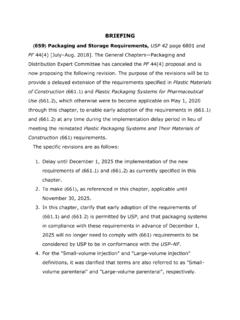
Transcription of 659 PACKAGING AND STORAGE REQUIREMENTS
1 Printed on: Fri Jan 17 2020, 12:08:20 pmCurrently Official as of: 17-Jan-2020 Official as of 1-May-2017 DocId: GUID-48C0134E-8117-4B3B-8DC4-EA70C93 EEE8F_3_en-USPrinted from: 2020 USPC 659 PACKAGING AND STORAGE REQUIREMENTS (A portion of theAssociated Componentssection of this chapter will become official on May 1, 2019, and a portion of the Packagingsection of this chapter will become official on May 1, 2020, as indicated. Early adoption of the REQUIREMENTS in this chapter and Plastic Materials of Construction and Plastic PACKAGING Systems for pharmaceutical Use are permitted by USP.)INTRODUCTIONThe purpose of this chapter is to provide PACKAGING definitions, auxiliary PACKAGING information, and STORAGE condition definitions relevant to the STORAGE and distribution of active ingredients, excipients, and medical products, such as pharmaceuticals, devices, combination products ( , drug-eluting stents), and dietary supplements.
2 Change to read:PACKAGINGP ackaging materials must not interact physically or chemically with a packaged article in a manner that causes its safety, identity, strength, quality, or purity to fail to conform to established REQUIREMENTS . Any plastic material used to construct a PACKAGING systemmust meet the applicable REQUIREMENTS of Plastic Materials of Construction . (Official 1-May-2020)All PACKAGING systemsmust meet the applicable REQUIREMENTS specified in Containers Glass 660 , Plastic PACKAGING Systems and Their Materials of Construction 661 , Plastic PACKAGING Systems for pharmaceutical Use , (Official 1-May-2020)and Auxiliary PACKAGING Components 670.
3 All elastomeric closures must meet the applicable REQUIREMENTS in Elastomeric Closures for Injections 381 . Every monograph in USP NFmust have PACKAGING and STORAGE REQUIREMENTS . For the PACKAGING portion of the statement, the choice of containers is provided in this chapter. For active pharmaceutical ingredients (APIs), the choice would be a tight, well-closed, or, where needed, light-resistant container. For excipients, given their typical presentation as large-volume commodity items ( PACKAGING systemsranging from drums to tank cars), a well-closed container is an appropriate default requirement. Articles must be protected from moisture, freezing, and excessive heat (see General Definitions) when no specific directions or limitations are provided.
4 The compendial REQUIREMENTS for the use of specified containers apply also to articles packaged by Dispensers, Repackagers, or other individuals, unless otherwise indicated in the individual drug product monograph. POISON PREVENTION PACKAGING ACTThis act, which is administered by the United States Consumer Product Safety Commission (CPSC), requires special PACKAGING for most human oral prescription drugs, oral controlled drugs, certain non-oral prescription drugs, certain dietary supplements, and many over-the-counter (OTC) drug preparations, to protect the public from personal injury or illness from misuse of these preparations (16 CFR ). The primary PACKAGING of substances regulated under the Poison Prevention PACKAGING Act (PPPA) must comply with the special PACKAGING standards (16 CFR ).
5 These apply to all PACKAGING types, including reclosable, non-reclosable, and unit-dose types. Special PACKAGING is not required for drugs dispensed within a hospital setting for inpatient administration. Also, special PACKAGING does not need to be used by manufacturers and packagers of bulk-packaged prescription drugs that will be repackaged by the pharmacist. PPPA-regulated prescription drugs may be dispensed in non-Child-resistant packagingupon the request of the purchaser or when directed in a legitimate prescription (15 USC 1473). Manufacturers or packagers of PPPA-regulated OTC preparations are allowed to package one size in non-Child-resistant packagingas long as popular-size, special packages are also supplied.
6 The non-Child-resistant packagingrequires special labeling (16 CFR ). TEMPERATURE AND STORAGES pecific directions are stated in some monographs with respect to STORAGE conditions ( , the temperature or humidity) at which an article must be stored and shipped. Such directions apply except where the label on the article has different STORAGE conditions that are based on stability studies. Where no specific directions or limitations are provided in the article's labeling, articles must be protected from moisture, freezing, and excessive heat, and, where necessary, from light during shipping and distribution. Drug substances are exempt from this standard.
7 GENERAL DEFINITIONSP ackaging DefinitionsPackaging system (also referred to as a Container closure system):The sum of PACKAGING componentsand materials that together contain and protect the article. This includes primary PACKAGING componentsas well as Secondary PACKAGING componentswhen such components are required to provide additional :A receptacle that holds an intermediate compound, API, excipient, or dosage form, and is in direct contact with the article ( , ampules, vials, bottles, syringes, and pen injectors).Closure:A material that seals an otherwise open space of a Containerand provides protection for the contents. It also provides access to the contents of the Container( , screw caps and stoppers).
8 PACKAGING component:Any single part of the Packageor Container closure system,including: the Container( , ampules, syringes, vials, and bottles); Closures( , screw caps and stoppers); ferrules and overseals; Closureliners ( , tube cartridge liners); inner seals; administration ports; overwraps; administration accessories; labels; cardboard boxes; and shrink PACKAGING component:A PACKAGING componentthat is in direct contact with or may come into direct contact with the PACKAGING component:A PACKAGING componentthat is in direct contact with a primary PACKAGING componentand may provide additional protection for the PACKAGING component:A PACKAGING componentthat is in direct contact with a Secondary PACKAGING componentand may provide additional protection for the article during transportation and/or 1 of 5 USP-NF1/17/2020 component.
9 A component or entity that may come into contact with a Tertiary PACKAGING componentduring the distribution, STORAGE , and/or transportation of the packaged article ( , pallets, skids, and shrink wrap).Associated component:A PACKAGING componentthat is typically intended to deliver the drug article to the patient but is not stored in contact with the article for its entire shelf life ( , spoons, Dosing cups, and dosing syringes).Materials of construction:The materials ( , glass, plastic, elastomers, and metal) of which a PACKAGING injection (Small-volume parenteral):An injectable dosage form that is packaged in Containerslabeled as containing 100 mL or injection (Large-volume parenteral):An injectable dosage form that is packaged in Containerslabeled as containing more than 100 PACKAGING :A PACKAGING systemdesigned or constructed to meet CPSC standards pertaining to opening by children (16 CFR et seq.)
10 And 16 CFR ).Senior-friendly PACKAGING :A PACKAGING systemdesigned or constructed to meet CPSC standards pertaining to opening by senior adults (16 CFR and 16 CFR ).Restricted delivery system:A PACKAGING systemdesigned or constructed to restrict (control) the amount of the drug product that may be delivered in order to limit unintended access by children and other similarly vulnerable populations. Restricted delivery systemsshould meet and may exceed CPSC standards for special PACKAGING [Child-resistantand Senior-friendly PACKAGING (16 CFR et seq.)]. For oral medicinal liquids, surface and flow characteristics vary. It is the responsibility of the manufacturer to ensure that all components of the Restricted delivery systemprovide the intended safety protection.