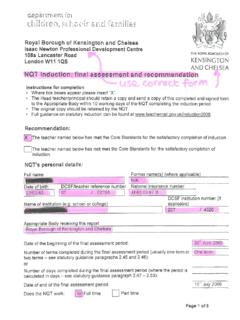
Transcription of 7504 CORE STANDARDS
1 Professional STANDARDS for Teachers Core Introduction Professional STANDARDS for Teachers in England from September 20071. Bringing coherence to the professional and occupational STANDARDS for the whole school workforce 1. The framework of professional STANDARDS for teachers will form part of a wider framework of STANDARDS for the whole school workforce. This includes the Training and Development Agency for Schools' (TDA) review of the national occupational STANDARDS for teaching/classroom assistants and the professional STANDARDS for higher level teaching assistants in consultation with social partners and other key stakeholders and a review of leadership STANDARDS informed by the independent review of the roles and responsibilities of head teachers and the leadership group.
2 What these STANDARDS cover How the STANDARDS 2. The framework of professional STANDARDS for teachers will be used set out below de nes the characteristics of teachers at 5. The STANDARDS provide the framework for a teacher's each career stage. Speci cally it provides professional career and clarify what progression looks like. As STANDARDS for: now, to access each career stage a teacher will need to demonstrate that he/she has met the relevant the award of Quali ed Teacher Status (QTS) (Q). STANDARDS .
3 The process for this varies depending on teachers on the main scale (Core) (C). the STANDARDS concerned. Teachers seeking Excellent teachers on the upper pay scale Teacher or AST status need to apply and be assessed (Post Threshold Teachers) (P). through an external assessment process. Teachers Excellent Teachers (E). seeking to cross the threshold are assessed by their Advanced Skills Teachers (ASTs) (A). head teacher. The STANDARDS for Post Threshold Teachers, Excellent Teachers and ASTs are pay 3.
4 Professional STANDARDS are statements of STANDARDS and teachers who are assessed as meeting a teacher's professional attributes, professional them also access the relevant pay scale. knowledge and understanding, and professional skills. They provide clarity of the expectations at 6. The STANDARDS clarify the professional characteristics each career stage. The STANDARDS are not to be that a teacher should be expected to maintain and confused with and do not replace the professional to build on at their current career stage.
5 After the duties contained in the School Teachers' Pay and induction year, therefore, teachers would be expected Conditions Document, which sets out the roles to continue to meet the core STANDARDS and to and responsibilities of teachers. broaden and deepen their professional attributes, knowledge, understanding and skills within that 4. The framework of STANDARDS below is arranged context. This principle applies at all subsequent career in three interrelated sections covering: stages. So, for example, teachers who have gone through the threshold would be expected to meet the a.
6 Professional attributes core and post-threshold STANDARDS and to broaden b. professional knowledge and understanding and deepen their professional attributes, knowledge, c. professional skills. 1. The framework as a whole, as set out here, applies in England only. The STANDARDS for Post Threshold Teachers, Excellent Teachers and ASTs are pay STANDARDS (as set out in the School Teachers' Pay and Conditions Document) and apply in England and Wales. 2. understanding and skills in that context. There are no of professional STANDARDS will provide a backdrop to new criteria for pay progression for teachers paid on discussions about how a teacher's performance should the upper pay scale in the 2006 School Teachers' Pay be viewed in relation to their current career stage and and Conditions Document.
7 The career stage they are approaching. The relevant STANDARDS should be looked at as a whole in order 7. The STANDARDS will support teachers in identifying to help teachers identify areas of strength and areas their professional development needs. Where teachers for further professional development. For example, a wish to progress to the next career stage, the next level teacher who aspires to become an AST will need to of the framework provides a reference point for all re ect on and discuss how they might plan their future teachers when considering future development.
8 Whilst development so they can work towards becoming an not all teachers will necessarily want to move to the AST, and performance management would provide next career stage, the STANDARDS will also support evidence for the teacher's future application. teachers in identifying ways to broaden and deepen their expertise within their current career stages. 10. All quali ed teachers in maintained schools and non-maintained special schools are required to be 8. All teachers should have a professional responsibility registered with the GTCE.
9 To maintain registration to be engaged in effective, sustained and relevant they must uphold the GTCE's Code of Conduct and professional development throughout their careers Practice for Registered Teachers. and all teachers should have a contractual entitlement to effective, sustained and relevant professional 11. The recommendation for the award of quali ed development throughout their careers. There should teacher status and registration with the GTCE is made be a continuum of expectations about the level by an accredited Initial Teacher Training (ITT) provider of engagement in professional development that following an assessment which shows that all of the provides clarity and appropriate differentiation QTS STANDARDS have been met.
10 The Newly Quali ed for each career stage. The expectations about the Teacher (NQT) may then begin the induction period. contribution teachers make to the development of NQTs will not be required to meet fully the core others should take account of their levels of skills, STANDARDS until the end of their induction period. expertise and experience, their role within the school, The core STANDARDS underpin all the subsequent and re ect their use of up-to-date subject knowledge STANDARDS and, where there is no progression at and subsequent career stages, are valid at all points of teachers' careers within both their immediate 9.