Transcription of 8-bit Microcontroller with 8K Bytes In-System Programmable ...
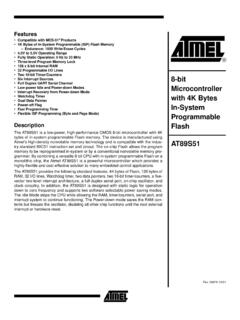
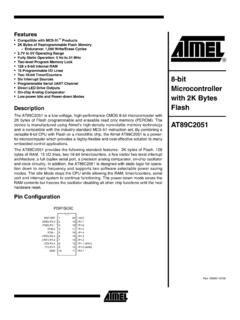
1 1 Features Compatible with MCS-51 Products 8K Bytes of In-System Programmable (ISP) Flash Memory Endurance: 1000 Write/Erase Cycles to Operating Range Fully Static Operation: 0 Hz to 33 MHz Three-level Program Memory Lock 256 x 8-bit Internal RAM 32 Programmable I/O Lines Three 16-bit Timer/Counters Eight Interrupt Sources Full Duplex UART Serial Channel Low-power Idle and Power-down Modes Interrupt Recovery from Power-down Mode Watchdog Timer Dual Data Pointer Power-off FlagDescriptionThe AT89S52 is a low-power, high-performance CMOS 8-bit Microcontroller with 8 Kbytes of In-System Programmable Flash memory.
2 The device is manufactured usingAtmel s high-density nonvolatile memory technology and is compatible with the indus-try-standard 80C51 instruction set and pinout. The on-chip Flash allows the programmemory to be reprogrammed In-System or by a conventional nonvolatile memory pro-grammer. By combining a versatile 8-bit CPU with In-System Programmable Flash ona monolithic chip, the Atmel AT89S52 is a powerful Microcontroller which provides ahighly-flexible and cost-effective solution to many embedded control AT89S52 provides the following standard features: 8K Bytes of Flash, 256 bytesof RAM, 32 I/O lines, Watchdog timer, two data pointers, three 16-bit timer/counters, asix-vector two-level interrupt architecture, a full duplex serial port, on-chip oscillator,and clock circuitry.
3 In addition, the AT89S52 is designed with static logic for operationdown to zero frequency and supports two software selectable power saving Idle Mode stops the CPU while allowing the RAM, timer/counters, serial port, andinterrupt system to continue functioning. The Power-down mode saves the RAM con-tents but freezes the oscillator, disabling all other chip functions until the next interruptor hardware 1919A-07/018-bit Microcontroller with 8K Bytes In-System Programmable FlashAT 8 9 S 5 2AT89S522 TQFP123456789101133323130292827262524234 4434241403938373635341213141516171819202 122(MOSI) (MISO) (SCK) (RXD) (TXD) (INT0) (INT1) (T0) (T1) (AD4) (AD5) (AD6) (AD7)EA/ (A15) (A14) (A13) (T2 EX) (T2) (AD0) (AD1) (AD2) (AD3)(WR) (RD) (A8) (A9) (A10) (A11) (A12) (MOSI)
4 (MISO) (SCK) (RXD) (TXD) (INT0) (INT1) (T0) (T1) (AD4) (AD5) (AD6) (AD7)EA/ (A15) (A14) (A13)65432144434241401819202122232425262 728(WR) (RD) (A8) (A9) (A10) (A11) (A12) (T2 EX) (T2) (AD0) (AD1) (AD2) (AD3)Pin ConfigurationsPDIP1234567891011121314151 6171819204039383736353433323130292827262 524232221(T2) (T2 EX) (MOSI) (MISO) (SCK) (RXD) (TXD) (INT0) (INT1) (T0) (T1) (WR) (RD) (AD0) (AD1) (AD2) (AD3) (AD4) (AD5) (AD6) (AD7)EA/ (A15) (A14) (A13) (A12) (A11) (A10) (A9) (A8)AT89S523 Block DiagramPORT 2 DRIVERSPORT - 0 LATCHRAMPROGRAMADDRESSREGISTERBUFFERPCIN CREMENTERPROGRAMCOUNTERDUAL DPTRINSTRUCTIONREGISTERBREGISTERINTERRUP T, SERIAL PORT,AND TIMER BLOCKSSTACKPOINTERACCTMP2 TMP1 ALUPSWTIMINGANDCONTROLPORT 1 - 3 LATCHPORT 3 - / VPPRSTRAM 0 - 1 LATCHWATCHDOGISPPORTPROGRAMLOGICAT89S524 Pin DescriptionVCCS upply 0 Port 0 is an 8-bit open drain bidirectional I/O port.
5 As anoutput port, each pin can sink eight TTL inputs. When 1sare written to port 0 pins, the pins can be used as high-impedance inputs. Port 0 can also be configured to be the multiplexed low-order address/data bus during accesses to externalprogram and data memory. In this mode, P0 has 0 also receives the code Bytes during Flash program-ming and outputs the code Bytes during program verifica-tion. External pullups are required during programverification. Port 1 Port 1 is an 8-bit bidirectional I/O port with internal Port 1 output buffers can sink/source four TTL 1s are written to Port 1 pins, they are pulled high bythe internal pullups and can be used as inputs.
6 As inputs,Port 1 pins that are externally being pulled low will sourcecurrent (IIL) because of the internal pullups. In addition, and can be configured to be thetimer/counter 2 external count input ( ) and thetimer/counter 2 trigger input ( ), respectively, asshown in the following 1 also receives the low-order address Bytes duringFlash programming and 2 Port 2 is an 8-bit bidirectional I/O port with internal Port 2 output buffers can sink/source four TTL 1s are written to Port 2 pins, they are pulled high bythe internal pullups and can be used as inputs.
7 As inputs,Port 2 pins that are externally being pulled low will sourcecurrent (IIL) because of the internal 2 emits the high-order address byte during fetchesfrom external program memory and during accesses toexternal data memory that use 16-bit addresses (MOVX In this application, Port 2 uses strong internal pul-lups when emitting 1s. During accesses to external datamemory that use 8-bit addresses (MOVX @ RI), Port 2emits the contents of the P2 Special Function 2 also receives the high-order address bits and somecontrol signals during Flash programming and 3 Port 3 is an 8-bit bidirectional I/O port with internal Port 3 output buffers can sink/source four TTL 1s are written to Port 3 pins, they are pulled high bythe internal pullups and can be used as inputs.)
8 As inputs,Port 3 pins that are externally being pulled low will sourcecurrent (IIL) because of the 3 also serves the functions of various special featuresof the AT89S52, as shown in the following 3 also receives some control signals for Flash pro-gramming and input. A high on this pin for two machine cycles whilethe oscillator is running resets the device. This pin drivesHigh for 96 oscillator periods after the Watchdog times DISRTO bit in SFR AUXR (address 8EH) can be usedto disable this feature. In the default state of bit DISRTO,the RESET HIGH out feature is Latch Enable (ALE) is an output pulse for latchingthe low byte of the address during accesses to externalmemory.
9 This pin is also the program pulse input (PROG)during Flash programming. In normal operation, ALE is emitted at a constant rate of1/6 the oscillator frequency and may be used for externaltiming or clocking purposes. Note, however, that oneALE pulse is skipped during each access to external datamemory. If desired, ALE operation can be disabled by setting bit 0 ofSFR location 8EH. With the bit set, ALE is active only dur-ing a MOVX or MOVC instruction. Otherwise, the pin isPort PinAlternate (external count input to Timer/Counter 2), (Timer/Counter 2 capture/reload trigger and direction control) (used for In-System Programming) (used for In-System Programming) (used for In-System Programming)Port PinAlternate (serial input port) (serial output port) (external interrupt 0) (external interrupt 1) (timer 0 external input) (timer 1 external input) (external data memory write strobe) (external data memory read strobe)AT89S525weakly pulled high.
10 Setting the ALE-disable bit has noeffect if the Microcontroller is in external execution Store Enable (PSEN) is the read strobe to exter-nal program memory. When the AT89S52 is executing code from external pro-gram memory, PSEN is activated twice each machinecycle, except that two PSEN activations are skipped duringeach access to external data memory. EA/VPPE xternal Access Enable. EA must be strapped to GND inorder to enable the device to fetch code from external pro-gram memory locations starting at 0000H up to , however, that if lock bit 1 is programmed, EA will beinternally latched on reset.