Transcription of 999 Missing Segment Data Elements - X12
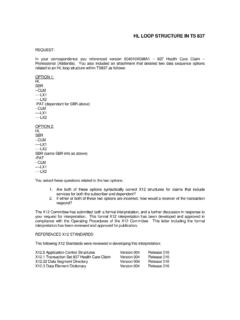
1 999 Missing Segment / data Elements RFI 2008-05, JUNE 2009 REQUEST For the 999 transaction, as a result of routine testing and/or when a WEDI Level 6 or WEDI Level 4 testing error is determined to exist, how is a Segment or data element that is * Missing * identified? The 'error' codes being used are: data element IK304, code list 620: code value 3: Required Segment Missing code value I6: Implementation Dependent Segment Missing data element IK403, code list 621: code value 1: Required data Element Missing code value 2: Conditional Required data Element Missing code value I9: Implementation Dependent data Element Missing . Since the segments and/or data Elements are * Missing *, no references to them within the received transactions being acknowledged are possible as the precise Segment or data element sequence numbers don't exist.
2 I have searched TR3 005010X231 and can find no discussions or explanations of how to identify * Missing * segments or data Elements . And, unfortunately, the examples on pages 47-48 are not sufficiently edifying. For reference, WEDI Level 6 testing is: "The specialized testing required by certain healthcare specialties. For example, ambulance, chiropractic, podiatry, home health, parenteral and enteral nutrition, durable medical equipment, psychiatry, and other specialties have specific requirements that must be tested before putting the transaction into production." WEDI Level 4 testing is: "The testing of specific inter Segment situations described in the HIPAA implementation guides, such that: If A occurs then B must be populated.
3 This is considered to include the validation of situational fields given values or situations present elsewhere in the file. Example: if the claim is for an accident, the accident date must be present." REFERENCED X12 STANDARDS A Request for Interpretation applies to a specific version of the X12 Standards. The author failed to provide a specific version of the standard in the request. We have chosen to base this response on Version 5 Release 5 of the X12 Standard. As the areas of the X12 Standards applicable to this interpretation have been relatively stable over time, it is likely that the same interpretation would be provided for earlier versions of the X12 Standards. The following X12 Standards were reviewed in developing this interpretation: Transaction Sets Version 005 Release 010 Application Control Structure Version 005 Release 010 data Segment Directory Version 005 Release 010 data Element Dictionary Version 005 Release 010 INTERPRETATION The ASC X12 standards do not specify algorithms for identifying Missing segments or data Elements in a transaction set instance.
4 The 999 Transaction Set provides mechanisms for reporting errors. In the cases of a required or implementation dependent Segment being Missing from a transaction set instance, the Missing Segment is not specifically identified. The data Elements of the IK3 Segment are populated as follows: IK301 DE721 Segment ID Code Segment ID of the Segment where the Missing Segment error was detected IK302 DE719 Segment Position in Transaction Set Position in the transaction set of the Segment where the Missing Segment error was detected IK304 DE620 - Implementation Segment Syntax Error Code Value of 7 or I6 In the cases of a required, conditional required, or implementation dependent data element being Missing from a transaction set instance, the data Elements of the IK4 Segment are populated as follows.
5 IK401 C030 Position in Segment The position of the data element in error within the Segment , the composite data structure, or series of repeating data Elements , within the Segment . IK402 DE725 data Element Reference Number The reference number of the Missing data element IK403 DE621 - Implementation data Element Syntax Error Code Value of 1 , 2 , or I9 FURTHER DISCUSSION As noted in the formal interpretation, ASC X12 does not specify algorithms for validating Segment sequence and similar parsing problems. However, we note that in industry practice different algorithms may provide varying degrees of insight into the root cause of a sequence error. For example, let us consider TS102 in version 005010: Table 1 name max 0100 ST Transaction Set Header M 1 N 0200 ORI Object Reference Identification M 1 N 0300 REF Reference Information O >1 N 0400 OOI Associated Object Type Identification M >1 N 0500 BDS Binary data Structure M 1 0600 SE Transaction Set Trailer M 1 Let us consider this example ST*102*0001~ BDS*ASC*1*A~ SE*3*0001~ In this example the ORI and OOI segments, which are mandatory in the standard, are absent.
6 At the BDS Segment , the following conditions are true: The BDS Segment is unexpected after the ST Segment The BDS Segment is not in proper sequence The mandatory ORI Segment is Missing The mandatory OOI Segment is Missing A report indicating any of these conditions as an error would be correct. Different algorithms may put these errors in different precedence, or may not implement all of them.