Transcription of A CLASSROOM GUIDE TO - candlewick.com
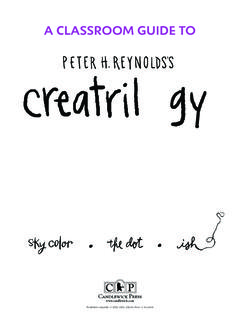
1 A CLASSROOM GUIDE TO. Illustrations copyright 2003, 2004, 2012 by Peter H. Reynolds A Message from the Author-Illustrator I'm thrilled that the books in my Creatrilogy The Dot, Ish, and Sky Color have found their way into the hands of educators. But I'm even happier that people have understood that the messages go well beyond art. All three stories provide encouragement for children and grown-up children to discover, explore, and develop their voice and express it in a unique way. It takes courage to do that, unfettered by self-doubt, unproductive feedback, or preconceived ideas. The Dot is about getting started getting unstuck. It is also about creative teaching, exploring an idea in many ways, and sharing our gifts with others. Ish is about not getting squashed by the opinions of others and finding the vocabulary to defend your ideas.
2 I use the Ish Approach with kids to help them relax in order to express themselves. Ish-ful strategies can allow art, writing, or problem-solving to flow creatively. You can't become better at something you don't do. Sky Color is about developing perspective, examining the world from varying points of view, thinking outside the box, and pushing yourself to the next level. The star, Marisol, is very confident in her artistic ability, but she comes to an important revelation after she is inspired to move beyond learned conventions by observing the world more mindfully. I hope the suggested activities in this GUIDE will serve as a springboard for you and your students to explore and celebrate creative self-expression and to be brave enough to share your voices with the world. So make your mark and see where it takes you!
3 Wishing you a most creative journey, Peter H. Reynolds is a New York Times best-selling illustrator who has created many acclaimed books for children. He is the author-illustrator of Rose's Garden, The North Star, So Few of Me, The Smallest Gift of Christmas, and Playing from the Heart, as well as the illustrator of Megan McDonald's Judy Moody and Stink series. Born in Canada, Peter H. Reynolds now lives in Dedham, Massachusetts. Photo by Gretje Ferguson Creatrilogy Boxed Set ISBN: 978-0-7636-6327-8. A CLASSROOM GUIDE to Peter H. Reynolds's Creatrilogy page 2. Illustration copyright 2003 by Peter H. Reynolds HC: 978-0-7636-1961-9. Celebrate International Dot Day on September 15! For more details, visit This is a rough sketch of possible ways to introduce and follow up on The Dot.
4 Feel free to adapt it to your grade level. Have fun! Before reading the book, have a talk with your students about how we feel when we are starting something new. (This is especially apt at the beginning of the school year.). How do we feel when things seem difficult to do? Ask how many students like to draw. Tell them you are going to read a story about a girl who does not think she is good at drawing and what happens to her when she goes to art class. Follow the reading with a discussion about the story. Pass out large dots (paper circles) to your students and have them write their names on them, as well as some activities they enjoy. Have the students draw dots on the reproducible easel page provided. They can then carefully cut out their dots and paste them into their own swirly gold (or any color!)
5 Frame on the next reproducible page. Invite your students to choose another shape or object. Have them explore this idea by making as many different versions of the same thing, varying size, color, or texture, using negative space, etc. Provide your students with blank-page journals for them to make a mark in every day (a word, a picture, something funny that happened that day, a doodle, a squiggle, a dot!). A CLASSROOM GUIDE to Peter H. Reynolds's Creatrilogy page 3. Teachers: Photocopy this page to share with your students. A CLASSROOM GUIDE to Peter H. Reynolds's Creatrilogy page 4. Illustrations copyright 2003 by Peter H. Reynolds Teachers: Photocopy this page to share with your students. A CLASSROOM GUIDE to Peter H. Reynolds's Creatrilogy page 5. Illustrations copyright 2003 by Peter H.
6 Reynolds HC: 978-0-7636-2344-9. This is an Ish-ish list of possible ways to introduce and follow up on Ish. Feel free to adapt it to your grade level. Have fun! The Squiggle-ish Game: Have two students each squiggle a line for the other and trade sheets of paper. Then ask them to make a drawing from the line their partner made. They can add some paint, cut out their images, and mount them on a darker piece of paper. Be sure to have BOTH artists sign their name to each finished drawing. Ishing Not Dishing: After reading the book, discuss what Leon could have said to Ramon to be kinder. Have your students heard people say hurtful things about someone's art or their attempt to try something new? Brainstorm some things you can say to encourage rather than discourage. Ishful Portraits: Have the whole class create ishful self-portraits, or have pairs do portraits of each other.
7 Label them ishfully; for example, Peter-ish or Wanda-ish. Ishful Gallery: Start a gallery of art that is ishful. For example, print out a Picasso portrait you can label it Face-ish. Look online using a search like abstract boat or Greek painting boat or children face art, print out the images, and add them to the gallery. Ask the class what each one is. Students will learn to see patterns, be more imaginative, be more generous in their interpretations, be less literal, and develop open minds. Ishful Feelings: Brainstorm moods. Have students select a mood to paint or draw. Label them ishfully; for example, stubborn-ish or happy-ish. A CLASSROOM GUIDE to Peter H. Reynolds's Creatrilogy page 6. Illustrations copyright 2004 by Peter H. Reynolds Ish Upon a Star: Have each student draw a star on a note card, paint it, and sign their name.
8 Then glue them all to a big banner, creating a night sky. You can label it When You Ish Upon a Star. Ask students if there are two stars that are exactly the same. Then discuss what a real star is. What does it look like? Show images from of real stars and ask the class if their stars look like the photos. Let them discover that their drawings are actually star-ish! Ishful Poems: Read Ramon's poem from the book and some poems that don't rhyme or have innovative structure. Have students brainstorm their favorite words. Perhaps those words will trigger some ishful poetry. Magnetic poetry is also helpful for ishing up a good poem. Ishful Math: Estimation is a skill students will use throughout their lives. Show the class photographs of groups of items, but only for a few seconds. Then ask students to estimate how many items were in the image.
9 For example, how many chickens in the farmyard? Perhaps a dozen-ish? The number of muffins in a bakery store window a hundred-ish? The number of people in a baseball stadium twenty thousand-ish? If a student is stumped in math class, encourage them to put down an answer-ish. If they show you some work or an answer, even if it is wrong, they will have provided you with something to help you see the pattern of their thinking. This will give you some insight into how you might be able to help them. Ishful Science: Show the class images of familiar animals. Then begin showing some that are less familiar and ask students to identify them. If they are unsure, encourage them to use ishful thinking: monkey-ish, raccoon-ish, etc. Write down their ishful names and then discuss the possible connections between the animals is that leopard-ish animal related to a leopard somehow?
10 This kind of thinking allows scientists to make an educated guess or hypothesis, which is one step of the scientific method. A CLASSROOM GUIDE to Peter H. Reynolds's Creatrilogy page 7. Illustrations copyright 2004 by Peter H. Reynolds Teachers: Photocopy this page to share with your students. This is an ishful boy. activity sheet Peter H. Reynolds Is this a hand? It looks like a squiggle, but we're sure it's a hand because it's at the end of his arm! It is a hand-ish! If you'd like to, paint this ishful boy. Paint on him or around him. Fin-ish this ishful girl. A CLASSROOM GUIDE to Peter H. Reynolds's Creatrilogy page 8. Illustrations copyright 2003 by Peter H. Reynolds Teachers: Photocopy this page to share with your students. activity sheet page 9. Peter H. Reynolds .. A CLASSROOM GUIDE to Peter H.