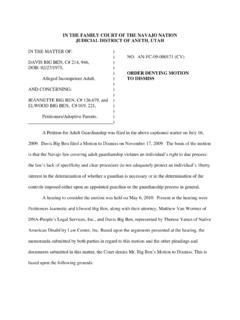
Transcription of A GUIDE TO UNDERSTANDING THE …
1 A GUIDE TO UNDERSTANDING THE emancipation OF A MINOR Traditionally, any person under the age of 18 who was married or entered military service was considered emancipated. An additional category consisted of those young persons who lived separate and apart from their parents and were financially responsible for themselves. A declaration of emancipation traditionally entitled the child, among other things, to be treated as an adult for the purposes of consenting to medical treatment, entering contracts, suing or being sued, ending parental support, controlling the disposition of wages, obtaining a work permit and enrolling in school. In the late 1970s, a number of individuals became concerned that these traditional approaches to the concept of emancipation of a minor were too limiting.
2 As result, across the country individual states adopted statutory grounds upon which a minor could obtain a judicial determination that they were emancipated. In 1980, the State of Illinois adopted what is now known as the emancipation of Minors Act (750 ILCS 30/1 et seq.). This statute allows a mature minor, a person aged 16 or 17, who has demonstrated the ability and capacity to manage their own affairs and to live wholly and partially independent of their parents or guardian to obtain the legal status of an emancipated person, if the court determines that emancipation is in the child s best interest. This will enable the emancipated person to enter into valid legal contracts. The Statute also provides a means by which a homeless minor may seek assistance, without consulting parents order or guardian.
3 This second category is defined as a person 16 years of age but less than 18 years of age who lacks a regular, fixed, or adequate place to live and who desires to participate in a youth transitional housing program. The term includes, but is not limited to, a minor who is sharing the dwelling of another or living in a temporary shelter or who is unable or unwilling to return to the residence of a parent. A homeless minor is not one who is in the custody or under the guardianship of the Department of Children and Family Services. Indeed, no child may be terminated from the custody or guardianship of the Department of Children and Family Services for the purpose of obtaining emancipation as a homeless minor. An order of emancipation as a homeless minor will allow that individual to receive shelter, housing, and services provided by a licensed agency that has the ability and willingness to serve the person.
4 However, the legislation respects the rights of parents and guardians, as well as, the State's interest in preserving the integrity of the family unit. Consequently no order of complete or partial emancipation under this Act may be granted by a court if a parent or guardian objects. In addition, a petition for the partial emancipation of a homeless minor cannot be filed unless appropriate attempts have been made to reunify the homeless minor with his or her family through the services of a Comprehensive Community Based Youth Services Agency. A legal determination that a minor is emancipated requires of the filing of a petition on behalf on the minor, by a "next friend", parent or guardian of the child which factually establishes the legal grounds for emancipation .
5 A minor may not file a petition on their own behalf. (750 ILCS 30/4). The petition may be filed in the Circuit Court in the county where the minor resides, is found, owns property, or in which a court action affecting the interest of the minor is pending. The petition for emancipation must be verified and set forth: (1) the age of the minor; (2) that the minor is a resident of Illinois at the time of the filing of the petition, or owns real estate in Illinois, or has an interest or is a party in any case pending in Illinois; (3) the cause for which the minor seeks to obtain partial or complete emancipation ; (4) the names of the minor's parents, and the address, if living; (5) the names and addresses of any guardians or custodians appointed for the minor; (6) that the minor is (i) a mature minor who has demonstrated the ability and capacity to manage their own affairs or (ii.)
6 A homeless minor who is located in the state; and (7) that the minor has lived wholly or partially independent of their parents or guardian. If the proceeding is filed on behalf of a homeless minor, the petition shall also set forth the name of the youth transitional housing program that is willing and able to provide services and shelter or housing to the minor, the address of the program, and the name and phone number of the contact person at the program. This petition shall also assert the reason that the services and shelter or housing to be offered are appropriate and necessary for the well-being of the homeless minor. 2 All persons named in the petition filed by behalf of a child asserted to be a mature minor must be given written notice of the filing of the petition within 21 days after its filing.
7 The persons named in the petition would include parents and/or guardians. In the case of a homeless child seeking to be declared emancipated for the sole purpose of receiving housing or other services, notice of the proceedings need not be served on the persons named in the petition. This is due to the fact that the petition must allege what efforts to reconcile the family with the minor have been taken. There appears to be an inference in the law that the petition is being filed because the minor's parents have not been found or have declined to reconcile any differences that exist between day and the child. The notice should include a copy of the petition for emancipation that was filed. This notice must be served personally by either the sheriff, a properly appointed process server or by certified mail return receipt requested addressee only.
8 If you are unable to personally serve any of the individuals named in the petition for emancipation because their current address is unknown and after diligent search that person cannot belocated, notice may be given by publication as outlined in the Code of Civil Procedure (735 ILCS 5/2-206). It is important, that if notice by publication is attempted, a detailed affidavit showing what steps were undertaken to locate the person who should receive actual notice of the proceedings. The affidavit must be filed and approved by the court. Once, it has been established that all persons entitled to notice have either been served personally or by publication, the matter should be scheduled for a hearing before the court. In order to obtain a court date, the party of filing the petition should go to the County Division Motion Desk located in Room 1202 and schedule a hearing.
9 The clerk or other court personnel will set the matter for a certain date, time and courtroom. Every person who was notified personally should be advised of the date, time, courtroom number, and courthouse location where the hearing will be held. This can be done by sending each of them a "Notice of Motion" on the form regularly published by the Clerk of Court. The notice can be served by regular mail, deposited not less than five business days prior to the scheduled court date, or delivered to the person entitled to notice not less than two business days prior to the scheduled court date. The "Notice of Motion" should 3state that when the matter is presented to the court, an order declaring the minor to be emancipated will be requested. The names of those persons to whom the Notice of Motion was sent and the date and manner of service must be added to the form.
10 This document must be presented to the Court at the time of hearing. On the hearing date, the person filing the petition must produce sufficient evidence to establish that the persons entitled to notice of the proceeding and hearing date were served and the grounds which would justify the entry of an order of emancipation . If, the minor is alleged to be a mature minor, a person who has demonstrated the ability and capacity to manage their own affairs and to live wholly or partially independent of parents or guardian, the petitioner must establish that the minor is of sound mind and has the capacity and maturity to manage their own affairs including finances and that the best interest of the minor and the minor's family will be promoted by declaring the minor emancipated.