Transcription of A Handbook For Trustees (2017 Edition)
1 A Handbook For Trustees (2017 Edition) Administering a Special Needs TrustTABLE OF CONTENTSINTRODUCTION AND DEFINITION OF TERMS ..4 Grantor ..4 trustee ..4 Beneficiary ..4 Disability ..4 Incapacity ..4 Revocable trust ..5 Irrevocable trust ..5 Social Security Disability Insurance ..5 Supplemental Security Income ..5 Medicare ..5 Medicaid ..5 THE MOST IMPORTANT DISTINCTION ..5 Self-Settled Special Needs Trusts ..5 Third-party Special Needs Trusts ..6 The Sole Benefit trust ..6 THE SECOND MOST IMPORTANT DISTINCTION ..6 SSDI/Medicare SSI/Medicaid Recipients ..7 Veterans Benefits ..7 Subsidized Housing ..7 Federal Subsidized Housing ..7 Section 8.
2 8 Temporary Assistance for Needy Families ( TANF ) .8 Other Means-Tested Benefits Programs ..8 ELIGIBILITY RULES FOR MEANS-TESTED PROGRAMS ..8 Income ..8 Assets ..10 Deeming ..10 I WANT TO BUY A (PAY FOR) ..10 Home, Upkeep and Utilities ..10 Clothing ..11 Phone, Cable, and Internet Services ..11 Vehicle, Insurance, Maintenance, Gas ..11 Copyright, Special Needs Alliance Pre-paid Burial/Funeral Arrangements ..11 Tuition, Books, Tutoring ..11 Travel and Entertainment ..11 Household Furnishings and Furniture ..11 Television, Computers and Electronics ..11 Durable Medical Equipment ..12 Care Management ..12 Therapy, Medications, Alternative Treatments.
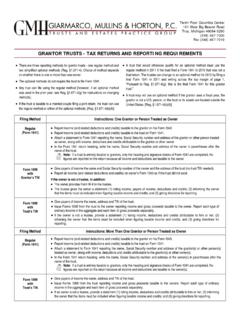
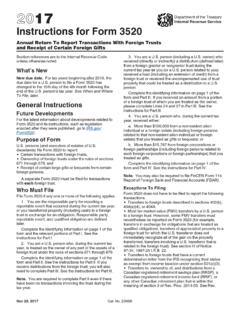
3 12 Taxes ..12 Legal, Guardianship and trustee Fees ..12 LOANS, CREDIT, DEBIT AND GIFT CARDS ..12 trust ADMINISTRATION AND ACCOUNTING ..12 trustee s Duties ..13 No self-dealing ..13 Impartiality ..13 Delegation ..13 Investment ..13 Bond ..13 Titling Assets ..14 Accounting Requirements ..14 Reporting to Social Security ..14 Reporting to Medicaid ..15 Reporting to the Court ..15 Modification of trust ..15 Wrapping up the trust ..15 INCOME TAXATION OF SPECIAL NEEDS TRUSTS ..15 Grantor Trusts ..15 Tax ID numbers ..16 Filing tax returns ..16 Non-Grantor Trusts ..16 Tax ID numbers ..16 Filing tax returns ..16 Qualified Disability trust ..16 Seeking Professional Tax Advice.
4 16 FOR FURTHER READING ..174 Introduction and Definition of Terms Special Needs trusts are complicated and can be hard to understand and administer. They are like other trusts in many respects the general rules of trust accounting, law and taxation apply but unlike more familiar trusts in other respects. The very notion of more familiar types of trusts will, for many, be amusing most people have no particular experience dealing with formal trust arrangements, and special needs trusts are often established for the benefit of individuals who would not otherwise expect to have experience with trust concepts. The essential purpose of a special needs trust is usually to improve the quality of an individual s life without disqualifying him or her from eligibility for public benefits.
5 Therefore, one of the central duties of the trustee of a special needs trust is to understand what public benefits programs might be available to the beneficiary and how receipt of income, or provision of food or shelter, might affect eligibility. Because there are numerous programs, competing (and sometimes even conflicting) eligibility rules, and at least two different types of special needs trusts to contend with, the entire area is fraught with opportunities to make mistakes. Because the stakes are often so high the public benefits programs may well be providing all the necessities of life to the beneficiary a good understanding of the rules and programs is critically important.
6 Before delving into a detailed discussion of special needs trust principles, it might be useful to define a few terms: GRANTOR (sometimes Settlor or Trustor ) the person who establishes the trust and generally the person whose assets fund the trust . There might be more than one grantor for a given trust . The tax agency may define the term differently than the public benefits agency. Special needs trusts can make this term more confusing than other types of trusts, since the true grantor for some purposes may not be the same as the person signing the trust instrument. If, for example, a parent creates a trust for the benefit of a child with a disability, and the parent s own money funds the trust , the parent is the grantor.
7 In another case, where a parent has established a special needs trust to handle settlement proceeds from a personal injury lawsuit or improperly directed inheritance, the minor child (through a guardian) or an adult child will be the grantor, even though he or she did not decide to establish the trust or sign any trust documents. trustee the person who manages trust assets and administers the trust provisions. Once again, there may be two (or more) Trustees acting at the same time. The grantor(s) may also be the trustee (s) in some cases. The trustee may be a professional trustee (such as a bank trust department or a lawyer), or may be a family member or trusted adviser though it may be difficult to qualify a non-professional to serve as trustee .
8 BENEFICIARY the person for whose benefit the trust is established. The beneficiary of a special needs trust will usually (but not always) be disabled. While a beneficiary may also act as trustee in some types of trusts, a special needs trust beneficiary will almost never be able to act as trustee . DISABILITY for most purposes involving special needs trusts, disability refers to the standard used to determine eligibility for Social Security Disability Insurance or Supplemental Security Income benefits: the inability to perform any substantial gainful employment. INCAPACITY (sometimes Incompetence) although incapacity and incompetence are not interchangeable, for our purposes they may both refer to the inability of a trustee to manage the trust , usually because of mental limitations.
9 Incapacity is usually important when applied to the trustee (rather than the beneficiary), since the trust will ordinarily provide a mechanism for transition of power to a successor trustee if the original trustee becomes unable to manage the trust . Incapacity of a beneficiary may sometimes be important as well. Not every disability will result in a finding of incapacity; it is possible for a special needs trust beneficiary to be disabled, but not mentally incapacitated. Minors are considered to be incapacitated as a matter of law. The age of majority differs slightly from state to state, though it is 18 in all but a handful of states. Administering a Special Needs trust :A Handbook for TrusteesThe essential purpose of a special needs trust is usually to improve the quality of an individual s life without disqualifying him or her from eligibility to receive public on page 6 REVOCABLE trust refers to any trust which is, by its own terms, revocable and/or amendable, meaning able to be undone, or changed.
10 Many trusts in common use today are revocable, but special needs trusts are usually irrevocable, meaning permanent or irreversible. IRREVOCABLE trust means any trust which was established as irrevocable (that is, no one reserved the power to revoke the trust ) or which has become irrevocable (for example, because of the death of the original grantor). SOCIAL SECURITY DISABILITY INSURANCE sometimes referred to as SSDI or SSD, this benefit program is available to individuals with a disability who either have sufficient work history prior to becoming disabled or are entitled to receive benefits by virtue of being a dependent or survivor of a disabled, retired, or deceased insured worker.