Transcription of A LEVEL PURE MATHS REVISON NOTES
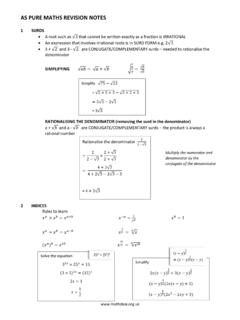
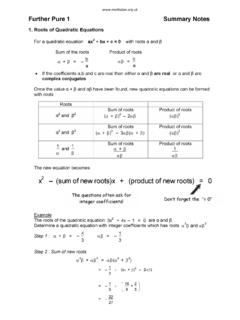
1 A LEVEL pure MATHS REVISON NOTES . 1 ALGEBRA AND FUNCTIONS. a) INDICES. Rules to learn : . 1 . = + = ( ) = = = = ( ).. 3 1. Simplify 2 ( )2 + 3( )2 Solve 32 25 = 15. 1. = ( ) (2 ( ) + 3)). 2 (3 5)2 = 151. 1. = ( ) (2 2 2 + 3). 2 2 = 1. 1. =. 2. b) SURDS. A root such as 3 that cannot be written as a fraction is IRRATIONAL. An expression that involves irrational roots is in SURD FORM. RATIONALISING THE DENOMINATOR is removing the surd from the denominator (multiply by the conjugate). 2. Simplify Rationalise the denominator 2 3. The conjugate of the denominator 2 2+ 3 2 - 3 is 2 + 3 so that 75 12 = 2+.
2 2 3 3 (2 - 3)( 2 + 3). = 5 5 3 2 2 3 = 22 - 32. = 5 3 2 3 = 4 + 2 3 =1. = 3 3. c) QUADRATIC EQUATIONS AND GRAPHS. Factorising identifying the roots of the equation ax2 + bx + c = 0. Look for the difference of 2 squares x2 a2 = (x + a)(x a) or (ax)2 - b2 = (ax + b)( ax b). Look for the perfect square x2 + 2ax + a2 = (x + a)2. Look out for equations which can be transformed into quadratic equations 12. Solve + 1 = 0 Solve 6 4 7 2 + 2 = 0. 2 + 12 = 0 Let z = x2 6 2 7 + 2 = 0. ( + 4)( 3) = 0 (2 1)(3 2) = 0. 1 1 2 2. x = -4 x = 3 = 2. = 2 = 3. = 3. Completing the square identifying the vertex and line of symmetry y = (x + a)2 + b vertex at (-a , b) line of symmetry as equation x = -a Line of symmetry x=2.
3 Quadratic formula (and the DISCRIMINANT). 2 4 . = for solving ax2 + bx + c = 0. 2 . The DISCRIMINANT b2 4ac can be used to identify the number of roots b2 4ac > 0 there are 2 real distinct roots (graph crosses the x-axis twice). b2 4ac = 0 there is a single repeated root (the x-axis is a tangent). b2 4ac < 0 there are no real roots (the graph does not touch the x-axis). d) SIMULTANEOUS EQUATIONS. Solving by elimination 3x 2y = 19 3 9x 6y = 57. 2x 3y = 21 2 4x 6y = 42. 5x 0y =15 x = 3 ( 9 2y = 19) y = -5. Solving by substitution x + y = 1 (y = 1 x). x2 + y2 = 25 x2 + (1 x)2 = 25. 2x2 2x 24 = 0.
4 2(x 4)(x + 3) = 0 x = 4 y = -3 x=-3 y=4. If you end up with a quadratic equation when solving simultaneously the discriminant can be used to determine the relationship between the graphs If b2 4ac > 0 the graphs intersect at 2 distinct points b2 4ac = 0 the graphs intersect at 1 point (or tangent). b2 4ac < 0 the graphs do not intersect e) INQUALITIES. Linear Inequality - solve using the same method as solving a linear equation but remember to reverse the inequality if you multiply or divide by a negative number Quadratic Inequality always a good idea to sketch a graph plot the graph as a solid line or curve < > plot as a dotted/dashed line or curve If you are unsure of which area to shade pick a point in one of the regions and check the inequalities using the coordinates of the point f) POLYNOMIALS.
5 A polynomial is an expression which can be written in the form axn + bxn-1 + cxn-2 + where a,b, c are constants and n is a positive integer. The order of the polynomial is the highest power of x in the polynomial Polynomials can be divided to give a Quotient and Remainder Factor Theorem If (x a) is a factor of f(x) then f(a) = 0 and is root of the equation f(x) = 0. Show that (x 3) is a factor of x3 19x + 30 = 0. f(x) = x3 19x + 30. f(3) = 33 -19 3 + 20. =0. f(3) = 0 so x 3 is a factor of f(x). g) GRAPHS OF FUNCTIONS. Sketching Graphs Identify where the graph crossed the y-axis (x = 0).
6 Identify where the graph crossed the x-axis (y = 0). Identify any asymptotes and plot with a dashed line . y=mx + c y = kx2 y=kx3 y= Asymptotes at y= Asymptotes at x = 0 and y = 0 2. x = 0 and y = 0. y is proportional to x2 . y is proportional to x2 y is proportional to y is proportional to 2. Modulus Graphs |x| is the modulus of x' or the absolute value |2|=2 |-2|= 2. To sketch the graph of y = |f(x)| sketch y = f(x) and take any part of the graph which is below the x-axis and reflect it in the x-axis Solve |2x - 4|<|x|. 2x - 4 = x 2x 4 = -x x =4 3x = 4. 4. x=3. 4. 3. <x<4. h) FUNCTIONS.
7 A function is a rule which generates exactly ONE OUTPUT for EVERY INPUT. DOMAIN defines the set of the values that can be put into' the function f(x) = domain x 0. RANGE defines the set of values output' by the function make sure it is defined in terms of f(x) and not x 2 means an input a is converted to a2 where the input a' can be any real number ( ) 0. 3. ( ) = +2 find 1 ( ). INVERSE FUNCTION denoted by f (x) -1. The domain of f-1(x) is the range of f(x) 3. = +2. -1. The range of f (x) is the domain of f(x). 3. = 2. Using the same scale on the x and y axis the graphs of a function and it's inverse have reflection symmetry 3.
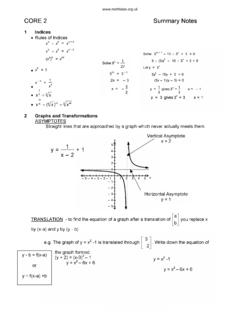
8 1 ( ) = 2. in the line y = x COMPOSITE FUNCTIONS. The function gf(x) is a composite function which tells you to do' f first and then use the output in g f(x) = 4x g(x) = x2 1. fg(x) = 4(x2 -1) gf(x) = (4x)2 - 1. = 4x2 - 4 = 16x2 - 1. i) TRANSFORMING GRAPHS. Translation . To find the equation of a graph after a translation of [ ] replace x by (x a) and y by (y b).. y = f(x -a) + b 3. The graph of y = x2 -1 is translated by [ ]. 2. Find the equation of the resulting graph. (y + 2) = (x 3)2 - 1. y = x2 6x + 6. Reflection Reflection in the x-axis replace y with -y y = -f(x). Reflection in the y-axis replace x with -x y = f(-x).
9 Stretch Stretch in the y-direction by scale factor a y = af(x). 1. Stretch on the x-direction by scale factor y = f(ax). Combining Transformations Take care with the order in which the transformations are carried out. The graph of y = x2 is reflected in the y axis and The graph of y = x2 is translated by [ ] and then . reflected in the y axis. Find the equation of the then translated by [ ]. Find the equation of the . resulting graph resulting graph Translation y = (x 3)2 Reflection y = (-x)2. = x2 -6x + 9 = x2. Reflection y = (-x)2 -6(-x) + 9 Translation y = (x 3)2. = x2 + 6x + 9 = x2 - 6x + 9.
10 J) PARTIAL FRACTIONS. Any proper algebraic fractions with a denominator that is a product of linear factors can be written as partial fractions Useful for integrating a rational function Useful for finding binomial approximations + + . ( + )( + )( + ). = + . + + + + ( + )( + )2. = + . + + + ( + )2. 5 . Express ( 2)( +3) in the form 2 + +3. ( +3)+ ( 2). 2. + +3 ( +3)( 2). A(x + 3) + B(x - 2) = 5 x = 2 5A = 5 x = -3 -5B = 5. A=1 B = -1. 5 1 1. = . ( 2)( +3) 2 +3. 2 COORDINATE GEOMETRY. a) Graphs of linear functions y = mx + c the line intercepts the y axis at (0, c).. Gradient = . Positive gradient Negative gradient Finding the equation of a line with gradient m through point (x1, y1).