Transcription of AS PURE MATHS REVISION NOTES
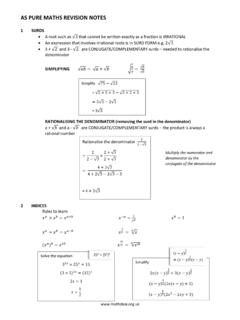
1 AS PURE MATHS REVISION NOTES . 1 SURDS. A root such as 3 that cannot be written exactly as a fraction is IRRATIONAL. An expression that involves irrational roots is in SURD FORM 2 3. 3 + 2 and 3 - 2 are CONJUGATE/COMPLEMENTARY surds needed to rationalise the denominator . SIMPLIFYING = = . Simplify 75 12. = 5 5 3 2 2 3. = 5 3 2 3. = 3 3. RATIONALISING THE DENOMINATOR (removing the surd in the denominator). a + and a - are CONJUGATE/COMPLEMENTARY surds the product is always a rational number 2. Rationalise the denominator 2 3. 2 2 + 3 Multiply the numerator and = . 2 3 2 + 3 denominator by the conjugate of the denominator 4 + 2 3. =. 4 + 2 3 2 3 3. = 4 + 2 3. 2 INDICES. Rules to learn 1. = + = 0 = 1. 1.. = = .. ( ) = = . 3. 25x = (52)x ( )2. Solve the equation 1. = ( )2 ( ). Simplify 32 25 = 15. 3 1. (3 5)2 = (15)1 2 ( )2 + 3( )2. 2 = 1 1. ( )2 (2 ( ) + 3). 1 1. = ( )2 (2 2 2 + 3). 2. 3 QUADRATIC EQUATIONS AND GRAPHS. Factorising identifying the roots of the equation ax2 + bc + c = 0.
2 Look out for the difference of 2 squares x2 a2= (x - a)(x + a). Look out for the perfect square x2 + 2ax + a2 = (x + a)2 or x2 2ax + a2 = (x -a)2. Look out for equations which can be transformed into quadratic equations Solve + 1 . 12. =0 Solve 6 4 7 2 + 2 = 0.. Let z = x2. 2 + 12 = 0. ( + 4)( 3) = 0 6 2 7 + 2 = 0. x = 3, x = -4 (2 1)(3 2) = 0. 1 2. = =. 2 3. 1 2. = 2 = 3. Completing the square - Identifying the vertex and line of symmetry In completed square form y = (x + a)2 b the vertex is (-a, b). the equation of the line of symmetry is x = -a y = (x - 3)2 - 4. Line of symmetry Sketch the graph of x=3 y = 4x x2 1. y = - (x2 - 4x) 1. y = - ((x 2)2 4) 1. Vertex (2,3). y = - (x-2)2 + 3. Vertex (3,-4). Quadratic formula 2 4 . = for solving ax2 + bx + c = 0. 2 . The DISCRIMINANT b2 4ac can be used to identify the number of solutions b2 4ac > 0 there are 2 real and distinct roots (the graphs crosses the x- axis in 2 places). b2 4ac = 0 the is a single repeated root (the x-axis is a tangent to the graph).
3 B2 4ac < 0 there are no 2 real roots (the graph does not touch or cross the x-axis). 4 SIMULTANEOUS EQUATIONS. Solving by elimination 3x 2y = 19 3 9x 6y = 57. 2x 3y = 21 2 4x 6y = 42. 5x 0y =15 x=3 ( 9 2y = 19) y = -5. Solving by substitution x + y =1 rearranges to y = 1 - x x2 + y2 = 25. x2 + (1 x)2 = 25. x2 + 1 -2x + x2 25 = 0. 2x2 2x 24 = 0. 2(x2 - x 12) = 0. 2(x 4)(x + 3) = 0 x=4 x = -3. y = -3 y=4. If when solving a pair of simultaneous equations, you arrive with a quadratic equation to solve, this can be used to determine the relationship between the graphs of the original equations Using the discriminant b2 4ac > 0 the graphs intersect at 2 distinct points b2 4ac = 0 the graphs intersect at 1 point (tangent). b2 4a < 0 the graphs do not intersect 5 INEQUALITIES. Linear Inequality Solve 10 3x < 4. This can be solved like a linear equation except that Multiplying or Dividing by a negative value reverses the inequality -3x < -6.
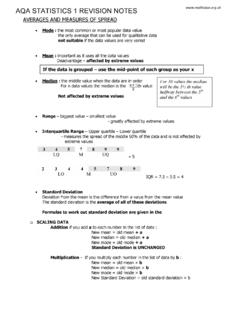
4 X>2. Quadratic Inequality always a good idea to sketch the graph! Solve 4x2 - 25 0. 2. Solve x + 4x 5 < 0. 4x2 - 25 = 0. x2 + 4x 5= 0 (2x 5)(2x + 5) = 0. (x 1)(x + 5) = 0 5. x=2 x=-2. 5. x = 1 x = -5. x2 + 4x 5 < 0 4x2 - 25 0. 5 5. -5 < x < 1 x - or x . 2 2. which can be written as which can be written as {x : x > -5 } {x : x <1 } 5 5. {x : x - 2 } {x : x 2}. 6 GRAPHS OF LINEAR FUNCTIONS. y = mx + c the line intercepts the y axis at (0, c).. Gradient = . Positive gradient Negative gradient Finding the equation of a line with gradient m through point (a,b). Use the equation (y b) = m(x a). If necessary rearrange to the required form (ax + by = c or y = mx c). Parallel and Perpendicular Lines y = m1x + c1 y = m2x + c2. If m1 = m2 then the lines are PARALLEL. If m1 m2 = -1 then the lines are PERPENDICULAR. Find the equation of the line perpendicular to the line y 2x = 7 passing through point (4, -6). Gradient of y 2x = 7 is 2 (y = 2x + 7).
5 Gradient of the perpendicular line = - (2 - = -1). Equation of the line with gradient passing through (4, -6). (y + 6) = - (x 4). 2y + 12 = 4 x x + 2y = - 8. Finding mid-point of the line segment joining (a,b) and (c,d). + + . Mid-point = ( , ). 2 2. Calculating the length of a line segment joining (a,b) and (c,d). Length = ( )2 + ( )2. 7 CIRCLES. A circle with centre (0,0) and radius r has the equations x2 + y2 = r2. A circle with centre (a,b) and radius r is given by (x - a)2 + (y - b)2 = r2. Finding the centre and the radius (completing the square for x and y). Find the centre and radius of the circle x2 + y2 + 2x 4y 4 = 0. x2 + 2x + y2 4y 4 = 0. (x + 1)2 1 + (y 2)2 4 4 = 0. (x + 1)2 + (y 2)2 = 32. Centre ( -1, 2) Radius = 3. The following circle properties might be useful Angle in a semi-circle The perpendicular from the centre The tangent to a circle is is a right angle to a chord bisects the chord perpendicular to the radius Finding the equation of a tangent to a circle at point (a,b).
6 The gradient of the tangent at (a,b) is perpendicular to the gradient of the radius which meets the circumference at (a, b). Find equation of the tangent to the circle x2 + y2 - 2x - 2y 23 = 0 at the point (5,4). (x - 1)2 + (y 1)2 25 = 0. Centre of the circle (1,1). 4 1 3 4. Gradient of radius = 5 1 = 4. Gradient of tangent = - 3. 4. Equation of the tangent (y 4) = - 3(x 5) 3y 12 = 20 - 4x 4x + 3y = 32. Lines and circles Solving simultaneously to investigate the relationship between a line and a circle will result in a quadratic equation. Use the discriminant to determine the relationship between the line and the circle b2 4ac > 0 b2 4ac = 0 (tangent) b2 4ac < 0. 8 TRIGONOMETRY. You need to learn ALL of the following Exact Values 2 1 3. sin 45 = sin 30 = 2 sin 60 = 2. 2. 2 2 3 1. cos 45 = cos 30 = cos 60 = 2. 2 2 3. 1. tan 45 = 1 tan 30 = tan 60 = 3. 3. Cosine Rule a2 = b2 + c2 - 2bc Cos A.. Sine Rule = =.. 1. Area of a triangle.
7 2. Identities . sin2x + cos2x = 1 tan x = . Graphs of Trigonometric Functions y = sin y = cos y =tan .. Solve the equation sin2 2 + cos 2 + 1 = 0 0 360 . (1 cos2 2 ) + cos 2 + 1 = 0. cos2 2 cos 2 2 = 0. (cos 2 2)(cos 2 + 1) = 0.. cos 2 = 2 (no solutions). cos 2 = -1 2 = 180 , 540 . = 90 , 270 . 9 POLYNOMIALS. A polynomial is an expression which can be written in the form + 1 + 2 . when a,b, c are constants and n is a positive integer. The ORDER of the polynomial is the highest power of x in the polynomial Algebraic Division Polynomials can be divided to give a Quotient and Remainder Divide x3 x2 + x + 15 by x + 2. x2 -3x +7 Quotient 3. x +2 x - x2 +x + 15. x3 + 2x2. -3x2 +x -3x2 -6x 7x + 15. 7x + 14. 1. Remainder Factor Theorem The factor theorem states that if (x a) is a factor of f(x) then f(a) = 0. Show that (x 3) is a factor of x3 -19x + 30 = 0. f(x) = x3 19x + 30. f(3) = 33 - 19 3 + 30. =0. f(3) = 0 so (x 3) is a factor Sketching graphs of polynomial functions To sketch a polynomial Identify where the graph crosses the y-axis (x = 0).
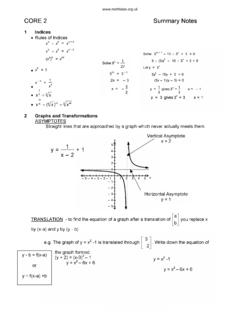
8 Identify the where the graph crosses the x-axis, the roots of the equation y = 0. Identify the general shape by considering the ORDER of the polynomial y = + 1 + 2 . n is even n is odd Positive a > 0 Negative a < 0 Positive a > 0 Negative a < 0. 10 GRAPHS AND TRANSFORMATIONS. 3 graphs to recognise 1 1. = = 2 = .. Asymptote x = 0. Asymptotes x= 0 and y = 0. TRANSLATION. The graph of y = x2 - 1 is translated To find the equation of a graph after a translation of [ ]. 3. replace x with (x - a) and replace y with (y b) by vector [ ]. Write down the 2. equation of the new graph In function notation (y + 2) = (x 3)2 -1. y = f(x) is transformed to y = f(x -a) + b y = x2 - 6x + 6. REFLECTION. To reflect in the x-axis replace y with -y (y = -f(x)). To reflect in the y- axis replace x with -x (y = f(-x)). STRETCHING. 1 1. To stretch with scale factor k in the x direction (parallel to the x-axis) replace x with x y = f( x). 1. To stretch with scale factor k in the y direction (parallel to the y-axis) replace y with y y = kf(x).
9 Describe a stretch that will transform y = x2 + x 1 to the graph y = 4x2 + 2x - 1. y = (2x)2 + (2x) 1. x has been replaced by 2x which is a stretch of scale factor parallel to the x-axis 11 binomial EXPANSIONS. Permutations and Combinations The number of ways of arranging n distinct objects in a line is n! = n(n - 1)(n - 2) .3 2 1. ! The number of ways of arranging a selection of r object from n is nPr = ( )! ! The number of ways of picking r objects from n is nCr = !( )! A committee comprising of 3 males and 3 females is to be selected from a group of 5 male and 7. female members of a club. How many different selections are possible? 7! 5! Female Selection 7C3 = = 35 ways Male Selection 5C3 = = 10 ways 3!4! 3!2! Total number of different selections = 35 10 = 350. expansion of ( + ) . ( 1) 2 ( 1)( 2) 3. (1 + ) = 1 + + + + 1 + . 1 2 1 2 3. Use the binomial expansion to write down the first four terms of (1 - 2x)8. 8 7 8 7 6. (1 2 )8 = 1 + 8 ( 2 ) + ( 2 )2 + ( 2 )3.
10 1 2 1 2 3. = 1 16 + 112 2 448 3. expansion of ( + ) . ( 1) 2 2 ( 1)( 2) 3 3. ( + ) = + 1 + + + 1 + . 1 2 1 2 3. Find the coefficient of the x3 term in the expansion of (2 + 3x)9. (3x)3 must have 26 as part of the coefficient (3 + 6 = 9). 9 8 7. 26 (3 )3 = 145152 (x3). 1 2 3. 12 DIFFERENTIATION.. The gradient is denoted by if y is given as a function of x The gradient is denoted by f'(x) is the function is given as f(x).. = = 1 = = 1 = =0.. Using Differentiation Tangents and Normals The gradient of a curve at a given point = gradient of the tangent to the curve at that point The gradient of the normal is perpendicular to the gradient of the tangent that point Find the equation of the normal to the curve y = 8x x2 at the point (2,12).. = 8 2 Gradient of tangent at (2,12) = 8 4 = 4. Gradient of the normal = - (y - 12) = - (x 2). 4y + x = 50. Stationary (Turning) Points . The points where = 0 are stationary points (turning points) of a graph The nature of the turning points can be found by: Calculating the gradient close to the point Maximum point Minimum Point.