Transcription of A MEDWATCH CONTINUING EDUCATION ARTICLE
1 BENEFITS AND RISKS OFIMMUNIZATIONOver ten million childhood vaccina-tions are given to children (birth through 5ye a rs) annu a l ly, and many million ofdoses are given to adults. All medicinalproducts,including vaccines,have risksand benefits. Vaccines protect many peo-ple from dangerous illnesses,but,likedrugs,can cause side effects,a small per-centage of which may be serious. Thebenefit of vaccines is measured as pre-vented disease,and the risk of vaccinationis measured as potential side effects; bothare monitored as part of the US publichealth EVALUATIONOF VACCINESL icensure requires extensive clinicaleva l u ation of the va c c i n e s s a fety andeffectiveness which is completed in stagesover several years. First,laboratory andanimal studies are performed. Then can-didate vaccines are tested in small groupsof adult volunteers to establish first thesafety,and then,the efficacy of the vac-cine.
2 Finally larger-scale clinical trials,u s u a l ly ra n d o m i zed and placeb o - c o n-trolled,measure the rates of the morecommon adverse events and the protectivee ffi c a cy of the va c c i n e. The contro lgroups in these clinical trials who do notreceive vaccine are critical to distinguish-ing between vaccine-related events and anevent unrelated to vaccine but occurringspontaneously in the study of the most common vaccine reac-tions,such as injection site reactions andfever,can be estimated before licensure,but the comparatively small number ofpatients enrolled in these trials generallylimits detection of rare events or eventsthat occur after long-term exposure. Eventhe largest pre-licensure trials (>10,000persons) are inadequate to assess the vac-cine s potential to induce rare but seriousside effects. Consequently,it is essentialto continue to collect info rm ation onva c c i n e - a s s o c i ated adve rse events afterl i c e n s u re wh i ch may only occur afterwide-scale use of the vaccine in the gener-al population.
3 POST-MARKETINGSURVEILLANCEPost-marketing surveillance is a nec-essary component of vaccine safety moni-toring. The manufacturers label/productinformation approved at licensure has thepotential to be continuously updated ass i g n i ficant adve rse event info rm at i o nwhich differs from what was originallyknown at the time of approval is to the relatively small number ofpatients studied in pre-licensure studies,rarer side effects or events that may onlyoccur in a sub-group of the population notsignificantly represented in pre-marketingstudies ( ,neonates and infants whore c e ive hep atitis B va c c i n e,p reg n a n twomen,immunosuppressed patients),orside effects that occur only with chronic orrepeated exposure to a vaccine-inducedantigen may not be revealed until the vac-cine is licensed to the general clinical trials are conductedin a controlled environment,much differ-ent from data obtained from passive ora c t ive post-marketing surveillance sys-tems.
4 After licensure, vaccinated personshave diverse demographic characteristics( e. g. ,age, ra c e, socioeconomic back-ground),medical history (immunocom-promised host),and/or multiple medicalproblems necessitating medication (poten-tial drug interactions). These previouslyunstudied components of a patient s socialor medical history may be risk factorswhich could impact the outcome of vacci-nation and contribute to the developmentof adverse events. Thus,when the productleaves the controlled study environment of AMEDWATCHCONTINUING EDUCATION ARTICLEPost-marketing surveillance for adverse events after vaccination:the national Vaccine Adverse Event Reporting System (VAERS)Provided as a service by the National Institutes of Health/Foundation for Advanced EDUCATION in the Sciences (NIH/FAES), Bethesda, MD,and the Food and Drug Administration (FDA), Rockville, MDLearning Objectives:Upon completion of this program,health professionals should be able to.
5 Identify the principles ofpost-marketing surveillance Understand the objectives of VAERS Understand how VAERS operates Discuss basic limitations and strengths of data derived from VAERS List examples of FDA regulatoryactions that have been based onpost-marketing passive surveillance Describe how FDA disseminatesinformation regarding vaccine safetyto the public Understand how clinical practiceimpacts a national post-marketingsurveillance systemFaculty:Manette T. Niu,MDMedical OfficerEpidemiology BranchDivision of Biostatistics andEpidemiology (DBE)Center for Biologics Evaluation andResearch(CBER),FDAM arcel E. Salive,MD,MPHC hiefEpidemiology BranchDivision of Biostatistics andEpidemiology (DBE)Center for Biologics Evaluation andResearch (CBER),FDAS usan S. Ellenberg,PhDDirectorDivision of Biostatistics andEpidemiology (DBE)Center for Biologics Evaluation andResearch (CBER),FDAN ovember 1998clinical trials and is put into general clini-cal use by practitioners,the ability todetermine the actual incidence of adverseevents is objectives of post-marketing surveil-lance are to identify rare adverse reactionsnot detected during pre-licensure studies,monitor increases in known re a c t i o n s ,identify risk factors or pre-existing condi-tions that may promote re a c t i o n s ,and identify particular vaccine lots with unusually high rates or types of events.
6 There are two types of post-marketing sur-veillance systems typically in use:activeand passive surveil-lance links the vaccination status of allpersons in a defined population to theirclinical outcomes,t h u s ,m i n i m i z i n gunder-reporting. Such a system may pro-vide comprehensive data,but may be veryexpensive and due to the comparativelysmall number of participants,may lackability to detect very rare events or s s ive surveillance systems re ly onhealth professionals or vaccinees to volun-tarily submit reports of illness followingvaccination. There is no solicitation ofthese reports; this system is simpler,lessexpensive,does not limit the populationf rom wh i ch rep o rts are accep t e d,a n dbecause of the broad pool of reporters,o ffe rs the potential for detecting ra reevents. However,limitations of passivesurveillance systems include variability inreporting standards,reporter bias and sig-nificant under-reporting of events.
7 Bothactive and passive surveillance systemslack specificity,that is,reported post-vac-cination events may be coincidental andnot caused by the causality of reported post-vaccination events with a specific vaccineis challenging and requires careful weigh-ing of all the scientific evidence, evalua-tion of the quality and consistency of thedata,and consideration of biologic plau-sibility of the association between vacci-nation and event (Table 1)(1,2,17). Thestronger the vaccine-event relationship ineach case,and rarer the spontaneous inci-dence of the event ( ,background rate inan unvaccinated population),the fewercases are needed to establish a causalassociation (1,2,17). Biologic plausibility and strength of association aid in evaluat-ing if an association is causal,as does avaccination re-challenge ( positive rechal-lenge ) which elicits an identical vaccinereaction (1,2).
8 When faced with a suspicious event,it isimportant to try to determine the back-ground incidence rate of the event beforemaking a judgement as to causality (1,2).Defining the relationship between vaccine exposure and the occurrence of an event isnot easy,and it is often impossible withthe available data to reach a events may act through the samephysiological and pathological pathwaysas normal disease,they are difficult to dis-tinguish. The causal association betweenvaccination and event may be suggestedby various criteria (Table 1)(1,2,17).VACCINE SAFETYSURVEILLANCE:VAERSThe National Childhood Va c c i n eI n j u ry Act (NCVIA) of 1989 re q u i re shealth professionals and vaccine manufac-t u re rs to rep o rt to the Dep a rtment of Health and Human Services (DHHS) spe-cific adverse events following the admin-istration of vaccines specified in the Reportable Events Table,part of theA c t ,lists rep o rt able post-va c c i n at i o nevents and the time frames in which theymust occur in order to qualify as beingreportable (Table 2)(17).
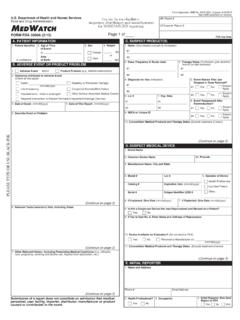
9 In 1990,DHHSe s t ablished the Vaccine A dve rse Eve n tReporting System (VAERS),co-adminis-t e red by the Food and Dru gA d m i n i s t ration (FDA) and Centers fo rDisease Control and Prevention (CDC) toaccept all reports of suspected adverseevents after administration of any ,the national passive surveillancesystem monitoring vaccine safety,is a sys-tem to which clinical events after vaccina-tion are voluntarily reported from healthprofessionals,vaccine manufacturers,andthe public (2,3). The reports are submittedto state or local public health authorities,vaccine manu fa c t u re rs ,or dire c t ly toVAERS,and all ultimately end up in theVAERS dat ab a s e. Food and Dru gRegulations (21 CFR section ) cur-rently require that the following adverseevents be reported to VAERS by eachm a nu fa c t u rer having a product licensef rom FDA :all spontaneous rep o rts ofadverse experiences occurring within theU.
10 S. ,whether seri o u s ,n o n - s e ri o u s ,expected or unexpected; and all seriousand unexpected adve rse ex p e ri e n c e soccurring outside of the or reportedin scientific/medical journals as casereports or as the result of formal clinicaltrials (Table 2)(17). In order to encourage reporting of adverseevents,FDA regulations offer substantialprotection against disclosure of the identi-ties of both reports and patients. SinceJuly 3,1995,a regulation preempted stated i s c ove ry laws rega rding vo l u n t a ryPost-marketing surveillance for adverse events after vaccination:the national Vaccine Adverse Event Reporting System (VAERS)2 EVALUATING SIDE EFFECTS AFTER VACCINATION:TEMPORAL VERSUS CAUSAL ASSOCIATIONS (17)An adverse event can be causally attributed to vaccine more readily if:1. Chronology of administration of agent,including beginning andending of treatment and adverse event onset is known2.