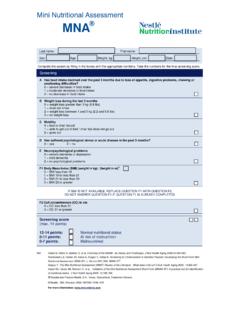
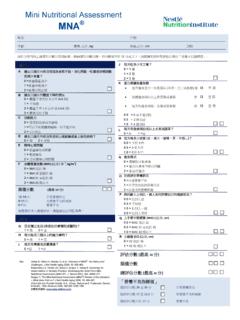
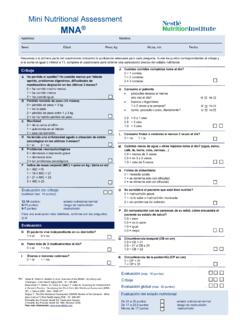
Transcription of A SELF-COMPLETED NUTRITION SCREENING TOOL …
1 IntroductionIn 2000, there were approximately 35 million Americansaged 65 years or older and million aged 80 years or 2030, these numbers are projected to increase to anestimated 71 million and million persons, respectively (1).Decreases in food intake by an older adult can have far worseconsequences as they are more likely to suffer from multiplemedical conditions, causing severe physiologic and bodycomposition changes (1). The demographic epidemiologic shifttowards an increasing proportion of the aging populationcoupled with continuous changes in dietary and nutritionalpatterns have presented the field of public health with newchallenges.
2 In an era of healthcare reform and self-directedcare, patients have become more involved in their own healthmanagement. Previous studies have found that malnutrition and being atrisk for malnutrition exists in 38% of community older adultsworldwide (2), and malnutrition may be present in up to 50% ofelderly adults (3). Malnutrition, which is frequentlyundetected, is the cumulative effect of the often compromiseddietary habits of the elderly and the physiological changesassociated with aging.
3 It is associated with a significant risk ofmorbidity and mortality in independently living older adults, aswell as in nursing home residents and hospitalized patients (3). The purpose of nutritional SCREENING is to quickly identifyindividuals that are malnourished or at risk of malnutrition (4).National and international societies recommend routinenutrition SCREENING to identify malnutrition and the risk ofmalnutrition (4, 5). The characteristics of an effectivenutritional SCREENING tool include: simplicity, utilization ofreadily available data or data that is easy to obtain, and theinclusion of data relevant to nutritional status.
4 Ideally, aneffective SCREENING tool will result in a viable intervention andwill also be international societies recommend the use ofnutrition SCREENING tools to facilitate the identification ofmalnutrition (4, 5). One of the most common barriers towidespread and regular NUTRITION SCREENING of the elderly hasbeen the lack of a validated, convenient SCREENING tool that iseasily and quickly administered by healthcare professionals(HCPs). For this reason, the Mini Nutritional Assessment(MNA), developed by Guigoz, is a SCREENING tool that can beused to identify geriatric patients ( 65 years) at risk ofmalnutrition (6, 7).
5 The Mini Nutritional Assessment ShortForm (SF-MNA ), is a 6-question short form of the MNA thatcan be completed in 5 minutes or less. The MNA has beenvalidated in international studies with a broad range of HCPs ina variety of settings (6, 8). Currently, this instrument isadministered by HCPs to determine patients nutritional status. We hypothesize that greater gains could be made in the earlydetection of declining nutritional status if the elderly couldassist in the identification of their own nutritional status bycompleting the self-administered MNA (Self-MNA)themselves, or if it could be completed by a family member orother caregiver.
6 For this reason, we conducted a study toA SELF-COMPLETED NUTRITION SCREENING TOOL FOR COMMUNITY-DWELLING OLDER ADULTS WITH HIGH RELIABILITY: A COMPARISON STUDY HUHMANN1, V. PEREZ2, ALEXANDER3, THOMAS41. Nestl Health Science, Parsippany, NJ; 2. Exponent, Inc. Health Sciences, Chicago, IL; 3. Exponent, Inc. Health Sciences, Boulder, CO; 4. Division of Geriatrics/Gerontology, University School of Medicine, St. Louis, MO. Corresponding author: Maureen B. Huhmann, Nestl Health Science, Parsippany, NJ, USAA bstract:Objectives: Malnutrition is common in community-dwelling older adults and is associated with pooroutcomes including hospitalization and mortality.
7 Recently, a 6-question short form mini nutritional assessment(SF-MNA) was validated for rapid NUTRITION SCREENING . Ideally, NUTRITION SCREENING could be performed byindividuals or their caregivers prior to or during an outpatient clinical visit, thus allowing for the ongoingmonitoring of nutritional status among older adults. Design:We compared the SF-MNA administered by ahealthcare professional (HCP) to a 6-item self-administered SCREENING tool (Self-MNA) in 463 communitydwelling older adults who gave informed consent.
8 The population was 60% women with a mean age of The HCP was blinded to the results of the Self-MNA questionnaire. Results:Using the SF-MNA, 27% ofsubjects were malnourished, 38% were at risk, and 35% had normal NUTRITION status. The agreement between theSelf-MNA and the SF-MNA was 99% (Self-MNA sensitivity 99%, specificity 98%, false negative rate 1%, falsepositive rate 2%) for identifying Malnourished subjects and 83% (sensitivity 89%, specificity 77%, false negativerate 11%, false positive rate 23%) for identifying At Risk of Malnutrition compared to the MNA-SF administeredby a HCP.
9 Conclusion:We found that the Self-MNA demonstrates sufficient inter-rater reliability for use innutrition SCREENING among community-dwelling older adults. Further validation studies and the possible impactof language translation should be words:Malnutrition, NUTRITION SCREENING , elderly, older Journal of NUTRITION , Health & Aging Volume 17, Number 4, 2013 Received December 5, 2012 Accepted for publication January 7, 201314 HUHMANN_04 LORD_c 05/03/14 09:39 Page339determine the inter-rater agreement between the Self-MNA andSF-MNA by comparing the level of agreement in thecategorization of nutritional status between both SCREENING toolsin a population aged 65 years or older when completed byeither the individuals themselves or by their caregiver.
10 MethodsThe Self-MNA was created by modifying the patient interviews, each item of the SF-MNA wastested with individuals aged 65 years or older. Table 1illustrates the changes in the Self-MNA as compared to the individuals aged 65 years or older and caregiverswere recruited to attend an in-person interview in one of 40centrally located market research facilities. Subjects andcaregivers were recruited using multiple sample sources,including Kantar Health s Lightspeed Consumer Panel, facilitydatabases, and newspaper advertising.