Transcription of (A) Senior Worker Support Package
1 (A) Senior Worker Support Package To Support employers in implementing the key recommendations by the Tripartite Workgroup on Older Workers (TWG-OW), the Government will provide a Senior Worker Support Package comprising the following components: 1. Senior Employment Credit 2. CPF Transition Offset 3. Senior Worker Early Adopter Grant 4. Part-time Re-employment Grant (1) Senior Employment Credit To help employers with the transition to the higher Retirement Age (RA) and Re-employment Age (REA), the Government will provide wage offsets , through the Senior Employment Credit scheme, to employers that hire Senior Singaporean workers aged 55 and above. For 2021 and 2022, employers will get up to 8% of the wages paid to workers aged 55 and above, depending on the workers age and wage. More Support will be given for the older age bands. Table 1: Senior Employment Credit Wage offsets Age 2021 2022 55-59 Up to 2% Up to 1% 60-64 Up to 3% 65-66 Up to 5% 67 & over Up to 8% The wage offset will apply to Senior workers earning up to $4,000, with the maximum wage offset targeted at Senior workers earning $3,000.
2 (2) CPF Transition Offset# To alleviate the rise in business costs due to the increase of CPF contribution rates in 2022, the Government will provide employers with a one-year offset of to percent of wages (equivalent to 50% of the increase in employer CPF contribution rates in 2022) for every Singaporean and Permanent Resident Worker they employ who are aged above 55 to 701. The offset to employers will be calculated based on employees incomes paid up to the CPF salary ceiling of $6,000 per month in 2022. More details will be made available at a later stage. 1 The CPF Transition Offset was announced at Budget on 18 February 2020 to take effect from 1 Jan 2021 to 31 Dec 2021. With the deferral in increase in CPF contribution rates announced by DPM Heng on 26 May 2020 during the Ministerial Statement, the CPF Transition Offset scheme will similarly be deferred by one year and take effect from 1 Jan 2022 to 31 Dec 2022 instead.
3 Table 2: CPF Transition Offset Age Bands Increase in CPF Contribution by Employer from 2022 CPF Transition Offset for Employers in 2022 (equivalent to 50% of increase in employer CPF contribution rates) 55 No change >55 to 60 +1%-point >60 to 65 +1%-point >65 to 70 + >70 No change (3) Senior Worker Early Adopter Grant To Support progressive companies that are willing and able to implement a higher RA and REA ahead of time, the Government will introduce a Senior Worker Early Adopter Grant which provides companies up to $250,000 to raise their company s own retirement and re-employment ages above minimum statutory requirements. Given that the potential challenge and impact of implementing these changes generally increase with the size of company s Senior workforce, the funding quantum will be based on (i) the number of resident Senior workers in the company nearing the RA and REA ( 60 years) and thus most likely to benefit, and (ii) the extent of increase in the internal retirement and re-employment ages.
4 The total eligible funding will be capped at 50 Senior workers per company. Table 3: Senior Worker Early Adopter Grant Funding Parameters Extent of Advancement of RA and REA increases Funding per Senior Worker (age 60 and above) Total Eligible Funding (Cap of 50 Senior workers per company) By 1 year each $1,000 $50,000 By 2 years each $2,500 $125,000 By 3 or more years $5,000 $250,000 To ensure lasting change for the benefit of current and future Senior workers, companies will be required to make changes to company HR policies and employment contracts, and communicate them to employees. (4) Part-time Re-employment Grant Through the Tripartite Workgroup s public consultation and other surveys, we observed that Senior workers increasingly prefer to reduce their work intensity gradually as they approach retirement. They would be prepared to remain in the workforce if they could undertake part-time work arrangements during the re-employment phase.
5 As employers need time to restructure their work structures and processes to accommodate more part-time employees, the Tripartite Workgroup agreed on a promotional approach for a start. To Support this, the Government will provide up to $125,000 to companies that commit to providing part-time re-employment opportunities to eligible Senior workers upon their request. A company, which commits to providing part-time re-employment opportunities to eligible workers upon their request, will receive $2,500 per resident Senior Worker ( 60 years). The total eligible funding will be capped at 50 Senior workers per company. Companies that commit to the part-time re-employment grant but are not able to find a suitable part-time vacancy subsequently will be obliged to pay an Employment Assistance Payment. To ensure lasting change for the benefit of current and future Senior workers, companies will be required to formalise the changes through their HR policies and employees contracts.
6 (B) Recap of key recommendations by the Tripartite Workgroup on Older Workers Raising of Retirement and Re-employment Ages The statutory minimum RA and REA will be raised to 65 and 70 respectively by 2030. The first move will take effect from 1 July 2022, with RA increasing from 62 to 63, and REA increasing from 67 to 68. The exact timing of future moves will be decided later, but the full increase of three years should be completed by the end of the next decade ( by 2030). Raising CPF Contribution Rates# The CPF contribution rates for workers aged above 55 to 70, originally recommended to increase from 1 January 2021, has now been deferred to take place from 1 Jan 20222 as shown in Table 4 below. To boost retirement adequacy, the increase in contribution rates will be allocated to the Special Account. 2 To help businesses manage costs amidst this challenging period, the Government has decided to defer the increase to take place one year later from 1 January 2022 instead.
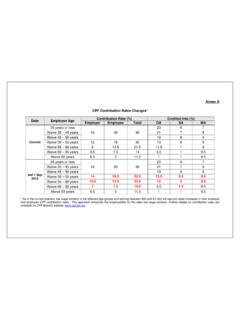
7 The deferral is in line with the recommendation by TWG-OW to pace increases in CPF contribution rates depending on prevailing economic conditions. This was announced by DPM Heng during the Ministerial Statement on 26 May 2020. Tables 5a and 5b show the new CPF contribution rates for Senior workers from 1 January 2022. Table 4: Increase in CPF Contribution Rates for Senior Workers Age Bands Today 1 Jan 2022 Long Term Target* 55 37% (No change) >55 to 60 26% 28% 37% >60 to 65 26% >65 to 70 14% >70 (No change) *Full increase to be completed within a decade as far as possible, depending on economic conditions Table 5a: New CPF Contribution Rates for Employees (increases in brackets) Date Age Bands Contribution Rate (% of wages) Contribution by Employer Contribution by Employee Total With effect from 1 Jan 2022 55 37 (No change) >55 to 60 14 (+1) 14 (+1) 28 (+2) >60 to 65 10 (+1) (+1) (+2) >65 to 70 8 (+ ) 6 (+1) 14 (+ ) >70 (No change) Table 5b.
8 Allocation of New CPF Contribution Rates for Employees (increases in brackets) Date Age Bands Allocation of CPF Contributions (% of wages) Ordinary Account Special Account Medisave Account With effect from 1 Jan 2022 55 15 >55 to 60 12 (+2) >60 to 65 (+2) >65 to 70 1 (+ ) >70 1 1 Note: 1. The rates in Tables 5a and 5b are applicable for Singapore Citizens and Singapore Permanent Residents (SPRs) in the 3rd year and onwards of obtaining SPR status and earning monthly wages of $750. As per current practice, the employee CPF contribution rates for employees earning >$500 but <$750 will be pro-rated. Further details on the changes to the contribution rates are available on CPF Board s website: 2. The Ordinary Wage Ceiling will remain as $6,000. Inclusive Workforce and Progressive Workplaces The TWG-OW also recommended that employers adopt age-friendly practices to ensure that Senior workers are valued and embraced as part of a diverse and inclusive workforce.
9 These include: o Providing part-time re-employment opportunities, and commit to do so via their HR policies and employment contracts. The approach should be promotional. By providing Senior workers with more opportunities for part time work, it would allow them to remain in the workforce. o Engaging employees in structured career planning sessions at various age milestones ( 45 and 55). Conversations with mature workers (around age 45) can be centred on their future career plans and potential Support from companies, while those with Senior workers (around age 55) can focus on relevant skills needed for re-employment. This will help keep Senior workers skills and knowledge relevant in the future economy, and enable employers to benefit from retaining experienced and well-trained workers. o Embarking on job redesign to effect organisation-wide and systems-level changes so as to (i) increase the number of Senior workers who can perform the job; and/or (ii) extend upwards the age at which workers can do a job.
10 O Restructuring their medical benefits schemes, and provide additional MediSave contributions or other flexible benefits instead. This eliminates duplication between employer-provided medical schemes and MediShield Life, and helps manage employers healthcare costs. #Updated as at 26 May 2020




![Top Accounting Interview Questions with Answers [Updated]](/cache/preview/b/6/7/8/9/d/b/b/thumb-b6789dbb7053d2879e1e2f0a08c4b511.jpg)

