Transcription of AC Industrial Electric Motors Data Sheet
1 Data SheetData Pack BIssuedNovember 20051502325812AC Industrial Electric MotorsStandards organisationsThe RS-ABB range of ac induction Motors is produced tocommon European standards, these being IEC andCENELEC (Comit Europ en de NormalisationElectrotechnique).These two organisations work together on harmonisations ofstandards both worldwide and within Western in particular aims to remove trade obstacles inWestern Europe that may occur due to differences in theregulations and national standards are increasingly identical to orbroadly based on these European standards issued and power standardsThe first edition of IEC Publication 72 was issued in 1959 andsupplemented in 1970 by IEC (International ElectrotechnicalCommission)
2 Publication contained the first recommendations and outlineproposals that Electric Motors should be produced withsimilar rated powers and mounting dimensions, shaftheight, fixing dimensions and shaft extension 1974 the joint agreement was superseded by a harmonisation document HD231 from CENELEC. Theresulting standardisation enabled a completeinterchangeability between Motors of different sizes, versions and rated outputs of 4-pole and 2-polemotors covered by the standard are shown in Table , the European standardisation does not fullycoincide with corresponding USA standards, which tend tobe based on imperial dimensions rather than thecorresponding metric-based European motor .
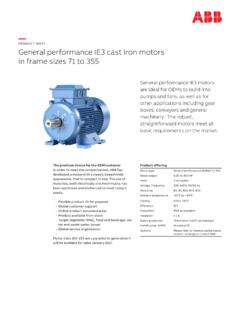
3 Power ratingsalso differ between US and European Manufactured to metric frame sizes Totally enclosed fan cooled (TEFC) construction Environmentally protected to IP55 Three-phase Motors available in both foot and flangemounting Wide voltage range on three-phase Motors of 220-240V/250-280V if delta ( ) connected or 380-420/440-480V if star (U) connected for Motors up to frame size 100 Wide voltage range 380-420/440-480V delta ( )connected or 660-690V star C connected for motorswith frame size 112 as above Suitable for use on 50/60Hz supplies Single-phase Motors available in both permanentcapacitor and capacitor start-run formats 2-pole and 4-pole Motors 1 Ratings according to IEC frame sizes IEC 34/1.
4 IP55 For squirrel-cage motorsThe meaning of the standardised letters in the size designation for sizes 90-132 are S = small, M = medium longand L = long SizeRated output, KW2 Pole4 induction motor15023258122 Insulation classesIEC Publication IEC85 divides insulation into classes. Eachclass is given a designation that corresponds to the uppertemperature limit of the insulating material when used undernormal operating correct insulation of the winding of a motor is thereforedetermined by both the temperature rise in the motor andthe temperature of the ambient air.
5 If a motor is subjected toan ambient temperature higher than 40 C, it must normallybe derated or a high insulation class of material standards measure temperature in degreesCelsius ( C), whilst temperature difference is stated in theunit Kelvin (K). One degree Celsius is equivalent to RS-ABB range of ac induction Motors is manufactured toa class F insulation rating. For class F the temperature risemust not exceed 105K, provided that the ambienttemperature does not exceed +40 should be noted that if the upper temperature limit of theinsulation material is exceeded by 8 to 10K (Table 2), the lifeof the insulation will be approximately graph illustrates the effect of exceeding the highestpermitted winding temperature on winding characteristicsThe following is a list of general characteristics of the acinduction Motors supplied by RS Components.
6 Each oneshould be considered before choosing the appropriatemotor for the , three-phase Motors can usually be re-connected for two usual way is to connect the three stator phase windingsin star (U) or delta ( ). All RS-ABB Motors are suppliedconfigured in star (U) up to frame size 100 for 380-420V50Hz, Motors above this size are supplied delta primarily butmay be converted for delta ( ). This means that the three-phase input voltage range is wide. For example if the motorwas connected in delta it would accept a three-phase inputvoltage range of 220-240V for a 50Hz supply frequency or250-280V for 60Hz with the motor connected in star an input voltagerange of 380-420V is acceptable on 50Hz or 440-480V on a60Hz supply wide voltage range and dual operating frequencyenables the Motors to be used throughout the convert the Motors refer to Figure 2 where indication isgiven of the required link.
7 To use these Motors in conjunction with single-phase240V input, three-phase output ac motor speedcontrollers, these three-phase Motors must beconnected in delta ( ). Motors from frame size 112 are supplied delta connected for380-420V 50Hz, 440-480V 60Hz. They can be connected in astar configuration for 660-690V 50Hz operation if deviationIf the supply voltage at constant output power deviates fromthe rated voltage of the motor , the starting and maximumtorques of the motor vary approximately as the square of change in torque will also result in a change in thespeed, efficiency and power factor (Figure 3).
8 Voltage deviations also affect the temperature rise in themotor windings. If the voltage is low the temperature will risein both large and small framed Motors ; if the voltage is highthe temperature may drop slightly in large sized Motors butrise rapidly in the small output connection220-240VY-connection380-420V51 0105156075801051254040404040 C C C C CThermalMarginPermissibletemperaturerise MaximumambienttemperatureA105E120B130F15 5H180 Insulation classesExcess temperature rise-KLife %%0102030404080120 Table 2 Figure 1 Temperature limits of the differentinsulation classesFigure 2 Arrangement of windings and terminalblocks for and Y connections15023258123 PowerWhen choosing a motor size it is essential to bear in mindthat
9 It is the power demand of the driven machine thatdetermines the output delivered by the motor and thereforethe power drawn from the supply. For example if a machineneeds 4kW it will take 4kW, regardless of whether the motoris 3kW or the smaller motor is installed it will be subjected to acontinuous 25% overload that it will not be able to sustain forlong periods. The protective overload device fitted should,however, protect against these types of high overloads, anddisconnect the motor supply within a suitable time motor must be capable of delivering the power needed bythe driven machine, and it is prudent to provide a safetymargin since minor overloads that are difficult to foresee canoften a motor winding is overheated the insulation of the copperconductors may be destroyed.
10 Given a choice between twomotor sizes the larger one should always be used. Howeverit is not a good idea to choose an unnecessarily large motorsince it will be disproportionately costly to purchase andhave a low power factor in service. In addition, when asquirrel cage motor is started the starting current will beexcessively high, since it is proportional to the size of themotor. If a motor is loaded at full load only for short periodswith periods of idling between them, known as intermittentduty, its temperature rise will be lower, and it will have acapacity to deliver a higher output than during 4 shows a typical temperature/time graph for a motorin both continuous and intermittent factorA motor consumes not only active power (kW), which itconverts into mechanical work, but also reactive power(kVAr)