Transcription of Acetone - labchem.com
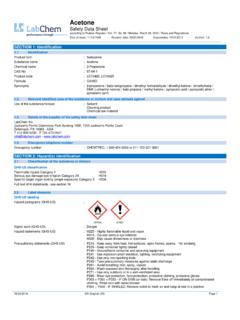
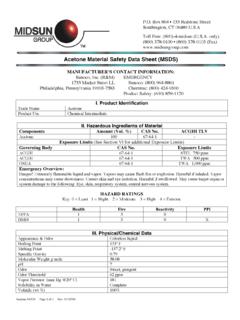
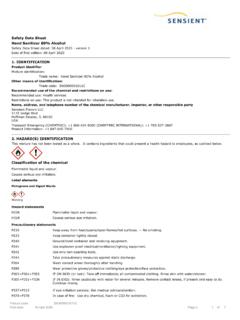
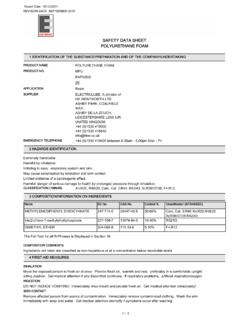
1 Acetone Safety Data Sheet according to Federal Register / Vol. 77, No. 58 / Monday, March 26, 2012 / Rules and Regulations Date of issue: 11/12/1998 Revision date: 09/20/2016 Supersedes: 10/01/2013 Version: 09/20/2016 EN (English US) Page 1 SECTION 1: Identification Identification Product form : Substance Substance name : Acetone Chemical name : 2-Propanone CAS No : 67-64-1 Product code : LC10420, LC10425 Formula : C3H6O Synonyms : 2-propanone / beta-ketopropane / dimethyl formaldehyde / dimethyl ketone / dimethylketal / DMK (=dimethyl ketone) / keto propane / methyl ketone / pyroacetic acid / pyroacetic ether / pyroacetic spirit Relevant identified uses of the substance or mixture and uses advised against Use of the substance/mixture : Solvent Cleaning product Chemical raw material Details of the supplier of the safety data sheet LabChem Inc Jackson's Pointe Commerce Park Building 1000, 1010 Jackson's Pointe Court Zelienople, PA 16063 - USA T 412-826-5230 - F 724-473-0647 - Emergency telephone number Emergency number : CHEMTREC.
2 1-800-424-9300 or 011-703-527-3887 SECTION 2: Hazard(s) identification classification of the substance or mixture GHS-US classification Flammable liquids Category 2 H225 Serious eye damage/eye irritation Category 2A H319 Specific target organ toxicity (single exposure) Category 3 H336 Full text of H statements : see section 16 Label elements GHS-US labeling Hazard pictograms (GHS-US) : GHS02 GHS07 Signal word (GHS-US) : Danger Hazard statements (GHS-US) : H225 - Highly flammable liquid and vapor H319 - Causes serious eye irritation H336 - May cause drowsiness or dizziness Precautionary statements (GHS-US) : P210 - Keep away from heat, hot surfaces, open flames, sparks.
3 - No smoking P233 - Keep container tightly closed P240 - Ground/bond container and receiving equipment P241 - Use explosion-proof electrical, lighting, ventilating equipment P242 - Use only non-sparking tools P243 - Take precautionary measures against static discharge P261 - Avoid breathing mist, spray, vapors P264 - Wash exposed skin thoroughly after handling P271 - Use only outdoors or in a well-ventilated area P280 - Wear eye protection, face protection, protective clothing, protective gloves P303 + P361 + P353 - IF ON SKIN (or hair): Remove/Take off immediately all contaminated clothing. Rinse skin with water/shower P304 + P340 - IF INHALED: Remove victim to fresh air and keep at rest in a position Acetone Safety Data Sheet according to Federal Register / Vol.
4 77, No. 58 / Monday, March 26, 2012 / Rules and Regulations 09/20/2016 EN (English US) 2/9 comfortable for breathing P305+P351+P338 - If in eyes: Rinse cautiously with water for several minutes. Remove contact lenses, if present and easy to do. Continue rinsing P312 - Call a POISON CENTER or doctor/physician if you feel unwell P337 + P313 - If eye irritation persists: Get medical advice/attention P370 + P378 - In case of fire: Use dry chemical powder, alcohol-resistant foam, carbon dioxide (CO2) to extinguish P403 + P233 - Store in a well-ventilated place. Keep container tightly closed P405 - Store locked up P501 - Dispose of contents/container to comply with local, state and federal regulations P235 - Keep cool Other hazards Other hazards not contributing to the classification : None.
5 Unknown acute toxicity (GHS US) Not applicable SECTION 3: Composition/Information on ingredients Substance Substance type : Mono-constituent Name Product identifier % GHS-US classification Acetone (Main constituent) (CAS No) 67-64-1 100 Flam. Liq. 2, H225 Eye Irrit. 2A, H319 STOT SE 3, H336 Full text of hazard classes and H-statements : see section 16 Mixture Not applicable SECTION 4: First aid measures Description of first aid measures First-aid measures general : Check the vital functions. Unconscious: maintain adequate airway and respiration. Respiratory arrest: artificial respiration or oxygen. Cardiac arrest: perform resuscitation.
6 Victim conscious with labored breathing: half-seated. Victim in shock: on his back with legs slightly raised. Vomiting: prevent asphyxia/aspiration pneumonia. Prevent cooling by covering the victim (no warming up). Keep watching the victim. Give psychological aid. Keep the victim calm, avoid physical strain. Depending on the victim's condition: doctor/hospital. First-aid measures after inhalation : Remove the victim into fresh air. Respiratory problems: consult a doctor/medical service. First-aid measures after skin contact : Wash immediately with lots of water. Soap may be used. Do not apply (chemical) neutralizing agents. Remove clothing before washing.
7 Take victim to a doctor if irritation persists. First-aid measures after eye contact : Rinse immediately with plenty of water. Do not apply neutralizing agents. Take victim to an ophthalmologist if irritation persists. First-aid measures after ingestion : Rinse mouth with water. Immediately after ingestion: give lots of water to drink. Do not give milk/oil to drink. Do not induce vomiting. Give activated charcoal. Call Poison Information Centre ( ). Consult a doctor/medical service if you feel unwell. Ingestion of large quantities: immediately to hospital. Doctor: gastric lavage. Most important symptoms and effects, both acute and delayed Symptoms/injuries : Not expected to present a significant hazard under anticipated conditions of normal use.
8 Symptoms/injuries after inhalation : EXPOSURE TO HIGH CONCENTRATIONS: Feeling of weakness. Irritation of the respiratory tract. Nausea. Vomiting. Headache. Central nervous system depression. Dizziness. Narcosis. Excited/restless. Drunkenness. Disturbed motor response. Respiratory difficulties. Disturbances of consciousness. Symptoms/injuries after skin contact : ON CONTINUOUS EXPOSURE/CONTACT: Dry skin. Cracking of the skin. Symptoms/injuries after eye contact : Irritation of the eye tissue. Symptoms/injuries after ingestion : Dry/sore throat. Risk of aspiration pneumonia. Symptoms similar to those listed under inhalation. AFTER ABSORPTION OF LARGE QUANTITIES: Irritation of the gastric/intestinal mucosa.
9 Change in the blood composition. Change in urine output. Renal disease. Enlargement/disease of the liver. Symptoms/injuries upon intravenous administration : Not available. Chronic symptoms : ON CONTINUOUS/REPEATED EXPOSURE/CONTACT: Red skin. Skin rash/inflammation. Dry/sore throat. Headache. Nausea. Feeling of weakness. Loss of weight. Possible inflammation of the respiratory tract. Acetone Safety Data Sheet according to Federal Register / Vol. 77, No. 58 / Monday, March 26, 2012 / Rules and Regulations 09/20/2016 EN (English US) 3/9 Indication of any immediate medical attention and special treatment needed Obtain medical assistance.
10 SECTION 5: Firefighting measures Extinguishing media Suitable extinguishing media : Preferably: alcohol resistant foam. Water spray. Polyvalent foam. Alcohol-resistant foam. BC powder. Carbon dioxide. Unsuitable extinguishing media : Solid water jet ineffective as extinguishing medium. Special hazards arising from the substance or mixture Fire hazard : DIRECT FIRE HAZARD. Highly flammable. Gas/vapor flammable with air within explosion limits. INDIRECT FIRE HAZARD. May be ignited by sparks. Gas/vapor spreads at floor level: ignition hazard. Reactions involving a fire hazard: see "Reactivity Hazard". Explosion hazard : DIRECT EXPLOSION HAZARD.