Transcription of ACLS Megacode Testing Scenarios - American Heart …
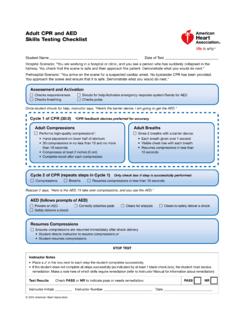
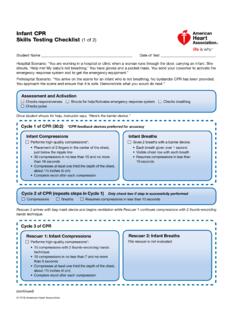
1 Megacode 1 Out-of-Hospital Unstable Bradycardia Megacode Testing checklist : Scenarios 1/3/8. (Unstable Bradycardia > pVT > PEA > PCAC) Bradycardia Pulseless VT PEA PCAC. Lead-in: You are a paramedic treating a man who had a syncopal episode. Student Name _____ Date of Test _____. Vital Signs Check Heart rate: Critical Performance Steps if done Blood pressure: 78/42 mm Hg correctly Respiratory rate: Spo2: Team Leader Temperature: Assigns team member roles Weight: Ensures high- Compression rate Compression Chest compression Chest recoil Ventilation Age: 62 years 100-120/min depth of 2 inches fraction >80% (optional) (optional).
2 Quality CPR at Initial Assessment all times . The patient is conscious and alert. Ensures that team members communicate well What are your initial actions? Bradycardia Management His skin is pale, and he is diaphoretic. Starts oxygen if needed, places monitor, starts IV. The patient is not following commands. Places monitor leads in proper position There is no radial pulse, but the carotid pulse is weak and slow. Recognizes symptomatic bradycardia Administers correct dose of atropine Adult Bradycardia Algorithm Prepares for second-line treatment Instructor notes: The ECG monitor shows a sinus bradycardia with Pulseless VT Management occasional PVC.
3 Recognizes pVT. The student should follow the Adult Bradycardia Algorithm and be prepared to Clears before analyze and shock administer a single dose of atropine while preparing for transcutaneous pacing. Immediately resumes CPR after shocks Adult Cardiac Arrest Algorithm (pVT) Appropriate airway management Appropriate cycles of drug rhythm check/shock CPR. Instructor notes: With the introduction of the pacing impulse, the ECG. Administers appropriate drug(s) and doses monitor displays VT. There is no pulse. The student should immediately discontinue pacing and defibrillate the patient.
4 PEA Management The student will follow the VF/pVT pathway of the Adult Cardiac Arrest Algorithm. Recognizes PEA. The student should assign team functions and monitor for high-quality CPR. Verbalizes potential reversible causes of PEA (H's and T's). The case should continue through safe defibrillation and administration of Administers appropriate drug(s) and doses epinephrine and amiodarone. Immediately resumes CPR after rhythm checks Adult Cardiac Arrest Algorithm (PEA) Post Cardiac Arrest Care Identifies ROSC. Instructor notes: After the third shock, the patient develops an organized Ensures BP and 12-lead ECG are performed, O2 saturation is monitored, verbalizes need for rhythm that is slow.
5 There is no pulse. The patient is now in PEA. endotracheal intubation and waveform capnography, and orders laboratory tests The student continues to monitor high-quality CPR and follows the PEA Considers targeted temperature management pathway of the Adult Cardiac Arrest Algorithm. STOP TEST. The student should consider reversible causes. Test Results Circle PASS or NR to indicate pass or needs remediation: PASS NR. Post Cardiac Arrest Care Algorithm Instructor notes: After ensuring effective ventilation, the student can now Instructor Initials _____ Instructor Number _____ Date _____.
6 Detect a carotid pulse. The patient has ROSC. Learning Station Competency The student should initiate the Post Cardiac Arrest Care Algorithm. Bradycardia Tachycardia Cardiac Arrest/Post Cardiac Arrest Care Megacode Practice 2020 American Heart Association Megacode 2 Out-of-Hospital Unstable Bradycardia Megacode Testing checklist : Scenarios 2/5. (Unstable Bradycardia > VF > Asystole > PCAC) Bradycardia VF Asystole PCAC. Lead-in: You are called to a restaurant for a man who suddenly became unresponsive, vomited, and then stopped breathing. You have a 4-minute response Student Name _____ Date of Test _____.
7 To the scene in your ALS ambulance. Check Vital Signs Critical Performance Steps if done correctly Heart rate: 44/min and very strong Blood pressure: 84/50 mm Hg Team Leader Respiratory rate: 3/min Spo2: Assigns team member roles Temperature: Ensures high- Compression rate Compression Chest compression Chest recoil Ventilation Weight: quality CPR at 100-120/min depth of 2 inches fraction >80% (optional) (optional). Age: all times . Ensures that team members communicate well Initial Assessment You arrive at the scene to find 3 firefighters assisting the patient.
8 Bradycardia Management One is maintaining an open airway, another is suctioning the patient, and the Starts oxygen if needed, places monitor, starts IV. third is getting vital signs. Places monitor leads in proper position Witnesses state that the patient had a normal day but seemed irritated. Recognizes symptomatic bradycardia Administers correct dose of atropine Adult Bradycardia Algorithm Prepares for second-line treatment Instructor notes: The patient is in sinus bradycardia when the limb leads are applied, and the 12-lead ECG is not suspicious for injury or ischemia.
9 VF Management An IV is being initiated when the patient has a 5-second episode of grand mal seizures Recognizes VF. and then remains unresponsive. Bag-mask ventilation is initiated with oxygen. Clears before analyze and shock Shortly after that, the patient has no respirations and no pulse. The monitor shows VF. Immediately resumes CPR after shocks Appropriate airway management Adult Cardiac Arrest Algorithm (VF) Appropriate cycles of drug rhythm check/shock CPR. Instructor notes: Defibrillation is attempted, and then CPR is provided for Administers appropriate drug(s) and doses 2 minutes.
10 During this time, his wife says that he is normally healthy and takes only Asystole Management vitamin supplements but that he's been under extreme stress at work lately. Recognizes asystole After the first 2 minutes of CPR, the rhythm is still VF. Another shock is given, followed by more CPR . Epinephrine is given, and an advanced airway is placed, Verbalizes potential reversible causes of asystole (H's and T's). with an ETCO2 reading of 22 mm Hg noted. Two minutes later, the rhythm is Administers appropriate drug(s) and doses asystole, confirmed in 2 leads.