Transcription of ACTFL Performance Descriptors
1 ACTFL . Performance Descriptors for language Learners The American Council on the Teaching of Foreign Languages 1001 North Fairfax Street, Suite 200. Alexandria, VA 22314. Second printing 2015. 2012 by The American Council on the Teaching of Foreign Languages, Alexandria, VA. All rights reserved. No part of this book may be reproduced, in any form or by any means, without expressed written consent of the publisher. ISBN: 978-1-942544-06-7. ACTFL . Performance Descriptors for language Learners ACTFL . Performance Descriptors for language Learners language learning is complex. Many factors impact how well language learners will acquire communication skills and how quickly they will reach different ranges of Performance . These factors include where one learns language , whether in an instructional setting or immersed in the language or culture; how one learns, whether through explicit instruction about the language or through authentic experiences using the language ; when one learns, as the age and cognitive development of language learners impact the speed of reaching each range of Performance .
2 And finally, why one is learning a language , whether motivated by extrinsic factors such as grades and requirements or intrinsic factors such as the language learner's heritage or intended uses of the language . Acknowledgements The American Council on the Teaching of Foreign ciency Guidelines, the 1998 task force carefully identi- Languages ( ACTFL ) wishes to acknowledge the editors fied appropriate learning targets that impacted instruc- and contributing authors of this new document. tion and assessment in language classrooms across Authors and Editors: Paul Sandrock and Elvira the and beyond. The new ACTFL Performance Swender Descriptors for language Leaners benefited from the Contributing authors: Maria Antonia Cowles, experience of language educators implementing the Cynthia Martin, and Robert Vicars original guidelines.
3 ACTFL also acknowledges the critical role of those members of the profession who reviewed these Per- ACTFL acknowledges the authors of the 1998 ACTFL . formance Descriptors : Arnold Bleicher, Peggy Boyles, Performance Guidelines for K 12 Learners: Greg Dun- Donna Clementi, Greg Duncan, Helga Fasciano, Mar- can and Elvira Swender; the Section Editors: Martha tin Smith, and Laura Terrill. Abbott, Peggy Boyles, and John Miles; and the mem- bers of the Performance Guidelines for K 12 Learners The ACTFL Performance Descriptors for language Task Force: Harriet Barnett, Karen Breiner-Sanders, Learners were built on the solid foundation provid- Mari Haas, Eileen Lorenz, Alisha Reeves Samples, Nan- ed by the original task force that produced the 1998 cy Rhodes, Kathleen Riordan, Margaret Singer.
4 ACTFL Performance Guidelines for K 12 Learners. The members of that task force forged new ground to help The ACTFL Peformance Descriptors for language educators implement the standards, providing import- Learners may be used for non-profit, educational pur- ant descriptions of how language learners demonstrate poses only, provided that they are reproduced in their Performance of the three modes of communication in entirety, with no alterations, and with credit to ACTFL . instructional settings. Informed by the ACTFL Profi- ACTFL Performance Descriptors for language Learners 3. 1 About the ACTFL Performance Descriptors for language Learners The ACTFL Performance Descriptors for language of three ranges of Performance (Novice, Intermedi- Learners are designed to describe language perfor- ate, and Advanced) allows users of these Performance mance that is the result of explicit instruction in an Descriptors to identify appropriate learning targets for instructional setting.
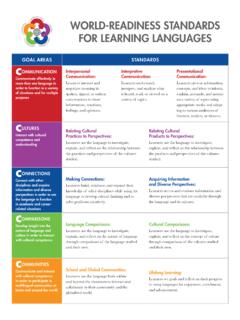
5 A companion to the ACTFL language learners who begin at any age or grade level Proficiency Guidelines, a document that describes (prekindergarten, elementary school, middle school, broad, general language proficiency regardless of when, high school, or postsecondary institutions) and whose where or how language is acquired, the ACTFL Per- language learning continues for varying amounts formance Descriptors for language Learners provide of time. more detailed and more granular information about language learners. Since the original publication date of the 1998 K 12. Guidelines, learning environments have changed. These The Standards for Foreign language Learning (1996, new Performance Descriptors reflect how language 1999, 2006), describe what students need to know and learners perform whether learning in classrooms, on- be able to do as they learn another language , defining line, through independent project-based learning, or in the what of language education.
6 The ACTFL Perfor- blended environments. mance Guidelines for K 12 Learners (1998) first described how well language learners were expected The Performance Descriptors form a roadmap for to do the what from the content standards. teaching and learning, helping teachers create perfor- The ACTFL Performance Descriptors for language mance tasks targeted to the appropriate Performance Learners are an update and revision to the 1998 range, while challenging learners to also use strategies Performance Guidelines. from the next higher range. In an instructional envi- ronment, the content and tasks are controlled, result- The current Standards for Foreign language Learning ing in higher expectations of learners' Performance are written for K 16 and include language -specific compared to how they perform in a non-instructional progress indicators for elementary, secondary, and environment.
7 For example, Novice language learners postsecondary learners. Likewise, these Performance use highly practiced and memorized sentences and Descriptors apply to language learners across the same questions within the supportive learning environment span of ages and grade levels, identifying a continu- and within known contexts even though they are not um of language learning, which will prove useful in yet Intermediate level language users. addressing articulation across all institutions. These Performance Descriptors also help educators language learners in instructional settings from pre- set realistic expectations at the summative assessment kindergarten through graduate studies are in a contin- level. The ability to look ahead to the next range of per- uous process of cognitive development that influences formance allows instructors to create assessments that their ability to perform language tasks.
8 Learning targets show what the language learner is able to do within the need to consider the age appropriateness and cognitive learner's current range as well as how well the learner is development of the language learners and may require able to perform in the next higher range. varying amounts of time to achieve. The description 4 ACTFL Performance Descriptors for language Learners 2 Comparing Performance and Proficiency In describing language ability, the terms Performance In assessing Performance , a language learner is eval- and proficiency both refer to evidence of what a lan- uated against the description of the features of the guage user is able to do with language . Similar strate- domains of a given range within those contexts and gies can be used when teaching for both Performance content areas that have been learned and practiced.
9 And proficiency. Likewise, assessments of both perfor- Demonstration of Performance within a specific range mance and proficiency reflect purposeful communica- may provide some indication of how the language user tion tasks, mirroring real-world uses of language . There might perform on a proficiency assessment and indeed are also significant differences between Performance might point toward a proficiency level, but perfor- and proficiency. What does each indicate? mance is not the same as proficiency. The language a learner produces on a collective set of performances Performance generally correlates to a proficiency level, that is, the Performance is the ability to use language that has ratings that a language learner receives on a variety of been learned and practiced in an instructional setting.
10 Performance assessments provides evidence of how the Coached by an instructor, whether in a classroom or learner will be rated on an assessment of proficiency. online, or guided by instructional materials, perfor- mance refers to language ability that has been practiced Proficiency and is within familiar contexts and content areas. The Proficiency is the ability to use language in real world practice and assessment of Performance should reflect situations in a spontaneous interaction and non-re- authentic, real world use of language , even though hearsed context and in a manner acceptable and the language is learned and practiced in some type of appropriate to native speakers of the language . Pro- learning environment. Best practices for assessment of ficiency demonstrates what a language user is able to Performance suggest that assessment be conducted in do regardless of where, when or how the language was the same communicative manner in which the lan- acquired.