Transcription of Activity: Exploring the Four Leadership Styles
1 | 1 Every student can be a leader within their action team. This activity helps young people to understand and value different kinds of Leadership , and to discover their own strengths and challenges as a leader, which they can then apply to their teamwork. By giving each student the power to be a leader, no one person will feel the burden of being responsible for the entire project. Record and Reflect:Before beginning this classroom activity, assign students a take-home written reflection, in which they respond to the following questions: What qualities make a good leader?
2 What Leadership qualities do I want to develop? Who are the role models I look to for inspiration? Which traits of those role models would I want to emulate? Do these role models exhibit all the qualities and characteristics that I ve listed in my response to the first question? With markers and paper, create four signs with one of each of the following colors: Red, Green, Yellow, Blue (or any four colors you like). Prior to the class session, set up four stations by taping the four signs to different walls in the room (to be used in the second part of the activity).
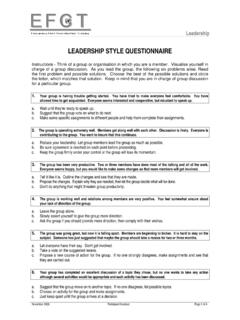
3 For this activity, have students independently complete the Four Leadership Styles worksheet. Once completed, provide students with the Leadership code provided in the Explanation of Leadership Styles section, which they will enter in the third column of their worksheet. Ask students to tally their scores. The color with the highest total will identify their most prominent Leadership style. Activity: Exploring the Four Leadership StylesExploring the Four Leadership Styles : Copyright 2016 WE. All rights reserved.| 2 Explanation of Leadership StylesGreenYellowGREEN LEADERS bring everyone together.
4 They resolve conflicts amongst team members and ensure that all team members are feeling good. Greens are great at building relationships within groups and creating a positive environment for groups. They are often seen as great people people. YELLOW LEADERS propel the team with action. They lead by example, motivating people and maintaining the team s momentum as they move toward the goal. They keep teams focused and can be persuasive in getting their way. They are often seen as reliable people who follow through and get things LEADERS use their logic-based skills to make sure that groups are being realistic and achievement focused.
5 T hey analyze the team s goals and actions and decide the best possible way to achieve the goals, given specific conditions and circumstances. Reds do a lot of calculating, analyzing, systematizing, organizing and budgeting. They are great at providing solutions that make the most logical sense. BLUE LEADERS dream and inspire. They are the idea-makers, they approach problems in new ways and tackle tasks differently than others. Blues are always thinking, brainstorming, suggesting and looking ahead at where the team can go. They are often seen as big picture thinkers.
6 | 3 Direct students to the four stations of the room based on their dominant Leadership style (the color with the highest score) to meet with others of the same Leadership style. Provide a copy of the Leadership Styles explanation at each station. Now, ask them to brainstorm the strengths and challenges of their particular Leadership style and to consider how they relate to people with other Leadership Styles by using the questions below. This will be the foundation for identifying the roles and responsibilities they should take on in their teams, according to their Leadership qualities, as well as the approaches they might take to negotiate team conflict.
7 It isn t necessary to have each Leadership style represented in a group. Any mix of Leadership Styles on each team is fine. The purpose of this activity is to help students identify their style so they will feel more confident in their role and understand the Styles of their teammates. As students are clustered according to Leadership style, ask them to discuss the following questions, while one person acts as recorder: What are the greatest strengths and advantages of our Leadership style? In what circumstances does our Leadership style thrive?
8 What group roles are we best suited for? How do we think the different Styles work with each other? What are the challenges/disadvantages of this Leadership style? In what ways might our approach to Leadership be a challenge for people with other Leadership Styles ? When there is conflict among team members, how would we advise others to approach people with our Leadership style? How can we integrate the different Leadership Styles in a team dynamic?Based on these discussions, students should share what they learned about their Leadership style, particularly the strengths, challenge areas, and best approaches for coping with conflict.
9 This may take place through groups reporting to the full class initially, but should ideally include a segment where students re-assemble into their action teams, to share with the students with whom they will be working most closely. | 4 The Four Leadership Styles Activity Copyright WE Day 2004. All rights Tip Students can repeat the exercise with the Four Leadership Styles Worksheet in their action teams by changing the initial statement ( When I am among a group of friends or ) to one that changes the situation ( When I am in a stressful OR The pressure is on and we re two days away from the ) and allows students to explore their Leadership style in those different situations.
10 Record and Reflect: Following this activity, provide students with a reflection assignment on the following questions: Why is it important to understand different Leadership Styles ? Do you think we possess more than one Leadership style? Why? What key insights do you now have about your Leadership style that you did not have before? What will you do differently because of your new perspective about Leadership ? How will this affect our class or the service project we are working on? Complete this activity by sharing with students that each one of them carries all four of the Leadership Styles .