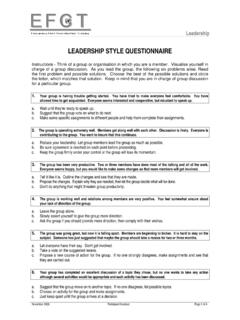
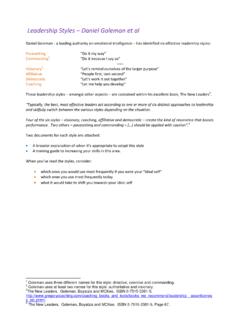
Transcription of Leadership Styles Questionnaires
1 Leadership Styles Questionnaires There are different Leadership Styles , each of which can be appropriate and effective in different situations. Most of us, if we find ourselves in a Leadership role, have a preference for a particular style. This questionnaire is designed to help you think about your preferences. Please read each statement and tick the appropriate box, indicating what you think is true for you. Exactly like me (3) Much like me (2) A bit like me (1) Not me at all (0) Score 1 I believe teams work best when everyone is involved in taking decisions 2 I am good at bringing out the best in other people 3 I can take on Leadership role when needed, but do not consider myself as a leader 4 I am happy to act as the spokesperson for our group 5 I am good at adapting to different situations 6 I am determined to push projects forward and get results 7 I think people should be allowed to make mistakes in order to learn 8 I enjoy working on committees (different groups/teams)
2 9 I think the most important thing for a team is the wellbeing of its members 10 I can see situations from many different perspectives 11 I do not mind how long discussions last, so long as we consider every angle 12 I am good at organising other people 13 I think all team members should abide by formal decisions, so long as we follow proper procedures 14 I set myself high standards and expect others to do the same for themselves 15 I enjoy role playing exercises 16 I love helping other people to develop Once you have ticked one box for each of the statements, please note the score for each question in the right-hand column In the table below, add scores for listed combinations of questions and total this for your Leadership Style Preference.
3 Question Numbers Scores (List your score for each question) Total Leadership Style Preference 4, 6, 12, 14 Authoritative 1, 8, 11, 13 Democratic 2, 7, 9, 16 Facilitative 3, 5, 10, 15 Situational Leadership is exercised in different ways by different people in different situations. The following are examples of different Leadership Styles . None is the right way; each has their strengths and weaknesses, and each would be right for certain people at certain times. Authoritative Democratic This style is based on the idea that leaders should assume personal responsibility for decisions. The authoritative style is attractive to people who are restless, action-oriented, and have a strong personal vision of what s needed.
4 While the authoritative leader may sometimes consult group members before taking decisions, their favoured approach is to take the decisions first and then tell or sell them to the rest of the group. The leader is determined to include all group members in decisions about how the group should operate. The democratic style is based on a belief that groups cannot be effective unless all members have an opportunity to participate fully. The democratic leader s role is largely one of establishing a structure and ground-rules for the group, protecting these, and enabling group activity Strengths Weaknesses Strengths Weaknesses Team members know where they stand Decisions can be taken rapidly, which is good in a crisis Team members can concentrate on operational tasks, without having to worry about strategic issues Unlikely to win full commitment from all group members Can lead to un-informed and shallow decisions.
5 Does not allow team members any space to develop Gives power to team members Energises and motivates team members to achieve their tasks Builds individual responsibility amongst members May slow down tasks, encouraging talk not action Can frustrate members who like clear direction Inappropriate when rapid decisions are needed The most popular decisions are not always the best Facilitative Situational The facilitative style is concerned with offering suggestions which group members may or may not take up. Structure, content and operation of the group are left to group members to determine. While facilitative leaders may have their own clear opinions about the best courses of action, they are not willing to influence the group unduly with their personal ideas.
6 They believe that group activity should be a constant learning process, and that it is OK to make mistakes so long as people learn from them. The journey is seen as more important than the destination Situational Leadership is an approach in which the leader attempts to adapt how they behave according to the needs of each situation. The situational leader will vary their style so that it is appropriate for the particular group (for example, their current levels of skill and confidence), and for the particular task in hand. Strengths Weaknesses Strengths Weaknesses Gives plenty of space for creative ideas to emerge and be explored Enables individual learning Can be empowering in the right circumstances Can allow the group to become aimless and chaotic The Leadership gap can get filled by other people, who have to operate as informal leaders Allows groups to change over the time.
7 Adapts to urgent and nonurgent situations Difficult to carry off effectively group members never know what to expect, and may resist changes in style. Leadership is exercised in different ways by different people in different situations. The following are examples of different Leadership Styles . None is the right way; each has their strengths and weaknesses, and each would be right for certain people at certain times. AUTHORITATIVE This style is based on the idea that leaders should assume personal responsibility for decisions. The authoritative style is attractive to people who are restless, action-oriented, and have a strong personal vision of what s needed.
8 While the authoritative leader may sometimes consult group members before taking decisions, their favoured approach is to take the decisions first and then tell or sell them to the rest of the group. Strengths Weaknesses Team members know where they stand Decisions can be taken rapidly, which is good in a crisis Team members can concentrate on operational tasks, without having to worry about strategic issues Unlikely to win full commitment from all group members Can lead to un-informed and shallow decisions. Does not allow team members any space to develop DEMOCRATIC The leader is determined to include all group members in decisions about how the group should operate.
9 The democratic style is based on a belief that groups cannot be effective unless all members have an opportunity to participate fully. The democratic leader s role is largely one of establishing a structure and ground-rules for the group, protecting these, and enabling group activity Strengths Weaknesses Gives power to team members Energises and motivates team members to achieve their tasks Builds individual responsibility amongst members May slow down tasks, encouraging talk not action Can frustrate members who like clear direction Inappropriate when rapid decisions are needed The most popular decisions are not always the best FACILITATIVE The facilitative style is concerned with offering suggestions which group members may or may not take up.
10 Structure, content and operation of the group are left to group members to determine. While facilitative leaders may have their own clear opinions about the best courses of action, they are not willing to influence the group unduly with their personal ideas. They believe that group activity should be a constant learning process, and that it is OK to make mistakes so long as people learn from them. The journey is seen as more important than the destination Strengths Weaknesses Gives plenty of space for creative ideas to emerge and be explored Enables individual learning Can be empowering in the right circumstances Can allow the group to become aimless and chaotic The Leadership gap can get filled by other people, who have to operate as informal leaders SITUATIONAL Situational Leadership is an approach in which the leader attempts to adapt how they behave according to the needs of each situation.