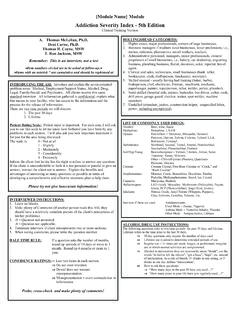
Transcription of Addiction Severity Index Handouts
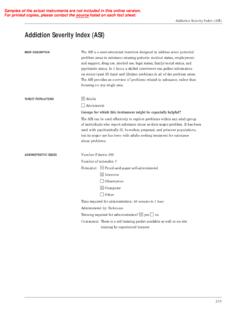
1 Addiction Severity Index Handouts This document was printed by: Oklahoma Department of Mental Health and Substance Abuse Services Printing Facility updated May 2016 This document was printed by: Oklahoma Department of Mental Health and Substance Abuse Services Printing Facility Addiction Severity Index This tool will tell us more about you such as the areas of need you have that brought you to this agency and how we can help you. We will ask you questions in seven potential problem areas: 1. Medical Status 2. Employment/Education Support Status 3. Alcohol/Drug Status 4. Legal Status 5. Family History Status 6. Family/Social Status 7. Psychiatric Status It is important that we receive honest accurate information from you to better know what your needs are and how to help you.
2 You can refuse to answer a question if it becomes too uncomfortable or personal to answer. All clients receive the same interview. All information gathered is confidential and will only be released with your permission. There are two time periods we will discuss: 1. The past 30 days 2. Lifetime CLIENT RATING SCALE Your input is important. For each area I will ask you to use a scale to let me know how troubled or bothered you have been by any problems in each section and how important getting help (counseling, treatment, ) is for you in each area being discussed. The scale is: 0 - Not at all 1- Slightly 2 - Moderately 3 - Considerably 4 -Extremely * Please remind the client to not give inaccurate information and that this is an interview, not a test.
3 This document was printed by: Oklahoma Department of Mental Health and Substance Abuse Services Printing Facility Interviewer Rating Scale: Patient Rating Scale 0 -1 No real problem, treatment not indicated. 2 - 3 Slight problem, treatment probably not indicated. 4 - 5 Moderate problem, some treatment indicated. 6 - 7 Considerable problem, treatment necessary 8 - 9 Extreme problem, treatment absolutely necessary This document was printed by: Oklahoma Department of Mental Health and Substance Abuse Services Printing Facility This document was printed by: Oklahoma Department of Mental Health and Substance Abuse Services Printing Facility POINTS TO INCLUDE WHEN INTRODUCING THE A S I All patients get this same interview.
4 All information gathered is confidential and will be used only by the treatment or research staff. The interview consists of seven parts, medical, legal, drugs, alcohol, etc. There are two time periods expressed, the past 30 days and lifetime data. Patient input is important. For each area I will ask you to use a scale to let me know how bothered you have been by any problems in each section. Also, I will ask you how important treatment is for you for the area being discussed. The client rating scale is: 0 not at all 1 slightly 2 moderately 3 considerably 4 extremely Ifyou are not comfortable giving an answer, simply decline to answer. Please do not give inaccurate information! The interviewer should mention each of these points.
5 The most important considerations are that the patient understands the purpose of the interview and that it is confidential. ** Inform the patient of any foilow-up interviews that will occur at a later date 2 This document was printed by: Oklahoma Department of Mental Health and Substance Abuse Services Printing Facility PLACEMENT OF THE N" ON THE ASI General Information: If #Gl9 is coded "1" for "no", then #G20 is an "N". Medical Section: If #Ml is coded "00", then #M2 is coded "N N". Employment/Support: If #E8 is coded "0" for "no", then #E9 is coded N". Drug/Alcohol Section: If #Dl5 is coded "00", Then #D16 is coded "N". If #D19 "Alcohol Abuse" is coded "00", then #D21 "Alcohol Abuse" is coded "N" If #D20 "Drug Abuse" is coded "00", then #D22 "Drug Abuse" is coded "N".
6 Legal Section: If #L3 through #L16 are all coded as "00", then #L17 is coded "N". If #L21 is coded "00", then #L22 and #L23 are coded 'N". If #L24 is coded "O" for "no", then #L25 is coded "N". Family/Social Section: Items #Fl2-#Fl 7 and Items #F18-#F26 are the only items in this section where an ''N" may be used. To understand when to use an "N" think in terms of the client's 01mortunity to have a relationship with the person/people referred to in each item. For Items #F12-#Fl 7 an "N" would be coded only if the relative didn't exist (as in the case of a client who has no children). For items #F18-#F26, the rule of thumb is that if there was no opportunity to experience the relationship in question ( if someone in a particular category is deceased or if there has been no contact), then an "N" is coded.
7 If the client reports that there has never been a relationship in a particular category (like no children, never any friends, never a relationship with father, etc.), then an "N" would be coded in both the "Lifetime and "Past 30 Days" boxes. If #Fl 1 in the F/S section is coded "O , then #F24 in the "Past 30 Days" column is coded "N". In such cases, the interviewer probes to see whether there had ever been any close friends to determine if an ''N" is also be coded under "Lifetime" in #F24. If #El 1in the E/S Section is coded "00" or if the client is self-employed with no employees or co- workers, then #E26 in the F/S section is coded "N" for the past 30 days. Psychiatric Section: There are no circumstances under which an "N" would be coded in this section.
8 Close ASI Section: If the interview has been completed, code Gl2 as ''N". 3 This document was printed by: Oklahoma Department of Mental Health and Substance Abuse Services Printing Facility LIST OF COMMONLY USED DRUGS: Alcohol: Beer, wine, liquor Methadone: Dolophine, LAAM Opiates: Pain killers: Morphine, Dilaudid, Demerol, Percocet, Darvon, Talwin, Codeine, Tylenol 2,3,4, Syrups, Robitussin, Fentanyl Barbiturates: Nembutal, Seconal, Tuinol, Amytal, Pentobarbital, Secobarbital, Phenobarbital, Fiorinol Sed/Hyp/Tranq: Benzodiazepines: Valium, Xanax, Librium, Ativan, Serax, Quaaludes Tranxene, Dalmane, Halcion, Miltown, Cocaine: Cocaine Crystal, Free-Base Cocaine or "Crack" and "Rock" Amphetamines: Monster, Crank, Benzedrine, Dexedrine, Ritalin, Preludin, Methamphetamine, Speed, Ice, Crystal Cannabis: Marijuana, Hashish, Pot Hallucinogens: LSD (Acid), Mescaline, Mushrooms (Psilocybin), Peyote, Green, PCP (Phencyclidine), Angel Dust, Ecstasy Inhalants: Nitrous Oxide, Amyl Nitrate, Whippits, Poppers, Glue, Solvents, Gasoline, Toluene, Etc.
9 4 This document was printed by: Oklahoma Department of Mental Health and Substance Abuse Services Printing Facility HOLLINGSHEAD CATEGORIES: 1. Higher execs, major professionals, owners of large businesses. 2. Managers of medium sized businesses, nurses, opticians, pharmacists, social workers, teachers. 3. Administrative personnel, managers, minor professionals, owners/proprietors of small businesses: bakery, car dealership, engraving business, plumbing business, florist, decorator, actor, reporter, travel agent. 4. Clerical and sales, technicians, bank teller, bookkeeper, clerk, draftsperson, timekeeper, secretary. 5. Skilled manual - usually having had training (baker, barber, brake person, chef, electrician, fireperson, lineperson, machinist, mechanic, paperhanger, painter, repairperson, tailor, welder, policeperson, plumber).
10 6. Semi-skilled (hospital aide, painter, bartender, bus driver, cutter, cook, drill press, garage guard, checker, waiter, spot welder, machine operator). 7. Unskilled (attendant, janitor, construction helper, unspecified labor, porter). 8. Homemaker. 9. Student, disabled, no occupation. 5 This document was printed by: Oklahoma Department of Mental Health and Substance Abuse Services Printing Facility Severity RATINGS Severity -defined as the need for new or additional treatment based on the amount, duration and intensity of symptoms within each area. All ratings are based on objective and subjective data within each area. A systematic method has been developed for Severity Ratings. Reliability is increased if this method is used.