Transcription of Administration, Scoring, and ... - Pearson Clinical
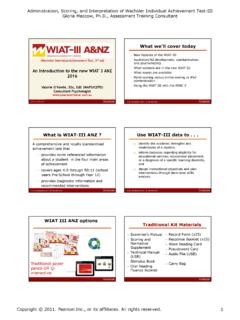
1 Administration, Scoring, and Interpretation of Wechsler Individual Achievement Test-IIIG loria Maccow, , assessment Training ConsultantCopyright 2011. Pearson Inc., or its affliliates. All rights Introduction to the new WIAT 3 ANZ2016 Valorie O Keefe, BSc, EdS (MAPS/CEPD)Consultant |Copyright 2011 |09/08/2011 What we ll cover today New features of the WIAT-III Australian/NZ development, standardisation, and psychometrics What subtests are in the new WIAT III What scores are available Hand-scoring versus online scoring or iPad administration. Using the WIAT III with the WISC V5|Copyright 2011 |09/08/2011 What is WIAT-III ANZ ?A comprehensive and locally standardised achievement test that provides norm referenced information about a student in the four main areas of achievement covers ages 4:0 through 50:11 (school years Pre-School through Year 12) provides diagnostic information and recommended interventions6|Copyright 2011 |09/08/2011(a)identify the academic strengths and weaknesses of a student, (b)inform decisions regarding eligibility for educational services, educational placement, or a diagnosis of a specific learning disability, and (c)design instructional objectives and plan interventions through item-level skills analysisUse WIAT-III data to.
2 WIAT III ANZ optionsTraditional paper pencil OR Q-interactive8 Traditional Kit Materials Examiner s Manual Scoring and Normative Supplement Technical Manual (USB) Stimulus Book Oral Reading Fluency Booklet Record Form (x25) Response Booklet (x25) Word Reading Card Pseudoword Card Audio File (USB) Carry BagAdministration, Scoring, and Interpretation of Wechsler Individual Achievement Test-IIIG loria Maccow, , assessment Training ConsultantCopyright 2011. Pearson Inc., or its affliliates. All rights |Copyright 2011 |09/08/2011 WIAT-III ANZ KitPaper/Pencil AdministrationOption 2:Q-global Online Scoring & ReportingOption 1: Hand-score Score Report: $3 per reportor $45 unlimited annual license per userOption 3: Q-interactive Administration/Scoring on iPad Automatic Scoring in real time Available mid- December Score report can be generated Q Interactive Annual license and subtest pricing.
3 2 iPads alongside Response BookletWIAT III ANZ Test Structure14|Copyright 2011 |09/08/2011 WIAT III Test Structure15|Copyright 2011 |09/08/2011 Administration, Scoring, and Interpretation of Wechsler Individual Achievement Test-IIIG loria Maccow, , assessment Training ConsultantCopyright 2011. Pearson Inc., or its affliliates. All rights |Copyright 2011 |09/08/2011 Overall Administration Time Total Achievement CompositeGrade PS FYears 1-2 Year 3 Years 4-12+Time (in minutes)35 45 8094104 Time based on average achieving students. Students with lower academic achievement will take less time to assess. Flexible battery: Time will also depend on how many subtests are How Long Does it Take if reading is the only concern?
4 SUBTESTY ears1-2 Year 3 Years 4-12 Reading Comp 101316 Word Decoding222 Oral Rdg. Fl. 57918|Copyright 2011 |09/08/2011 Overall Administration TimeTotal Achievement CompositeAge20:0-25:1126:0-35:1136:0-50: 11 Time (in minutes)9510397 Flexible battery: Time will also depend on how many subtests are Scores for Composites and Subtests Standard Score Age norms &/or School Year norms Percentile Rank Normal Curve Equivalent Stanines School Year Equivalent Age Equivalent Growth Scale ValuesStatus ScoresGrowthScores20 Derived Scores for the WIAT III Composites and SubtestsScore Type DescriptionStandard ScoreAge norms or School Year normsRange of 40 to 160 (M= 100, SD= 15)
5 Separate Term 1-2 and Term 3-4 norm RankIndicates the percentage of students of the same age or school year who scored the same or lower than the or Year EquivalentProvides the age or school year at which the student s raw score is the median score of all scores in that age or year Curve EquivalentA transformation of age and year-based standard score information on an equal interval scale with a range of 1 to 99 (M= 50, SD= ).StanineA transformation of age- and grade-based standard score information to a 9-point scale (M= 5, SD= 2).Growth Score (GSV)Sample-independent scores on an equal-interval scale for the purpose of tracking growth over ProjectAdministration, Scoring, and Interpretation of Wechsler Individual Achievement Test-IIIG loria Maccow, , assessment Training ConsultantCopyright 2011.
6 Pearson Inc., or its affliliates. All rights Language Adaptation Process Prior to data collection, language and stimulus content found in the edition of the WIAT-III that was not culturally appropriate for the ANZ edition was adapted. Eight independent expert reviewers from across Australia and New Zealand reviewed the WIAT-III. Reviewers were registered psychologists working in senior positions within schools, academia and private practice. Reviewers with experience working with indigenous groups from Australia and New Zealand were included. 245 Examiners participated in the WIAT-III A&NZ standardisation data collectionThe Standardisation ProcessLocal norms were collected based on census-matched samples of students.
7 Children from each age group and the 14 different school year levels were total of 1132 children were administered the WIAT 3 ANZ to make up the three norm samples based on (4:0-19:11) 1-2 3-4 normsNorms for 4 yrs to 13 yrs were broken down into 4-month intervalsWhen testing adults (age 20+), the US norms are used in ANZ. The Normative Samples Australian schooling levels were classified according to the Australian curriculum , assessment and Reporting Authority. For New Zealand participants, the Ministry of Education, New Zealand curriculum was used to classify the schooling levels. * Please note, Foundation refers to the student s first year of formal education - also referred to as Kindergarten in ACT and NSW; Preparatory in QLD, TAS and VIC; Pre-Primary in WA; Transition in NT.
8 And Reception in New ZealandPreschool (PS) Year 0 Foundation (F)* Year 1 Year 1 Year 2 Year 2 Year 3 Year 3 Year 4 Year 4 Year 5 Year 5 Year 6 Year 6 Year 7 Year 7 Year 8 Year 8 Year 9 Year 9 Year 10 Year 10 Year 11 Year 11 Year 12 Year 12 Year 13 The Normative Sample Norms stratified by Age Parental education Geographic region UrbanicityAncestry, Ethnicity and Indigenous Status also consideredThe Normative Sample(continued) Recruitment of Aboriginal and Torres Strait Islander and New Zealand M ori children was in line with the general Australian and New Zealand population. 5% of the Australian sample consisted of students identified as Aboriginal and/or Torres Strait Islander 23% of the New Zealand sample consisted of students identified as New Zealand M ori The Normative Samples(continued) To ensure that the Australian and New Zealand norms were based on the full range of abilities within the population, 42 children with an intellectual disability (FSIQ = 40 - 70) and 42 children identified as intellectually gifted (FSIQ 130) were included in the Australian and New Zealand sample This ensured that approximately 2% of cases performed at the intellectual disability level and 2% performed at the gifted level.
9 Administration, Scoring, and Interpretation of Wechsler Individual Achievement Test-IIIG loria Maccow, , assessment Training ConsultantCopyright 2011. Pearson Inc., or its affliliates. All rights Internal Consistency Reliability coefficients range from good (. ) to excellent (. ), with the exception of Alphabet Writing Fluency, which has an average reliability of .69. These reliabilities are similar to those reported for the US normative sample. Test-Retest Stability The evidence of test-retest stability for subtest and composite scores was obtained by administering the WIAT III twice. This study was completed as part of the standardisation and demonstrated that the WIAT III subtest and composite scores possess adequate stability across of ValidityCorrelations with the WIAT-II Australian The WIAT-IIIA&NZand the WIAT-II Australian were administered to 50 students in years AU PS-12 / NZ 0-13, with a testing interval between 4 and 42 days, and a mean testing interval of 25 days.
10 The mean WIAT-II Australian composite scores were generally higher than their corresponding WIAT-IIIA&NZscores. The mean composite score differences between the WIAT-IIIA&NZand WIAT-II Australian were in the direction and at the magnitude expected given the combined impact of the Flynn effect (Flynn, 2007) and practice effects resulting from the study design. The corrected correlation coefficients of composite scores for the two instruments ranged from .74 (Written Expression-Written Language) to .92 (Total Achievement-Total). Evidence of Validity(continued)Correlations with the WISC-VA&NZ The WIAT-IIIA&NZand the WISC-VA&NZwere administered to 403 children aged 6 16 yrs.