Transcription of ADMINISTRATIVE POLICY STATE OF …
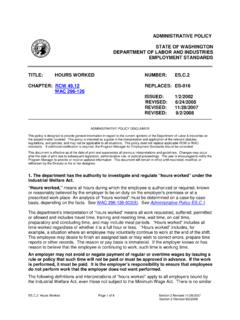
1 ADMINISTRATIVE POLICY . STATE OF WASHINGTON. DEPARTMENT OF LABOR AND INDUSTRIES. EMPLOYMENT standards . TITLE: MINIMUM wage ACT APPLICABILITY NUMBER: CHAPTER: RCW REPLACES: ES-005. WAC 296-128. ISSUED: 1/2/2002. REVISED: 6/24/2005. REVISED: 3/24/2006. REVISED: 7/15/2014. ADMINISTRATIVE POLICY DISCLAIMER. This POLICY is designed to provide general information in regard to the current opinions of the Department of Labor & Industries on the subject matter covered. This POLICY is intended as a guide in the interpretation and application of the relevant statutes, regulations, and policies, and may not be applicable to all situations.
2 This POLICY does not replace applicable RCW or WAC. standards . If additional clarification is required, the Program Manager for Employment standards should be consulted. This document is effective as of the date of print and supersedes all previous interpretations and guidelines. Changes may occur after the date of print due to subsequent legislation, ADMINISTRATIVE rule, or judicial proceedings. The user is encouraged to notify the Program Manager to provide or receive updated information. This document will remain in effect until rescinded, modified, or withdrawn by the Director or his or her designee.
3 1. When does Chapter , the Washington Minimum wage Act, apply? The Washington Minimum wage Act (MWA), RCW , establishes a minimum wage for employees in Washington STATE in RCW and RCW The MWA also requires employers to pay overtime wages of at least one and one-half an employee's regular rate of pay for hours worked in excess of 40 in a week, per RCW The MWA is an additional protection to workers employed in Washington STATE who are already protected by the Industrial Welfare Act (IWA), RCW While the IWA makes it illegal for an employer to employ workers at wages that are not adequate for their maintenance or under conditions of labor detrimental to their health, the MWA specifically sets forth an adequate.
4 wage (the current statutory minimum) and provides the additional protection of overtime compensation. The MWA is in addition and supplementary to not only the IWA, but to all other standards ( STATE , federal or local law, ordinance, rule or regulation) relating to wages, hours and working conditions. See RCW If, however, the alternative standard provides either more protection or is more favorable to an employee, the more protective authority will apply. Individuals with questions as to the more protective standards found in federal law should contact the Department of Labor, wage and Hour Division.
5 WAC 296-128 generally contains rules promulgated subject to RCW All of these rules have the same force of law as the provisions of RCW itself. Minimum wage Act Page 1 of 6 7/15/2014. 2. Which employers are subject to RCW Generally, an employer under RCW (4) is any individual, partnership, association, corporation, business trust, or any person or group of persons acting directly or indirectly in the interest of an employer in relation to an employee.. Public agencies subject to the MWA may nonetheless, in certain situations, be exempt from the requirement to pay overtime wages. See Overtime.
6 Employers who do business in other states , in addition to Washington, may be engaged in interstate commerce and are subject to the Fair Labor standards Act (FLSA), in addition to the MWA. FLSA is administered by the Department of Labor, and clarification must be obtained from that agency. Employers must follow the laws that are more protective to the worker when there is a difference between the applicability of STATE and federal laws. 3. Which employees are subject to the protections of RCW The protections of the MWA apply to all employees. An employee is defined as any individual employed by an employer except those employees specifically excluded by the legislature in RCW (3)(a) through (n).
7 Minimum wage is not required for employees who are excluded from the MWA. Note that there are additional exceptions to overtime, and as a result an employee can be entitled to minimum wage even if overtime pay is not required. See RCW and ADMINISTRATIVE POLICY , related to overtime. 4. Definition of employ. "Employ" means to engage, suffer or permit to work. See RCW. (3) and WAC 296-126-002 (3). See for a detailed discussion of the hours worked for which the employee must be paid at least the applicable minimum wage . The same concepts apply to employers and employees subject to the MWA. 5. Independent contractors are not employees.
8 A bona fide independent contractor is exempt from the MWA because that person is not employed by an employer. However, an employer cannot avoid conforming to the MWA by merely referring to someone as an "independent contractor." Whether a worker is an independent contractor must be carefully evaluated on a case-by-case basis. 6. Which employees are excluded from the protections of the MWA? The following exemptions are found in RCW (3). Application of these exemptions depends on the facts, which must be carefully evaluated on a case-by-case basis: (a) Certain agricultural employees: An individual who is employed as a hand harvest pieceworker in the region of employment, and who commutes daily from his or her permanent residence to the farm upon which he or she is employed and who has been employed in agriculture less than thirteen weeks during the preceding calendar year.
9 Each of the elements listed above must be met in order for the exemption to apply. Minimum wage Act Page 2 of 6 7/15/2014. Note: All other agricultural workers are covered under MWA. The employer has the burden of proving that agricultural workers fall within the above exemption. (b) Casual Laborers: Any individual employed in casual labor in or about a private home . unless the labor is performed in the course of the employer's trade, business, or profession. Casual refers to employment that is irregular, uncertain or incidental in nature and duration. This must be determined on a case-by-case basis by looking at the scope, duration and continuity of employment.
10 Employment that is intended to be permanent in nature is not casual, and is not exempt, regardless of the type of work performed. Employment of housekeepers, caregivers, or gardeners on a regular basis is not considered employed in casual labor and such workers may be subject to the protections of the MWA. (c) Executive, ADMINISTRATIVE , Professional, Computer Professional or Outside Sales. See through for further discussion of the white collar . exemptions. Note: The rules promulgated by the Washington STATE Department of Personnel affecting civil service employees have no bearing on department rules for wage and hour purposes.