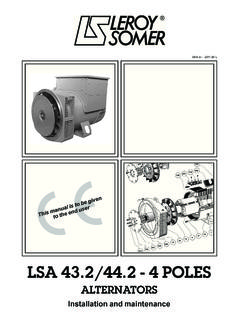
Transcription of AIR COMPRESSOR INSTALLATION AND …
1 CAP600 TSA MAY, 2010 CA SERIES AIR COMPRESSOR INSTALLATION AND operating INSTRUCTION MANUAL TWO STAGE *CONSULT FACTORY FOR SPECIAL APPLICATIONS CURTIS-TOLEDO, INC.
2 1905 Kienlen Avenue, St. Louis, Missouri 63133 phone: 314-383-1300 fax: 314-381-1439 website: Sales representatives in principal cities WARNING Before installing and operating this COMPRESSOR , read and understand the safety precautions contained in LV-474 supplement to and part of CAP-600 IMPORTANT Make a permanent record of the Model and Serial number of your machine here. You ll save time and expense by including this reference identification on replacement part orders. BY PERFORMANCE DATA TO MODEL & SERIAL OR ABOVE MAX.
3 AS STIPULATEDDO NOT OPERATE LOWER THAN 500 READ INSTAL. & OPERATION Kienlen AvenueSt. Louis, MO 63133 CURTIS-TOLEDO, 2 INSTALLATION CONGRATULATIONS on your new FSCurtis Challenge Air COMPRESSOR . Please examine the COMPRESSOR for shipping damage(s) and if any are found report it immediately to the carrier. Select a clean dry location with a rigid floor strong enough to support the COMPRESSOR . If the COMPRESSOR is to be located in an area where vibration is critical, properly engineered vibration mounts and flexible piping should be used.
4 Remove the skid. NOTE: The COMPRESSOR should never be operated on the shipping skid. Level the COMPRESSOR so it can be bolted down securely. Before tightening the bolts, check to see that all four feet are resting on the foundation. Shim as necessary to eliminate stress on the receiver or base when the bolts are tightened. We suggest using a level for proper alignment. Maximum ambient temperature in which the COMPRESSOR and motor should be operated is 104 F. Therefore, adequate ventilation must be provided.
5 The suction openings of the COMPRESSOR are equipped with a combination air filter-muffler to protect the COMPRESSOR from normal dust and other harmful substances. If the air around the COMPRESSOR is excessively hot, dusty, humid or contaminated with foreign gases (such as ammonia or acid fumes) move the filter-muffler to a remote point where the air is clean, cool and dry. Run a pipe to the COMPRESSOR suction opening. If the run is over 50 feet in length, use a larger pipe to avoid excessive pressure drop.
6 In order to fit the filter to the COMPRESSOR , bush down the connections. Be sure piping and fittings are clean and free from dirt and chips. If the filter is installed outside, check to insure that it is located above the normal outside dust level, and that rain cannot enter the filter element. Where the relocation of the filter-muffler is not possible or feasible, an oil bath filter is recommended and is available from FSCurtis. On basic or base mounted compressors run a discharge pipe to the receiver or optional aftercooler and bush up or down as necessary.
7 The pipe should enter near the top of the receiver. Keep in mind that condensate may form in the discharge line; therefore, the lines should always be pitched to drain condensate away from the COMPRESSOR . Always provide a safety relief valve in the discharge line between the COMPRESSOR and in-line shutoff valves. If more than one COMPRESSOR pumps into a common system, a check valve in the discharge line of each COMPRESSOR is recommended to prevent moisture from entering the cylinder head when one COMPRESSOR is idle.
8 A globe or gate valve installed in the discharge line will allow COMPRESSOR isolation from plant air system for COMPRESSOR maintenance. (Note: A safety relief valve should be located between the COMPRESSOR and the globe/gate valve.) Check the electrical supply for voltage, phase, and frequency to see that they match the nameplate stampings on the motor, magnetic starter, solenoids, and other controls. Use electrical wires of adequate size to carry the full load current of the motor without excessive voltage drop.
9 Charts are available from Curtis (upon request) to provide information on this. The motor must always be protected by a starter with properly sized thermal overload(s). The starter should protect the motor from overheating and burnout due to an overload, low voltage or single phasing of a 3-phase circuit. Failure to install the proper starter and overloads will void the motor manufacturers warranty. Follow the National Electric Code or local electric code in providing wiring, fusing and disconnect switches.
10 NOTE: Do not close the disconnect switch to start the COMPRESSOR until the procedures outlined under "Startup Procedures" have been completed. LIMITED SAFETY PRECAUTIONS (Also see supplement LV-474) The following safety precautions are recommended in the use of this COMPRESSOR : 1. Use a totally enclosed OSHA-approved belt guard to cover the drive assembly. Where possible, place the flywheel toward the wall, and mount the unit a minimum distance of 2 feet from the wall for maintenance convenience. 2. Turn off & lock out the electrical disconnect switch before working on the unit to prevent the unit from starting unexpectedly 3.