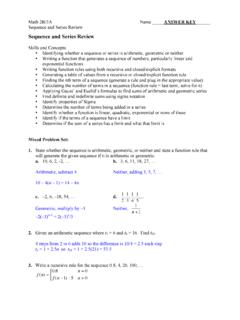
Transcription of Algebra 2/Trig: Chapter 6 Sequences and Series
1 Algebra 2/ trig : Chapter 6 Sequences and Series In this unit, we Identify an arithmetic or geometric sequence and find the formula for its nth term Determine the common difference in an arithmetic sequence Determine the common ratio in a geometric sequence Determine a specified term of an arithmetic or geometric sequence Specify terms of a sequence , given its recursive definition Represent the sum of a Series , using sigma notation Determine the sum of the first n terms of an arithmetic or geometric Series Table of Contents Day 1: Arithmetic and geometric Sequences SWBAT: Identify an arithmetic or geometric sequence and find the formula for its nth term Determine the common difference in an arithmetic sequence Determine the common ratio in a geometric sequence Determine a specified term of an arithmetic or geometric sequence Specify terms of a sequence , given its recursive definition Pgs.
2 1 6 in Packet HW: Pgs. 7 9 in Packet Day 2: More with Arithmetic & geometric Sequences SWBAT: Identify an arithmetic or geometric sequence and find the formula for its nth term Determine the common difference in an arithmetic sequence Determine the common ratio in a geometric sequence Determine a specified term of an arithmetic or geometric sequence Specify terms of a sequence , given its recursive definition Pgs. 10 14 in Packet HW: Pgs. 15 17 in Packet QUIZ on Day 3 ~ 7 min Day 3: Series SWBAT: Represent the sum of a Series , using sigma notation Determine the sum of the first n terms of an arithmetic or geometric Series Pgs.
3 18 22 in Packet HW: Pgs. 23 27 in Packet Day 4: Sequences and Series Mixed Practice SWBAT: Review problems involving Sequences and Series Pgs. 28 32 in Packet QUIZ on Day 4 ~ 15 min Day 5: Practice Test (Not in Packet) Day 6: Test 1 Lesson #1: Arithmetic and geometric Sequences Definition of a sequence : Example 1: Example 2: Concept 1: Ways to define a sequence There are two ways to define a sequence : _____or _____. An explicitly defined sequence is like a formula. Plugging into the formula gives the terms of the sequence .
4 Subscripts name terms. They are not values in the problem. Example 3: Consider = 3n + 2. Find the first 3 terms ( ) of this sequence . A recursively defined sequence has two parts; (1) It gives the first term and (2) all of the other terms are found using operations on the previous term(s) Key Points for Recursive Formulas Subscripts name terms. They are not values in the problem. If the next term is nathe term before it will be 1na because n-1 is one smaller than n. For example, if na is 3a, 1na is 2a . If the next term is 1na the term before it will be nabecause n is one smaller than n+1.
5 For example, if 1na is 3a, nais 2a . Bottom Line: Build off the last term! 2 For each problem, find the next four terms. Example 4: 121410nnaaa Example 5: 115nnaaan Label the following as either an Explicit Formula or a Recursive Formula. 3 Arithmetic Sequences If a sequence of values follows a pattern of adding a fixed amount from one term to the next, it is referred to as an arithmetic sequence . The number added to each term is constant (always the same). The fixed amount is called the common difference, d. a) The following is an example of an arithmetic sequence : 3,8,13,18,23.
6 What is the common difference, d? b) What is the common difference of the following arithmetic sequence ?: 715, , 2, , ..22 geometric Sequences If a sequence of values follows a pattern of multiplying a fixed amount (not zero) times each term to arrive at the following term, it is referred to as a geometric sequence . The number multiplied each time is constant (always the same). The fixed amount is called the common ratio, r. a) The following is an example of a geometric sequence : 8,56,392, 2744 .. What is the common ratio, r? b) What is the common ratio of the following geometric sequence ?
7 : 27, 9, 3, 1, , .. Concept 2: Generating a sequence A sequence can be defined by a formula (or generator) which generates each term. (Note: the variable n appears in most generator. It is used to indicate the position of a term in a sequence .) The formula to generate any arithmetic sequence can be written in the form: The formula to generate any geometric sequence can be written in the form: 4 Example 6: Find a formula to generate the arithmetic sequence 3, 5, 7, .. and use it to generate the 50th term. Step 1: Step 2: Example 7: Find a formula to generate the geometric sequence 4, 12, 36.
8 And use it to determine the 19th term. Step 1: Step 2: 5 You Try it! Determine if the sequence is arithmetic. If it is, find the common difference, the term named in the problem, and the explicit formula. Determine if the sequence is geometric . If it is, find the common ratio, the term named in the problem, and the explicit formula. 6 SUMMARY Exit Ticket 1. 2. 7 8 9 10 Lesson #2: More with Arithmetic & geometric Sequences WARM-UP! Writing Sequences using equations practice 1) 23 nan What type of sequence is this?
9 _____ Write the first 5 terms of the sequence : _____ 2) 131162 nna What type of sequence is this? _____ Write the first 4 terms of the sequence : _____ 3) nna)2(3 What type of sequence is this? _____ Write the first 5 terms of the sequence : _____ 4) )1(216 nan What type of sequence is this? _____ Write the first 5 terms of the sequence : _____ 5) 11 a and the common difference of this arithmetic sequence is -3. Write the first 4 terms of the sequence :_____ Write the explicit equation of this sequence :_____ 6) 21 a and the common ratio of this geometric sequence is 10.
10 Write the first 4 terms of the sequence :_____ Write the explicit equation of this sequence :_____ 11 7) Write an explicit equation for the sequence : ..,94,34,2,3,29 8) Write an explicit equation for the sequence : , , , , .. 12 Concept 1: Arithmetic Mean Arithmetic mean- the mean average between any two numbers of a sequence -a missing term can be found by finding the arithmetic mean of two terms. Ex: Given the arithmetic sequence 84,____, 110 , find the missing term. Arithmetic mean = = = 97 Ex: Find the missing term of each arithmetic sequence .